You can spot it in the P&L by month six. Customer service is supposed to be a fixed cost — one rep, maybe two, a $200/month helpdesk subscription. Then your team grows. Volume triples. You’re either drowning in tickets or paying for three more reps and a manager. Margins compress. Someone says the word “offshore” in a leadership meeting.
This is the part of running a small business nobody warned you about. Customer service is the cost line that grows exactly as fast as revenue — and faster, if your churn or refund rate creeps up. According to a 2024 Salesforce State of Service report, customer service teams at small businesses spent 71% of their time on repetitive, low-value queries. That’s the part AI actually fixes.
This guide walks through nine specific AI plays that reduce customer service costs 40–60% for businesses doing 5–50 employees. They’re ordered cheapest and fastest first, with real numbers from 30+ SMB deployments. The last play (custom CRM-integrated AI) is what we build at Builts AI, but most of the cost savings come from plays 1 through 6 — which you can ship yourself.
Why are customer service costs so hard to cut?
Customer service costs are hard to cut because the obvious moves usually make quality worse. Cutting headcount slows response times. Outsourcing offshore introduces quality and time-zone problems. Cheap chatbots annoy customers and route the same volume back to humans anyway. The real lever isn’t cutting — it’s deflecting repetitive volume so the humans you have can handle the work that actually needs a person.
Three patterns we see at Builts AI when small businesses try to cut customer service costs the wrong way:
- The “VA didn’t save time” trap. Hiring a virtual assistant for support shifts the work but rarely eliminates it. Most VAs need 4–8 weeks of training, get the same repetitive questions, and ping the owner with anything non-routine. Net time saved: 20–30%. Net cost: $1,500–$3,500/month.
- The “offshoring support didn’t work” trap. A 6-person offshore team at $1,800/agent looks cheap until you measure CSAT drops, escalation rates, and the friction of training people on your product nightly. Quality problems usually surface in month 3.
- The “AI chatbot we tried sucked” trap. A generic Chatbase widget trained on a 12-page FAQ deflects 8% of tickets, annoys 30% of customers, and gets disabled in month 4. The chatbot didn’t fail — the deployment did.
The plays below avoid all three. None require firing anyone. None require offshoring. None require trusting AI with your hardest tickets.
What does a human support team cost a small business in 2026?
The average small business (5–50 employees) spends $4,000–$25,000 per month on customer service when fully loaded. That includes 1–4 dedicated reps at $3,000–$5,500/month each (US/Canada), helpdesk software at $50–$300/month, and 10–20 hours of owner/manager time on escalations. Hidden costs — missed after-hours leads, slow-response churn, refund leakage — typically add another 30–50% that doesn’t show up in any budget line.
Here’s the math we use when scoping cost-reduction projects:
| Cost component | Monthly range | Notes |
|---|---|---|
| Dedicated CS reps (loaded) | $3,000–$5,500 each | Salary + benefits + tools + management overhead |
| Helpdesk software (3 seats) | $150–$500 | Zendesk, Intercom, Help Scout, Front |
| Owner/manager escalation time | $1,500–$3,000 | 10–20 hrs/mo at fully-loaded rate |
| Missed after-hours leads | $1,500–$8,000 | 40–60% of inquiries arrive outside business hours |
| Slow-response churn | $2,000–$10,000 | 12–25% of new customers churn from slow first reply |
| Refund leakage | $500–$3,000 | Customers escalate to refund instead of resolution |
The bottom three rows are the costs you’re already paying — they just don’t have a line item. Our AI customer service cost guide breaks down the visible-vs-hidden tradeoff for off-the-shelf tools in more depth.
How much can AI realistically reduce customer service costs?
AI realistically reduces customer service costs 40–60% for small businesses that implement 3–4 of the plays below, not just one chatbot. The savings come from three lines: staff hours reclaimed (typically 12–25 hours/week), new hires avoided ($45K–$70K/year per hire), and after-hours leads captured that previously went to competitors. The 40–60% range is what we measure in deployments at Builts AI; vendor claims of 70–90% reduction almost always exclude integration costs and failed-deflection handoffs.
A representative cost-reduction profile for a 12-person business doing 1,800 monthly support conversations:
| Cost line | Before AI | After AI (plays 1–6) | Monthly savings |
|---|---|---|---|
| Dedicated reps (2 at $4,500) | $9,000 | $9,000 (same headcount) | $0 |
| Hire-avoidance (would’ve added 1) | $0 | $0 | $4,500 avoided |
| Helpdesk software | $300 | $300 | $0 |
| AI tooling (Chatbase + Lyro + workflows) | $0 | $250 | -$250 |
| Captured after-hours leads | -$3,000 (lost) | +$3,000 (won) | $3,000 recovered |
| Slow-response churn | -$4,000 (lost) | -$1,200 (lost) | $2,800 recovered |
| Net change | $10,050/month |
That’s an annualized ~$120,000 in real cost reduction at a total AI tooling cost of $3,000/year. We’ve documented similar patterns in our insurance brokerage case study (status calls cut 85%, retention up 90%) and our IT support firm case study (60% of helpdesk tickets resolved without engineers).
What are the 9 AI plays that reduce customer service costs?
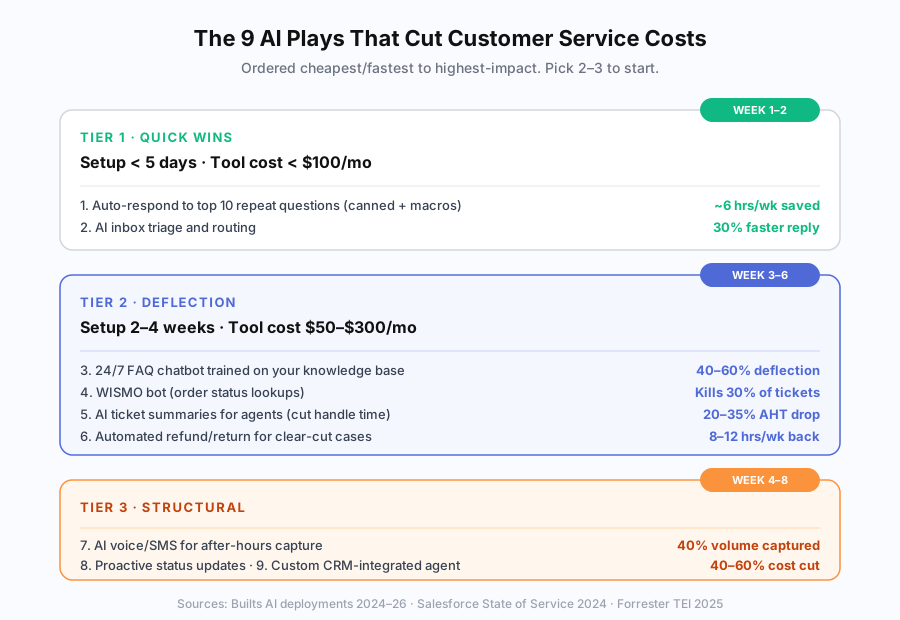
The nine plays below cluster into three tiers based on cost and complexity. Tier 1 ships in a week with under $100/month in tools. Tier 2 takes 2–4 weeks and deflects 40–60% of repeat tickets. Tier 3 restructures the cost base entirely — pick these once you’re past 1,500 monthly conversations.
Tier 1 — Quick wins (week 1–2, under $100/month)
1. Auto-respond to your top 10 repeat questions. Pull your last 200 support tickets. Group them. You’ll find 8–12 questions that account for 60–70% of volume. Build canned responses (Gmail templates, Help Scout saved replies, Zendesk macros, Intercom snippets) and route them via tag-based rules. Setup time: 4–6 hours. Time saved: 5–8 hours/week. This isn’t strictly AI — it’s the prerequisite. Skip it and AI plays compound less.
2. AI inbox triage and routing. Layer AI categorization on top of your inbox to auto-tag tickets by topic, urgency, and customer tier. Tools like Front’s AI Assist, Help Scout’s AI Categorization, or Intercom’s Workflows do this natively. Tickets get routed to the right rep (or auto-replied with the matching canned response from play 1). First-response time drops 30–40%. Tooling cost: $0–$50/month on top of your existing helpdesk.
Tier 2 — Deflection (week 3–6, $50–$300/month tooling)
3. Build a 24/7 FAQ chatbot on your existing knowledge base. This is the highest-impact play in Tier 2. Train a chatbot (Chatbase, Tidio Lyro, Intercom Fin, or custom) on your real help docs, product pages, and FAQ content. Properly trained, it deflects 40–60% of website inquiries — most of which are repeat questions you’d answer manually. Our RAG setup guide covers the architecture; the Intercom Fin review covers what tools work at what volume. For the full breakdown of what counts as “real” deflection (and the formula for tracking it without gaming the number), see our ticket deflection playbook.
4. Deploy a WISMO bot for order-status questions. If you sell physical products, “where is my order” (WISMO) typically accounts for 20–35% of total ticket volume. A simple bot that looks up tracking via your e-commerce platform’s API and returns a status update kills nearly all of it. ShopifyAI, Gorgias’s order bots, or a custom integration via Make/n8n handle this. Setup: 1–2 weeks. Volume reduction: 25–30% of all tickets, often the cheapest tickets to deflect.
5. AI ticket summaries for agents (cut handle time). Long ticket threads waste agent time. AI summarization tools (Intercom Copilot, Zendesk AI, Front’s AI Compose) generate a summary at the top of every ticket and suggest a draft response. Average handle time drops 20–35%. This doesn’t deflect tickets — it makes the humans you already have faster. Tooling cost: $30–$50/agent/month on top of existing helpdesk.
6. Automated refund/return decisions for clear-cut cases. Refund requests with clear policy match (within window, item undamaged, valid order) can be auto-approved. AI checks the rules, processes the refund, sends the confirmation. Edge cases route to humans. We’ve seen this save 8–12 hours/week at e-commerce businesses doing $500K–$3M in revenue. Tools: Gorgias Auto-Resolve, Re:amaze AI, or custom workflows.
Tier 3 — Structural (week 4–8, restructures cost base)
7. AI voice/SMS agent for after-hours capture. Forty to sixty percent of customer inquiries arrive outside business hours for most SMBs. An AI voice agent (Vapi, Bland AI, Retell) or SMS responder qualifies, captures, and books appointments while your team sleeps. For service businesses, this is often the single highest-ROI play — every captured after-hours call is $300–$2,000 in recovered revenue. Our AI voice agents guide covers vendor selection.
8. Proactive automated status updates. Customers call/email because they don’t know what’s happening. Send proactive updates at every key milestone (order received, shipped, delayed, delivered; service appointment confirmed, dispatched, en route, completed) via SMS and email. Inbound “status check” volume drops 60–80%. The pattern: trigger from your CRM/operations system whenever state changes. Tools: Twilio + webhook automation, Klaviyo flows, GoHighLevel workflows.
9. Custom CRM-integrated AI support agent. The endgame. An AI agent trained on your real knowledge base, integrated with your CRM, helpdesk, and operational tools (calendar, billing, field service). It can look up account state, take action, and escalate cleanly. Replaces the per-conversation fees of tools like Intercom Fin with a flat cost. Build cost: $8,000–$30,000 one-time. Payback: 4–8 months at 1,500+ monthly conversations. This is what we build at Builts AI.
How does AI compare to outsourcing customer service on cost?
AI customer service costs $0.02–$0.50 per interaction at scale. Offshore outsourcing costs $2–$8 per interaction (effective rate including training, attrition, and management overhead). Domestic BPOs run $5–$15 per interaction. For a small business doing 1,500 monthly tickets, that’s roughly $3,000–$12,000/month for offshore versus $50–$500/month for AI tooling — a 10–40x cost difference, before factoring in quality and 24/7 coverage.
The honest comparison most cost-cutting decisions skip:
| Approach | Cost per interaction | Setup time | Quality risk | 24/7 coverage |
|---|---|---|---|---|
| In-house rep ($4,500/mo loaded) | $3.00–$8.00 | 0 weeks | Low | No |
| Offshore BPO ($1,800/seat) | $2.00–$6.00 | 4–8 weeks | Medium-high | Optional ($) |
| Domestic BPO ($3,500/seat) | $5.00–$15.00 | 6–10 weeks | Medium | Optional ($) |
| AI tools (Chatbase, Lyro) | $0.10–$0.50 | 1–2 weeks | Low-medium | Yes |
| Custom AI agent | $0.02–$0.20 | 4–8 weeks | Low | Yes |
The case for outsourcing usually rests on quality assumptions that don’t survive contact with reality. Offshore CSAT scores average 12–18 points lower than in-house in studies we’ve reviewed. AI, when properly trained on your actual knowledge base, holds CSAT at parity or slightly above — because consistency beats variable human quality on repetitive tickets.
Our full AI vs offshore breakdown covers the migration playbook for businesses already on offshore contracts. Short version: don’t add AI on top of offshore. Replace one or the other.
What does bad customer service actually cost?
Bad customer service costs US businesses roughly $75 billion annually in lost revenue, per a 2024 NewVoiceMedia report. For an individual small business, slow responses cause 12–25% of new customers to switch to competitors within the first 30 days. Each lost customer typically represents 5–10x the cost of retention. For a typical SMB doing $1M annual revenue, this quietly costs $50,000–$150,000/year — most of which never appears in any expense line.
The four costs of bad customer service that don’t show up in any P&L:
- Slow-response churn. Customers who don’t get answered in under an hour are 2.4x more likely to churn within 30 days (per Salesforce data). For SaaS, this hits CAC payback. For services, this hits LTV.
- Negative reviews. A 1-star average review on Google costs roughly 22% of new customer acquisition for local businesses (BrightLocal 2024). Bad service drives 70% of negative reviews.
- Refund leakage. Customers who can’t get a fast resolution skip the support team and just chargeback or refund. For e-commerce, this is 2–4% of revenue silently leaking.
- Word-of-mouth damage. One unresolved bad experience reaches an average of 16 people (Zendesk CX Trends 2024). Acquisition CAC has to absorb that.
The cost of poor customer service contact center performance compounds across these four lines. The AI plays above address all four — not just by deflecting tickets, but by making sure no inquiry sits unanswered long enough to trigger one of these costs.
When will AI not reduce your customer service costs?
AI won’t reduce customer service costs if your volume is too low (under 200 tickets/month), your tickets are too varied (each one is genuinely unique), or your team treats AI as a bolt-on instead of restructuring workflows around it. Below 200 monthly tickets, the setup overhead exceeds savings. With genuinely varied tickets (custom legal, specialized B2B sales), there’s nothing repetitive to deflect. And if your team keeps doing the work AI now handles, you’ve added cost without removing it.
Honest disqualifiers we tell prospects at Builts AI:
- Under 200 tickets/month. Use auto-response templates (play 1). Skip everything else for now.
- Hyper-customized work. Custom legal opinions, M&A advisory, bespoke services — the ticket-deflection pattern doesn’t apply. Use AI for internal productivity, not customer-facing.
- Already-low-cost team. If your team is 1 owner doing support directly, AI’s biggest value is freeing your time, not cutting headcount. Different ROI math, but still worth doing.
- No knowledge base. If you don’t have docs, FAQs, or written policies, there’s nothing to train AI on. The first project is documenting, not deploying.
- No tolerance for any imperfect response. Some businesses (medical, legal, certain financial services) need 100% accuracy. AI gets to 96–99%. The right answer might be agent-assist (play 5) instead of customer-facing AI.
The deployments that fail are usually the ones that skipped this check. Our AI hallucination prevention guide covers the technical patterns that close the accuracy gap for businesses that can’t afford imperfect responses.
How long until AI customer service cost reduction pays back?
Payback periods we measure in SMB deployments: Tier 1 plays (auto-response, inbox triage) pay back immediately — the tooling is cheap enough that any time savings is positive. Tier 2 deflection (FAQ chatbot, WISMO bot, agent assist) pays back in 1–3 months at typical SMB volumes. Tier 3 structural (after-hours AI, custom integrated agent) pays back in 4–8 months for businesses doing 1,500+ monthly conversations, then continues compounding as volume grows.
The pattern: payback gets slower as the play gets bigger, but the ceiling on savings gets higher. A FAQ chatbot saves $1,500–$3,000/month and pays back in two months. A custom CRM-integrated agent saves $8,000–$15,000/month and pays back in six. The custom build wins on absolute savings; the chatbot wins on speed-to-value.
Per a 2025 Forrester Total Economic Impact study on AI-enabled customer service, the average 3-year ROI hits 248%. That number assumes you implement multiple plays, not one. The businesses we see hit the high end of that ROI range are the ones that ship Tier 1 in week one and don’t wait for the perfect deployment to start saving money.
What’s the right next step?
Pick two plays. Ship play 1 (auto-response templates) this week and one Tier 2 play (FAQ chatbot or WISMO bot) within 4 weeks. That combination typically produces 30–40% cost reduction inside 90 days at a tooling cost under $200/month. Past 1,500 monthly conversations or when you need real CRM integration, the custom agent (play 9) starts to make financial sense.
We build custom AI customer support systems at Builts AI for small and mid-sized businesses across Canada and the US. Pricing is transparent: $8,000–$30,000 CAD for the one-time Build Phase, plus optional $500–$2,500 CAD/month Maintenance. The free audit produces a written cost-reduction estimate in 48 hours, so you can compare against the off-the-shelf plays above with real numbers, not vendor estimates. Toronto and GTA businesses can find additional local context at our AI customer service Toronto page.
If you’re under 200 monthly tickets, start with plays 1 and 2. If you’re past 1,500, the math usually favors building something custom. The worst path is doing nothing — because the cost of doing nothing scales exactly as fast as your revenue, and faster than your margin.