AI customer service in 2026 is genuinely delivering for small businesses, but not the way vendors describe it. Gartner’s 2025 AI Implementation Survey found 62% of underperforming AI support projects fail because of insufficient data preparation, not technology. Zendesk’s 2025 CX Trends report shows businesses deploying tier-1 AI deflection see 18% CSAT improvement within 90 days. The winners aren’t running AI everywhere, they’re running it on the specific tasks where it works and keeping humans on everything else.
Here’s the honest breakdown of what’s working in production, what’s still vendor hype, and how to tell which bucket a feature falls into before you buy.
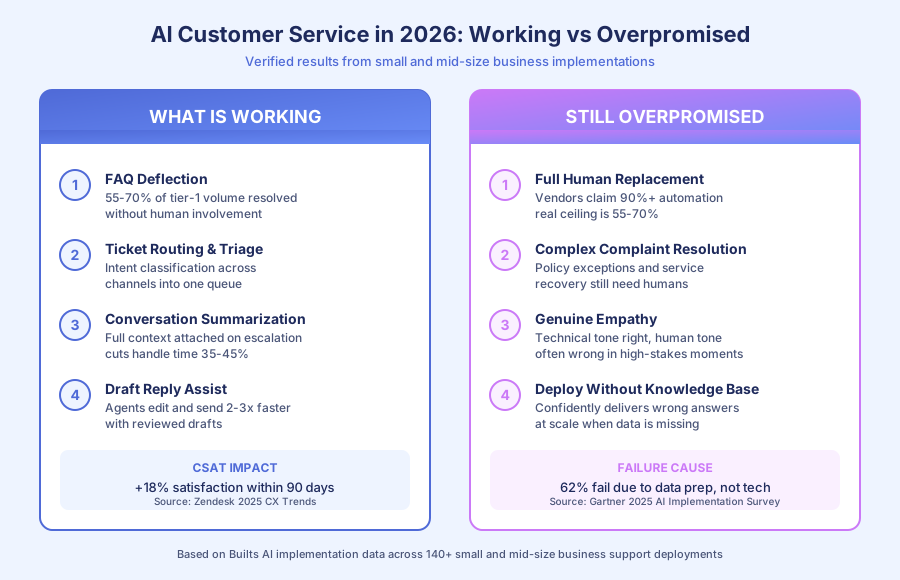
Top AI Customer Service Trends in 2026
The seven trends below are what actually delivers measurable results in production for small and mid-size businesses, separated from vendor demos:
- Tier-1 FAQ deflection at 55-70% — order status, business hours, returns, product availability handled without human involvement
- Multi-channel unified routing — email, chat, Instagram DMs, SMS, WhatsApp consolidated into one classified inbox
- Conversation summarization on escalation — cuts human-agent handle time by 35-45% (Gartner, 2025)
- Voice AI moving to production — AI receptionists handling after-hours calls and appointment bookings, no longer experimental
- Hybrid AI + human is winning over full automation — vendors marketing “90% deflection” lose to teams targeting “55% with great escalation”
- CSAT improvement of 18% within 90 days when tier-1 deflection is deployed correctly (Zendesk 2025 CX Trends)
- Knowledge-base prep is the #1 success predictor — 62% of failed AI projects trace to data preparation, not AI quality (Gartner, 2025)
The rest of this article breaks down what works, what’s still overpromised, and how to tell which bucket a feature falls into before you buy.
What’s actually working in AI customer service in 2026?
Three applications deliver measurable, repeatable results for small and mid-size businesses: tier-1 FAQ deflection, multi-channel ticket routing, and escalation with full context attached. Together they handle 55-70% of support volume without human involvement and cut escalation handle time by 35-45%. Everything else is still a judgment call.
How much support volume can AI deflect automatically?
AI reliably deflects 55-70% of tier-1 support volume for small and mid-size businesses. The winning questions are ones with known, documented answers: order status, business hours, return policies, product availability, shipping timelines, and account-related questions. These make up the majority of support tickets.
Zendesk’s 2025 CX Trends report puts average CSAT improvement at 18% within 90 days of deploying tier-1 deflection. The driver isn’t AI sophistication, it’s speed. Response times drop from hours to under 2 minutes, and customers rank speed as the top service priority.
| Inquiry Type | AI Deflection Rate | Avg Response Time |
|---|---|---|
| Order status | 85-95% | Under 30 seconds |
| Business hours / policies | 90-98% | Under 30 seconds |
| Return / refund initiation | 60-75% | 1-2 minutes |
| Product availability | 80-90% | Under 1 minute |
| Complex troubleshooting | 15-25% | Escalates to human |
Why is multi-channel routing one of the biggest AI wins?
Multi-channel routing wins because most small businesses manage customer communication across 3-5 channels and messages constantly fall through the gaps. AI-powered unified inbox tools consolidate email, chat, Instagram DMs, Messenger, SMS, and WhatsApp into one view, then classify and route each message with full customer history attached. Nothing gets missed.
Platforms take different approaches. Our Intercom vs Zendesk vs Tidio comparison breaks down which fits which business size, and if you’re evaluating Intercom specifically, our Intercom Fin AI review covers its AI agent capabilities in detail.
The core improvement is consistency. Every message flows through the same classification logic regardless of where it arrived, so a customer who emails and then DMs gets a single coherent conversation instead of two contradictory answers from two different agents.
Does AI-generated conversation summarization actually save time?
Yes, and it’s one of the most underrated AI customer service wins. When AI can’t resolve an inquiry and hands it to a human, the quality of that handoff determines the outcome. The old pattern: a ticket arrives with a one-line description and the human agent spends the first 8 minutes gathering context. AI context attachment eliminates that entirely.
According to Gartner’s 2025 Customer Service Technology report, human agents receiving escalations with full context attached resolve them 35-45% faster than agents starting from scratch. The context package includes full conversation history, the AI’s classification attempts, customer purchase history, previous support interactions, and suggested resolution steps based on similar past cases.
Gartner notes this single improvement justifies AI customer service investment for businesses handling more than 20 tickets per day.
What is still overpromised in AI customer service?
Three things remain overpromised in 2026: fully autonomous complaint handling, complete human replacement, and emotionally complex interactions. Vendors showcase 90%+ automation in demos, but production data across thousands of implementations consistently lands at 55-70%. The gap is where customer experience lives or dies.
Can AI replace human customer service agents?
AI cannot replace human customer service agents in 2026, and the businesses treating it like a replacement are the ones failing. Every vendor presentation shows AI handling 90% of inquiries automatically. Real numbers across production implementations land at 55-70%. The remaining 30-45% involves situations that genuinely require human judgment.
Those 30-45% aren’t evenly distributed. They tend to be the highest-stakes interactions: complaints, billing errors, policy exceptions, and conversations that determine whether a customer stays or leaves. Getting these wrong costs significantly more than the labor savings from automation.
The right framing isn’t “AI replaces support staff.” It’s “AI handles the routine volume so support staff can focus entirely on the interactions that matter.” Businesses that reduce headcount based on vendor projections and keep the automation target consistently hit understaffing during the escalation volume that AI can’t absorb. For the broader picture across roles — which small-business jobs face the highest automation risk, which stay safely human, and how to redirect recovered hours rather than cut headcount — see will AI replace jobs at small businesses.
Why can’t AI handle complex complaints in 2026?
AI can’t handle complex complaints because resolution requires emotional intelligence, service recovery judgment, and decisions about policy exceptions that current models get technically correct but tonally wrong. An AI trying to autonomously resolve a damaged product complaint or a billing error will often produce a response that’s factually accurate and emotionally tone-deaf.
The correct design pattern: AI acknowledges the complaint immediately (which matters enormously for customer perception), gathers the relevant information, and routes to a human with everything pre-populated. The AI handles the speed. The human handles the judgment.
This is why tier-1 deflection rates cap at 55-70% rather than 90%. Vendors measuring “automation rate” in demos include acknowledgment messages and information gathering steps. Businesses measuring resolution rate in production count only tickets fully closed without human touch. The two metrics differ by 20-30 percentage points.
What happens when you deploy AI without a knowledge base?
Deploying AI without a clean knowledge base produces confidently wrong answers at scale. This is the single most common failure mode in AI customer service implementations, and it’s also the most preventable. Gartner’s 2025 AI Implementation Survey puts the failure rate from insufficient data preparation at 62% of underperforming projects, compared to technology limitations at under 15%.
An AI support bot’s quality ceiling is set entirely by the quality of the information it can access. If your knowledge base has outdated return policies, missing product specs, and no documented answers to common questions, the AI will hallucinate answers that sound authoritative but reference policies that don’t exist. Customers get contradictory information depending on which channel they use.
The implication is uncomfortable for vendors but useful for buyers: the implementation work is building the knowledge base, not selecting the AI tool. Most businesses spend 80% of their evaluation effort on tool comparisons and 20% on data preparation. The ratio should be reversed.
What does a well-designed AI customer service system look like in 2026?
A well-designed system has three layers: automated response for tier-1 volume, AI-assisted human response for mid-complexity tickets, and a human-only queue for complaints and sensitive situations. Every channel routes into one unified inbox. Nothing falls through platform gaps. Total design cost is measured in weeks, not months.
The three-layer architecture
Layer 1: Automated response (no human involvement) Classifies and responds to tier-1 inquiries with known answers from the knowledge base. Covers 55-70% of total volume. Response time under 2 minutes. Target accuracy above 95% on questions the knowledge base actually covers.
Layer 2: AI-assisted human response For messages needing a human, AI prepares the context package before the agent opens the ticket: full conversation history, customer record, previous support history, and a suggested response draft. Agents edit and send in a fraction of the normal time. Handle time drops 35-45%.
Layer 3: Human-only queue Complaints, sensitive situations, complex exceptions, and VIP customers route directly to the most senior available team member with everything pre-populated. No AI attempts at resolution, just faster context gathering and smarter routing.
What metrics tell you it’s actually working?
Four metrics determine whether your AI customer service investment is delivering results. Track these monthly and compare against baseline numbers captured before deployment:
| Metric | Target | Timeline |
|---|---|---|
| First response time (automated) | Under 5 minutes | Week 1 |
| Automated resolution rate | 55-65% | 90 days |
| Escalation handle time reduction | 30-40% | 60 days |
| CSAT improvement | +10-18% | 90 days |
CSAT should be tracked but with patience. Early implementations may see flat or slightly lower CSAT if the knowledge base has coverage gaps. This typically resolves within 60-90 days as real customer questions surface the gaps and the team fills them in.
What should a small business invest in first?
Start with tier-1 deflection backed by a solid knowledge base, not a sophisticated AI agent or multi-channel orchestration platform. Classify common questions, answer them automatically, and route everything else to humans with context attached. That single capability cuts support volume by more than half and frees your team for the work that genuinely needs them.
The build order that actually works: audit your existing support tickets from the past 90 days, group them by inquiry type, identify the top 20 question types that represent 80% of volume, build documented answers for each, load them into an AI tool, deploy, and iterate weekly based on escalation patterns.
For tactical implementation, see our guide on how to set up an AI chatbot for your website, our best AI chatbot builders for small business comparison, and our article on how to create a support ticket routing system, and our support ticket routing automation overview. For platform selection, see our Intercom Fin AI alternatives and Zendesk alternatives for small business comparisons.
For Toronto and GTA businesses looking for a local implementation partner, see our AI customer service Toronto guide for Ontario-specific context and pricing.
Book a free automation audit and we’ll analyze your current support volume, build a knowledge base recommendation, and model the automated resolution rate you could realistically achieve within 90 days based on your actual ticket mix.