A dental practice in Mississauga gets 40 to 60 calls a day. Roughly 30 percent arrive before 9 AM or after 5 PM. Before AI voice agents, those calls went to voicemail and most never got a call back. After deploying one, every call gets answered, the agent books appointments straight into the calendar, and after-hours bookings jumped 65 percent in the first quarter. That single change recovered an estimated $9,000 a month in booked revenue from calls that used to evaporate. Juniper Research’s 2025 Conversational AI report pegs SMB voice agent adoption growth at 180 percent last year, and missed-call recovery is the reason most cited.
What is an AI voice agent?
An AI voice agent is software that handles phone calls in natural spoken language. It converts the caller’s speech to text, runs the text through a language model to understand intent, generates a response, converts it back to speech, and speaks it. The full loop happens in under a second, so the call feels conversational.
The difference from old phone menus is huge. Instead of “press 1 for billing,” callers just say what they want. “I need to reschedule my Thursday appointment” gets parsed, matched to the caller’s record, and handled end to end. No menu navigation, no waiting for the right option.
Under the hood, most production voice agents stitch together three pieces: a speech-to-text model like Deepgram or Whisper, a language model like GPT-4 or Claude for intent and response, and a neural text-to-speech engine like ElevenLabs or OpenAI TTS for the voice. Platforms like Bland AI and VAPI bundle all three plus telephony into one product.
Why are small businesses adopting voice agents faster than enterprises?
Small businesses are adopting voice agents faster than large enterprises, which is unusual for business technology. Juniper Research’s 2025 Conversational AI report logged 180 percent SMB adoption growth in 2025. The reason is structural: enterprises already run 24/7 call centers, while most small businesses have one receptionist on a 9-to-5 shift.
For a small business, every missed call is a potentially missed customer. Harvard Business Review’s 2011 lead response study, still the most cited benchmark, found that firms responding within an hour are seven times more likely to qualify a lead than firms responding the next day. A voice agent closes that gap to zero.
Three forces are pushing adoption:
- Hiring is hard. Reception wages in North America climbed 18 percent from 2022 to 2025 per BLS data, while turnover sits around 30 percent annually.
- Expectations have shifted. A 2025 Zendesk CX Trends report found 72 percent of consumers expect instant response from businesses they contact.
- The tech finally works. Latency under 800 ms and speech quality near human mean most callers don’t notice.
The combined effect is that a tool that cost $100 to $300 a month now does work a $45,000-a-year receptionist used to do after hours.
What are the highest-value small business applications?
The highest-value small business applications for voice agents are after-hours call handling, appointment booking, lead qualification, and FAQ answering. Most deployments focus on one or two of these first. Builts AI’s own deployment data shows after-hours recovery delivers the fastest ROI, usually inside 30 days, because the calls were already being lost.
After-hours call handling
This is where most deployments start, and it’s the fastest path to return. Calls arriving before opening or after closing currently hit voicemail, and Invoca’s 2024 call intelligence benchmark found roughly 80 percent of voicemails go unanswered.
A voice agent answers the call, handles what it can, and logs the rest as structured tickets for morning follow-up. For a business taking 300 calls a month with 30 percent after-hours, that’s 90 previously lost conversations now captured each month.
Appointment booking
A voice agent can check live calendar availability, offer specific times, confirm the booking, send a calendar invite, and trigger a reminder sequence, all in one call. For healthcare, beauty, fitness, and trades businesses, booking calls often make up 40 to 60 percent of total volume. Automating them is an enormous time saving per week for front-desk staff.
Lead qualification
Sales teams waste most of their time on unqualified leads. A voice agent asks the qualification questions on every inbound call: budget range, timeline, service area, decision maker. Qualified leads get routed straight to a sales calendar. The rest get a nurturing sequence. Forrester’s 2024 sales productivity research found properly qualified leads convert 2.4 times better than unqualified ones. Removing the human gatekeeping step speeds that up.
FAQ handling
Hours, location, pricing, parking, cancellation policy, insurance accepted. A voice agent answers these instantly, accurately, and the same way every time. For most local businesses, these questions represent 30 to 50 percent of inbound call volume.
What can AI voice agents do and what can’t they do?
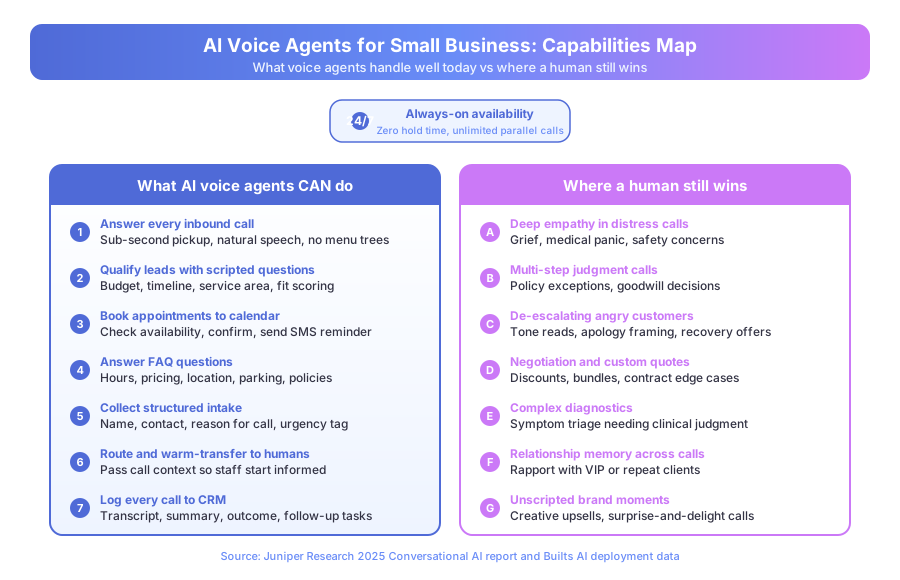
AI voice agents handle predictable, goal-oriented calls well and struggle with emotionally complex or judgment-heavy ones. They excel at booking, qualification, FAQs, and structured intake. They fall short on empathy calls, custom negotiation, and multi-step exceptions. The right design uses them as a first line with instant handoff to a human for anything outside trained scenarios.
| Capability | AI Voice Agent | Human Receptionist |
|---|---|---|
| Answer calls 24/7 | Yes | No |
| Handle multiple simultaneous calls | Unlimited | One at a time |
| Book appointments | Yes | Yes |
| Natural language variations | Yes | Yes |
| Distressed callers | Limited | Yes |
| Judgment-call exceptions | No | Yes |
| Rapport with repeat clients | Limited | Yes |
| Multi-step service transactions | Limited | Yes |
The honest limitation is emotional complexity. An angry patient, a caller in a medical panic, a situation needing empathy and judgment to de-escalate, these still need a human. The best deployments detect those signals fast and transfer the call with a brief summary so staff start informed, not asking the caller to repeat themselves.
How do you actually build a voice agent for a small business?
Most small business voice agent deployments follow the same five-step build. The work is less about writing prompts and more about mapping the call flows and connecting systems. Expect two to four weeks for a booking plus FAQ deployment and four to eight weeks for a multi-integration build. Testing with 50 to 100 simulated calls before going live is the biggest single predictor of call quality on day one.
Step 1. Map the call scenarios the agent will handle. List the top 10 reasons people call and how each should end.
Step 2. Write the conversation flows. For each scenario, define the questions the agent asks, the information it collects, and the handoff triggers.
Step 3. Connect the systems. Calendar for booking, CRM for contact logging, SMS for confirmations, and a routing table for escalations.
Step 4. Configure escalation triggers. Phrases like “speak to a manager,” emotional signals, and any off-script request should route to a human with the call context attached.
Step 5. Test with simulated calls. Edge cases, accents, background noise, interruptions. Fix what breaks before any real caller hears it.
The main platforms are Bland AI (most widely used), VAPI (most flexible, developer-oriented), Synthflow (no-code), and Retell AI (strong calendar integration). For a full side-by-side breakdown, see our VAPI vs Bland AI vs Retell AI comparison and our VAPI review for small business.
What does realistic ROI look like?
Realistic ROI for a voice agent is 20 to 60 times the monthly cost for most small businesses, driven almost entirely by recovered missed calls. The math is simple: after-hours calls currently lost to voicemail are the biggest single source of recoverable revenue, and a voice agent captures them at near-zero marginal cost.
Here’s a concrete example for a local service business:
| Metric | Value |
|---|---|
| Inbound calls per month | 300 |
| After-hours percentage | 30% |
| After-hours calls captured | 90 |
| Bookings recovered (50% conversion) | 45 |
| Average booking value | $150 |
| Monthly revenue recovered | $6,750 |
| Voice agent monthly cost | $100 to $200 |
| Return on spend | 33x to 67x |
That’s one application, one metric. Add lead qualification speed and FAQ deflection, and the math improves. Invoca’s 2024 benchmark found businesses that answer inbound calls within 30 seconds convert 78 percent more leads than those who don’t. A voice agent answers in under one.
How do voice agents handle regulated industries?
Voice agents work in regulated industries like healthcare, legal, and finance, but the setup is different. HIPAA deployments need BAA-signed providers, encrypted transcript storage, and scoping rules that prevent the agent from handling PHI it isn’t authorized to discuss. Finance deployments need call recording disclosures, strict retention rules, and escalation paths for any advice-adjacent question. Compliance setup typically adds two to four weeks to the build.
Three guardrails every regulated deployment needs:
- Scope restriction. The agent should refuse to go outside its trained scenarios. If a caller asks about medication dosages in a dental practice, the agent should transfer, not guess.
- Audit logging. Every call, every transcript, every action, stored for the retention period the regulator requires.
- Human-in-the-loop for edge cases. Anything legally binding, medically consequential, or financially material should be routed to a licensed human.
For related reading, see our guide on AI in customer service trends and our walkthrough on how to set up an AI chatbot for your website for text-based parallel deployments.
What’s the quickest way to get started?
The quickest way to get started is to pick one application, usually after-hours call handling, and deploy it as a pilot before expanding. Start with a narrow scope, measure recovered calls and booked appointments over 30 days, then add scenarios. Trying to automate every call type at once is the most common cause of failed deployments.
A good 30-day pilot looks like this:
- Week 1. Audit your current call data. How many calls, when, what are they about, how many are lost.
- Week 2. Pick one application and build the flow. Usually after-hours booking plus top-five FAQs.
- Week 3. Test with simulated calls and fix edge cases.
- Week 4. Go live, monitor every call, iterate daily.
By day 30 you’ll know your recovered call count, booking lift, and the edge cases that need human handoff. That’s the baseline for deciding whether to expand the agent to cover more scenarios.
Book a free automation audit and we’ll analyze your current call volume, identify the highest-value applications for a voice agent in your business, and build a realistic ROI model before recommending an implementation path.