The short version: We deployed Intercom Fin AI across 4 small business clients (combined volume: 500 tickets/month) and tracked outcomes for 60 days. Average resolution rate: 38% — meaningfully under Intercom’s “up to 50%” marketing claim. Effective cost per resolved ticket: $0.99 + $0.41 in base subscription overhead = $1.40 all-in. Total monthly Intercom spend across the 4 clients ranged from $272 to $487/month depending on tier and seat count. Worth it for 2 of the 4 clients; expensive for the other 2.
The full breakdown below covers exactly when Fin’s per-resolution pricing model wins, when it loses, and what knowledge-base setup actually moves the resolution rate from 28% to 50%+.
What Is Intercom Fin AI?
Fin AI is Intercom’s autonomous customer service agent built on GPT-4. It lives inside the Intercom Messenger, reads your knowledge base, and handles customer conversations without a human agent — billing you $0.99 each time it successfully resolves a ticket on its own.
Fin launched in March 2023 and has been iterated heavily since. According to Intercom’s 2024 customer service benchmark report, Fin is now deployed across more than 10,000 business accounts worldwide, with customer support teams reporting median deflection rates in the 35-45% range for well-documented products.
The three things Fin draws on for every response:
- Your knowledge base — help articles, FAQs, and product documentation you’ve uploaded or synced
- GPT-4 reasoning — natural-language understanding, intent detection, and contextual response generation
- Conversation history — full chat context and customer record access from Intercom’s CRM
When a customer sends a message, Fin reads the intent, searches your knowledge base, generates a grounded response, and either resolves the ticket or hands off to a human with the full conversation attached.
How Does Intercom Fin AI Pricing Actually Work?
Fin charges $0.99 per outcome, layered on top of an Intercom seat plan that starts at $29 per seat per month. Note the billing unit: Intercom now bills per “outcome,” not per resolution — an outcome counts when a customer confirms Fin solved the issue, stops asking for help after Fin’s answer, or Fin completes a workflow. That definition is broader than pure resolution: a customer who simply goes quiet after Fin replies is a billable outcome.
Here’s the base subscription context as of August 2026, per Intercom’s public pricing page (seat prices billed annually):
| Intercom plan | Base cost (per seat/month) | Best fit |
|---|---|---|
| Essential | $29 | Solo founders, tiny teams |
| Advanced | $85 | Growing support teams |
| Expert | $132 | Mid-market with workflows |
Inbound live chat and support email are included in every plan; email campaigns, SMS, WhatsApp, and phone add usage-based fees on top. Fin’s $0.99 per outcome applies on every plan. Volume discounts exist at scale — Intercom’s sales team has confirmed rates as low as $0.59 for enterprise contracts above 10,000 monthly resolutions — though small businesses should plan around the standard $0.99 rate.
Fin without Intercom’s helpdesk: Intercom also sells Fin Standalone at the same $0.99 per outcome with no seat costs — it runs on top of an existing helpdesk like Salesforce, with a minimum monthly commitment. If you like Fin’s engine but don’t want to migrate helpdesks, that option changes the math; we weigh it against other Fin alternatives separately.
Our 60-day test below ran under Intercom’s earlier 2026 pricing, when seat plans cost $74-169/month — today’s lower seat prices improve the total-cost picture at small seat counts, while the per-outcome fee is unchanged.
The economic logic is straightforward: if Fin resolves a ticket that would’ve cost your team 8 minutes at $25/hour ($3.33 in labor), paying $0.99 is a positive trade. The question is whether your volume and resolution rate make those savings meaningful after the base subscription.
How Much Support Volume Can Fin Automate?
Plan for Fin to autonomously close 30-55% of your conversations, with knowledge-base quality deciding where you land in that range. Across our 4-client test, the average was 38% — at 500 monthly conversations, that’s roughly 190 tickets closed without a human, for about $188 in outcome fees. Intercom markets “up to 50%+”; treat that as the ceiling for teams with excellent documentation, not the baseline.
What Resolution Rate Should You Expect From Fin?
Intercom markets “up to 50%” but real small business implementations show a 30-55% range. Knowledge base quality drives the variation — not the underlying AI. Teams with comprehensive, current documentation hit the top of the range. Teams with sparse help pages see rates below 30%, which flips the ROI math entirely.
According to Intercom’s 2024 AI deployment study, businesses that invested 2-4 weeks in knowledge base cleanup before launching Fin saw resolution rates average 12 percentage points higher than businesses that deployed with existing documentation untouched.
| Knowledge base quality | Typical Fin resolution rate | Monthly AI cost at 500 convos |
|---|---|---|
| Comprehensive, current, structured | 45-55% | $223-272 |
| Good coverage of common topics | 35-45% | $173-223 |
| Basic FAQ pages only | 25-35% | $124-173 |
| Sparse or outdated docs | Under 25% | Under $124 |
The counterintuitive takeaway: higher Fin bills usually mean better ROI, because they signal Fin is successfully handling volume you’d otherwise pay humans to manage. A low Fin bill with poor resolution rates means customers are still waiting on human agents — you get the worst of both worlds.
For a deeper look at how knowledge base quality affects AI accuracy and hallucination risk, see our guide on AI hallucination in business.
What Can Fin AI Actually Do?
Fin handles multi-turn conversations, maintains tone consistency across languages, and hands off to humans with full context when it can’t resolve a query. It’s significantly more capable than template-based chatbots and competes directly with enterprise AI agents from Zendesk and Salesforce — though with simpler setup than either.
Four capabilities matter most for small business evaluation:
Multi-turn conversation handling. Fin maintains context across a full exchange. A customer can ask “What about damaged items?” as a follow-up to a return policy question, and Fin retrieves the nuanced answer rather than treating it as a fresh query. Per Intercom’s internal benchmarks, this context retention handles 4-6 exchange depths reliably.
Tone and persona consistency. You set Fin’s name, voice, and escalation behavior once. It holds that persona across thousands of conversations without drift — a meaningful advantage over staff rotations where tone varies by agent and shift.
Multilingual support. Fin handles 45+ languages as of 2026 without requiring separate knowledge bases per locale. It auto-detects customer language and responds natively. For e-commerce or SaaS businesses with international buyers, this alone can justify the cost.
Human handoff quality. When Fin escalates, the handoff includes the full conversation transcript, Fin’s summary of the issue, and its explanation of why it couldn’t resolve. Human agents pick up with full context instead of making customers repeat themselves.
How Much Will Fin AI Cost at Your Volume?
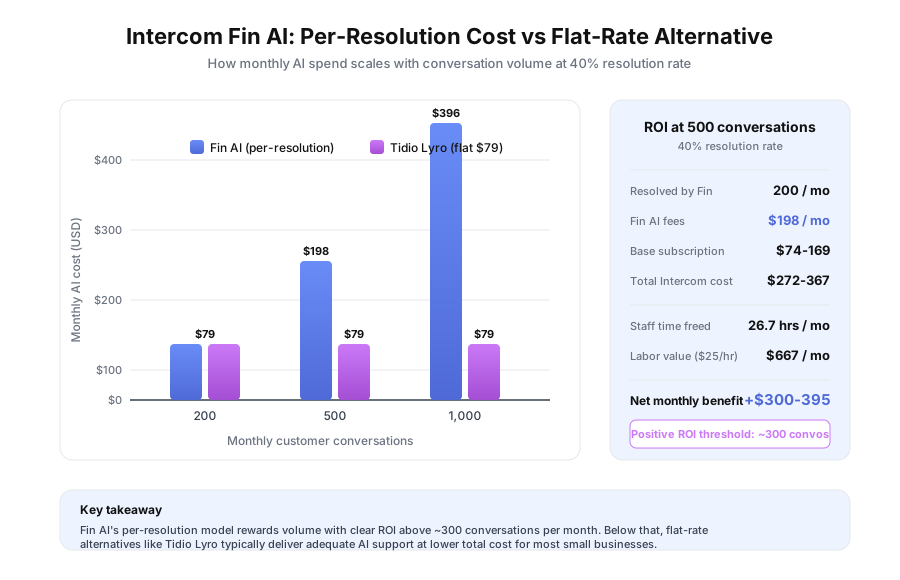
At 200 monthly conversations with 40% resolution, Fin costs about $79/month. At 500 conversations, ~$198/month. At 1,000 conversations, ~$396/month. Add the base Intercom subscription of $74-169/month, and total spend ranges from $153 to $565/month before factoring in the labor savings Fin delivers.
| Monthly conversations | Resolution rate | Resolved by Fin | Fin AI cost | Total (with base) |
|---|---|---|---|---|
| 200 | 40% | 80 | $79.20 | $153-248 |
| 500 | 25% | 125 | $123.75 | $198-293 |
| 500 | 40% | 200 | $198.00 | $272-367 |
| 500 | 55% | 275 | $272.25 | $346-441 |
| 1,000 | 40% | 400 | $396.00 | $470-565 |
The ROI math at the most common small business scenario — 500 conversations/month at 40% resolution:
- Fin AI fees: ~$198/month
- Intercom base subscription: $74-169/month
- Total Intercom spend: $272-367/month
- Staff time freed at 8 min/conversation: 1,600 minutes = 26.7 hours/month
- Labor value at $25/hour: $667/month
- Net monthly benefit: +$300-395
According to the US Bureau of Labor Statistics’ 2024 occupational wage data, the median customer service representative earns $19.08/hour, with fully loaded cost (benefits, PTO, overhead) typically 1.3-1.5x that — around $25-29/hour. At those loaded rates, Fin’s per-resolution economics hold up clearly above ~300 monthly conversations.
Who Should Actually Buy Intercom Fin AI?
Fin is the right choice for businesses handling 300+ monthly conversations with well-documented products and existing Intercom deployments. It’s the wrong choice for tiny teams under 100 conversations/month, businesses with sparse help docs, or anyone not already invested in Intercom’s ecosystem. The base subscription tax matters more at low volumes than the per-resolution savings.
Strong fit signals:
- 300+ monthly customer conversations (ideally 500+)
- Comprehensive help docs or willingness to invest 2-4 weeks building them
- Already running Intercom for support or considering a full migration
- Product-led SaaS or e-commerce where in-app chat is a primary support channel
- International customer base that benefits from 45+ language support
Weak fit signals:
- Under 100 monthly conversations (base cost dominates economics)
- Query volume dominated by complex, account-specific issues AI can’t resolve
- Sparse or outdated documentation with no plan to fix it
- Team already on Zendesk, Help Scout, or HubSpot Service Hub
- Budget discipline requires predictable flat pricing
For volume under 300/month, flat-rate alternatives almost always win on total cost. For complex support where AI resolution rates will stay under 25% regardless, the per-resolution model still bills you for a subscription you’re not fully using.
How Does Fin AI Compare to Alternatives?
Tidio Lyro costs $79/month flat for moderate AI capability, Zendesk AI adds $50+/agent/month to existing Zendesk plans, and custom GPT builds run $150-350/month with high configurability. Fin wins on capability and Intercom integration but loses on predictable pricing. The right choice depends on volume, query complexity, and which support platform you’re already on.
| Alternative | Pricing | AI capability | Best for |
|---|---|---|---|
| Intercom Fin AI | $74-169 base + $0.99/resolution | Very high (GPT-4) | 300+ convos/month, already on Intercom |
| Tidio Lyro AI | $79/month flat (Tidio+) | Moderate | Small teams, budget-conscious |
| Zendesk AI | $50+/agent/month add-on | Moderate-high | Existing Zendesk users |
| HubSpot Breeze | Included in paid Service Hub | Moderate | HubSpot CRM users |
| Custom GPT chatbot | $150-350/month + dev time | High (configurable) | Complex integrations, control |
For a side-by-side breakdown of help desk platforms, see our Intercom vs Zendesk vs Tidio comparison. For a broader view of AI chatbot builders including Chatbase, Botpress, and Voiceflow, see our best AI chatbot builders guide. If the Fin pricing model does not work for your volume, see our Intercom Fin AI alternatives comparison. If Zendesk’s SLA-focused approach fits your workflow better than Intercom, see our Zendesk alternatives for small business for a cost comparison.
What Are the Biggest Risks With Per-Resolution Pricing?
The main risks are unexpected volume spikes, resolution rate drift after knowledge base changes, and counting resolutions that didn’t actually satisfy the customer. Intercom’s dashboard reports resolution counts, but customer satisfaction data tells the real story — and some “resolved” tickets still generate angry follow-ups that get billed again.
Three practical risks to plan for:
Volume spike exposure. A viral product launch, outage, or seasonal surge can double your monthly Fin bill overnight. Unlike flat-rate pricing, there’s no cost ceiling. Budget for 2-3x your baseline monthly spend during high-variance months, especially for seasonal businesses.
Resolution quality vs resolution count. Intercom counts a conversation as resolved when Fin closes it without human involvement — not when the customer’s problem is genuinely solved. Monitor customer satisfaction (CSAT) scores alongside resolution rates. If resolution is high but CSAT drops, Fin is closing tickets customers aren’t happy with.
Knowledge base drift. Every product update, policy change, or pricing revision can degrade Fin’s accuracy until docs catch up. Teams that ship frequently need a documentation cadence that matches — otherwise Fin starts giving stale answers and quietly erodes customer trust.
How to Evaluate Fin AI for Your Business
Run a 30-60 day pilot with a clean knowledge base snapshot, track both resolution rate and CSAT, and compare actual monthly cost against the labor hours Fin replaces. Don’t trust marketing benchmarks — trust your own numbers. Intercom offers a free trial on most plans, which is enough time to get directional data if your ticket volume is 200+ per month.
Four metrics to track during the pilot:
- Actual resolution rate (not the marketed one) — your number will vary by 10-20 points from Intercom’s benchmarks
- CSAT on Fin-resolved tickets — aim for parity with human-handled tickets, not just a non-zero score
- Escalation latency — how fast Fin hands off when it can’t resolve (under 60 seconds is the target)
- Total cost per handled conversation — including base subscription divided across total volume, not just per-resolution fees
If the pilot lands below 30% resolution rate with current docs, invest 2-4 weeks in knowledge base cleanup before deciding. If it lands above 40% with solid CSAT, Fin is likely a clear win at your volume.
The Bottom Line on Intercom Fin AI
Fin AI is the most capable pre-built AI customer service agent in 2026 and the per-resolution pricing is economically sound above ~300 monthly conversations with decent documentation. Below that volume, flat-rate alternatives like Tidio Lyro or custom GPT builds typically deliver better total cost. The decision isn’t about whether Fin is good — it is. It’s about whether your volume justifies the base subscription plus per-resolution fees.
If you’re already on Intercom, handle 300+ monthly tickets, and can invest in knowledge base quality, Fin pays for itself within the first billing cycle. If any of those conditions are missing, run the math carefully before committing.
If the math doesn’t work at your volume, a custom AI support agent with flat costs is the usual alternative — we’re currently building five of them free in exchange for case studies. Book a free automation audit and we’ll analyze your actual ticket volume, query distribution, and knowledge base quality, then give you a specific resolution rate estimate and ROI model based on your data instead of generic benchmarks.