At 10:32 AM, a client employee couldn’t log into her email. She submitted a ticket. An engineer, mid-server-migration for a different client, saw the notification, paused his work, remoted in, and reset her password. Eleven minutes and one interrupted migration later, she was back in her inbox.
That same engineer handled 14 more tickets before 3 PM. Seven of them were password resets or software access issues that each took under 10 minutes. The server migration he had started that morning slipped to the next day.
This is the hidden cost of manual tier-1 IT support. It isn’t the time each ticket takes — it’s the compounding interruption cost that keeps engineers from doing work that actually requires their skills. The 12-engineer MSP in this case study deflected 60% of those tickets in 90 days.
What were the headline results after 90 days?
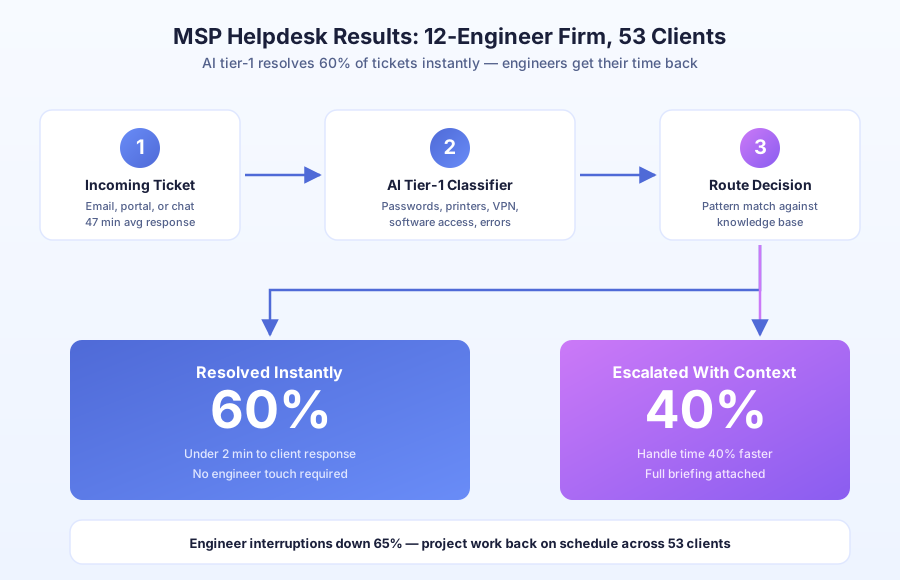
The MSP cut tier-1 ticket volume by 60% without adding staff. Average first response dropped from 47 minutes to under 2 minutes. Engineer interruptions fell by roughly 65% per person per day. Client satisfaction scores rose 40% in the first quarter — driven almost entirely by response speed, not resolution complexity.
| Metric | Before | After | Change |
|---|---|---|---|
| Tier-1 deflection rate | 0% | 60% | +60 pts |
| First response time | 47 min | Under 2 min | 96% faster |
| Engineer interruptions (per engineer, per day) | 15-20 | 6-8 | ~65% lower |
| Handle time on escalated tickets | Baseline | 40% faster | Context attached |
| Client CSAT score | Baseline | +40% | Q1 improvement |
| Engineer project completion | Frequently slipping | On-schedule | Fewer interrupts |
The project completion improvement is what the firm’s partners felt most acutely. Server migrations, network upgrades, and security implementations — the work that justifies engineering rates — started finishing on schedule because engineers weren’t being pulled away every 20 minutes for password resets.
What was the actual scope of the MSP’s ticket problem?
The firm was a 12-engineer managed service provider serving 53 business clients across professional services, healthcare, and financial sectors. Their SLA promised a 1-hour response time and 4-hour resolution time on standard tickets. In practice, they hit the SLA only because engineers monitored the queue instead of working on projects.
A 90-day ticket analysis showed the distribution:
- Password resets and account lockouts: 28%
- Software access and licensing issues: 18%
- VPN and remote access problems: 12%
- Printer and peripheral issues: 9%
- Standard software errors and crashes: 8%
- Everything requiring engineering judgment: 25%
Seventy-five percent of tickets were pattern-based and resolvable from documentation. They didn’t need the engineering expertise the firm was billing for — they just needed to be handled fast.
According to Gartner’s 2024 IT Support Automation research, organizations deploying automated tier-1 resolution see 50-70% deflection rates within 90 days. The MSP’s ticket composition suggested they could hit the high end of that range.
Why couldn’t they just hire a dedicated tier-1 support person?
MSP billing is priced against engineering talent on a per-device or per-user basis. A lower-cost tier-1 hire would either compress margins (if billed at the same rate) or force a two-tier contract restructure that existing clients hadn’t signed. Neither option worked. Tier-1 resolution patterns also repeat identically — they need a retrieval system, not a human re-reading the same runbook.
More fundamentally, tier-1 support is the wrong problem to solve with headcount. The resolution patterns for password resets and VPN issues are identical every time. A knowledge base that captures those patterns doesn’t need a person to apply them — it needs an automated system to retrieve and execute them.
According to IDC’s 2023 Future of Work study, IT support professionals spend an estimated 35% of their time on tasks that could be automated with no loss of resolution quality. For the MSP’s engineers, that 35% represented $240,000-$408,000 in annual salary allocated to work a system could handle — computed against Statistics Canada’s 2024 median IT engineer compensation range of $65,000-$85,000 in Ontario.
What did the automation system actually look like?
The firm built a three-layer system on top of its existing PSA platform and knowledge base. Layer 1 handled instant tier-1 resolution. Layer 2 escalated unresolved tickets with full context pre-attached. Layer 3 sent proactive status updates to clients at every stage. No engineer rewrote workflows — they tuned patterns as the system learned.
Layer 1: Automated tier-1 resolution
When a new ticket arrives, the system classifies it by issue type and checks the knowledge base for a matching resolution. For recognized tier-1 patterns, it executes the resolution autonomously and asks the employee to confirm the fix worked.
How each pattern resolves:
- Password reset: Triggers reset link via an MFA-verified channel to the employee
- Software access: Checks licensing dashboard, provisions access if a license is available, notifies the employee
- VPN issues: Sends a structured troubleshooting guide specific to the client’s VPN configuration
- Printer issues: Sends a setup guide for the specific printer model detected on the client’s network
- Common errors: Delivers documented resolution steps with screenshots
If the employee confirms the fix, the ticket closes and the knowledge base logs the outcome. If not, the ticket escalates to an engineer — with everything attempted and everything known about the client attached.
Layer 2: Intelligent escalation with full context
Engineers who previously received blank tickets now receive a complete briefing. Average handle time on escalated tickets dropped by 40% because they weren’t spending the first 10 minutes gathering context.
The escalation package includes:
- Full ticket description and conversation history
- What the automated system tried and how the client responded
- The client’s system profile: devices, OS versions, software installed, recent changes
- Ticket history: similar past issues and how they were resolved
- Priority classification based on issue type, SLA tier, and business impact
- Suggested resolution steps drawn from similar past tickets
Layer 3: Proactive client communication
The system sends automatic status updates at each stage of ticket handling — whether the ticket resolves automatically or escalates. Clients stopped calling to ask “is anyone working on my ticket?” because they already knew.
The sequence runs: immediate acknowledgment, resolution attempt confirmation, escalation notice (if needed) with engineer assigned and ETA, and a final resolution summary with any follow-up steps. The status-check calls that used to interrupt the front office disappeared almost entirely within the first month.
How was the rollout actually sequenced over 90 days?
The MSP didn’t flip a switch. They released categories one at a time, validated deflection numbers against the Gartner 2024 benchmark of 50-70%, then expanded. Each category went live only after supervised shadow mode confirmed the automated resolution matched what an engineer would have done. This cautious sequencing protected SLAs during the transition.
Week 0-2: Classification and baselining. The firm exported 90 days of PSA ticket history, tagged every ticket by resolution pattern, and built the knowledge base index the automation would query. This is the step most MSPs skip, and it’s the step that determines whether deflection lands at 30% or 60%.
Week 3-5: Password reset automation (shadow mode). Password reset is the highest-volume, lowest-risk category. The system ran in parallel with engineers for two weeks, generating the resolution it would have sent without actually sending it. Engineers compared the shadow output against what they would have done, flagged mismatches, and the automation tuned until the match rate exceeded 95%.
Week 6-7: Password reset (live) plus software access. Password automation went live for all 53 clients simultaneously. Software access requests — the second-highest-volume category — entered shadow mode. Deflection on password resets alone hit 26% of total ticket volume within the first week.
Week 8-10: VPN, printer, and standard error workflows. The remaining tier-1 categories came online in a staggered release. By the end of week 10, the deflection rate had reached 58% and stabilized at 60% by day 90. Engineers reviewed escalated tickets daily to catch any patterns that should have been automated but weren’t, feeding them back into the knowledge base.
How did clients experience the change?
From the client’s perspective, the change was immediate and obvious. A ticket that previously waited 47 minutes for a first response was now acknowledged and often resolved in under 2 minutes. For an employee locked out of email at 8 AM before a client meeting, that difference is significant — and memorable.
Client satisfaction scores rose 40% in the first quarter. Several clients specifically mentioned the response speed in quarterly review calls. One client’s IT coordinator noted the MSP now felt like an enterprise-grade support function rather than a small firm — not because of headcount, but because of responsiveness.
According to Zendesk’s 2024 Customer Experience Trends report, 60% of customers cite fast resolution as the most important factor in a positive support experience. The MSP had delivered exactly that — at scale, without adding staff. For related reading, see our Intercom vs Zendesk vs Tidio comparison on helpdesk platforms for small teams.
What lessons apply to other IT support operations?
Three principles apply to any IT support operation where engineers handle tickets that don’t require their expertise. They’re the same principles that took the MSP from 0% deflection to 60% in 90 days — and they generalize well beyond MSPs to internal IT, consulting firms, and technology support teams of any size.
1. Classify your tickets before you automate anything. The MSP’s 90-day analysis showed 75% of tickets were tier-1 automatable. Most IT teams don’t know their number. Classifying ticket volume by type and resolution pattern is the prerequisite for building effective automation, and the analysis itself usually reveals the opportunity more clearly than any industry benchmark would.
2. Context on escalation is worth more than fast escalation. An escalated ticket that arrives with full context — attempted resolutions, system profile, similar past tickets — takes 40% less time to resolve than a blank one. Automation’s value isn’t just what it resolves; it’s what it prepares for human resolution.
3. Proactive updates eliminate the status-check calls that nobody tracks. Clients who don’t know their ticket’s status call to find out. Those calls interrupt engineers, consume front-office time, and create anxiety for clients. Automatic status updates eliminate them without requiring anyone to remember to send them.
Could this pattern work for your IT support operation?
The tier-1 automation pattern described here applies to any IT support environment: internal IT departments, managed service providers, IT consulting firms, and technology support teams of any size. The specific resolution patterns differ by client environment — the automation structure is consistent. If 50-65% of your tickets are password resets, software access, VPN, or printer issues, the deflection math works, and we package the whole build as AI customer service for IT support firms and MSPs.
For related reading, see our guide on how to create a support ticket routing system without writing code and our walkthrough of setting up an AI chatbot for your website without a developer.
Book a free automation audit and we’ll analyze your ticket distribution and build a deflection model showing exactly what percentage of your volume can be automated — and what engineer hours you’d get back.