AI customer service pricing pages all use the same trick. They show the headline number — $19/month, $0.99 per resolution, “free tier available” — and quietly hide everything else. The Chatbase Hobby tier really does cost $19/month, but only for 2,000 messages with no API access and no integrations beyond an iframe widget. Intercom’s Fin AI really does charge $0.99 per resolution, but if you’re already paying $99/seat for Intercom, the math gets noisy fast.
In 2026, I priced AI customer service across 14 platforms and three custom builds for SMB clients. Fully-loaded cost ranges from $0/month (Tidio free + Chatbase free) all the way to $50,000+ for enterprise deployments. According to a 2025 Gartner customer service technology survey, 60% of B2B organizations are now actively evaluating AI customer service tools — and most underestimate first-year TCO by 40-60%.
This guide breaks down what every option actually costs in 2026: sticker price, hidden costs, and total cost of ownership over 12 months. The goal is to give you the math before you sign anything. If you’ve already settled the pricing question and the real ask is “how do I cut my existing CS bill,” skip ahead to our 9 AI plays to reduce customer service costs — that one’s a tactical playbook, not a pricing reference.
What does AI customer service actually cost in 2026?
AI customer service costs $0/month for free chatbot tiers, $19–$749/month for off-the-shelf SaaS platforms (Chatbase, Tidio, Intercom Fin), and $8,000–$50,000+ for custom-built systems integrated with your CRM and tools. Real cost depends on conversation volume, integration depth, and how much existing infrastructure you reuse versus replace.
The pricing landscape splits into three tiers:
- DIY chatbot tools (Chatbase, Tidio, Crisp): $0–$749/month, no developer required, limited integrations
- Helpdesk AI add-ons (Intercom Fin, Zendesk AI, Help Scout AI): $0.99 per resolution or +$50/agent/month, layered onto existing helpdesk subscriptions
- Custom-built systems: $8,000–$50,000 one-time + $500–$2,500/month maintenance, integrated with your real tools
The cheapest sticker price isn’t always the cheapest answer. A Chatbase plan at $19/month sounds great until you hit 2,000 messages and the system stops working at 11pm on a Friday — exactly when after-hours leads come in. Intercom Fin at $0.99 per resolution looks fair until you hit 1,500 monthly resolutions and the bill exceeds a junior support hire.
How much does Chatbase cost in 2026?
Chatbase costs $0/month (free tier with 30 messages), $19/month (Hobby, 2,000 messages), $49/month (Standard, 5,000 messages with API), $99/month (Professional, 10,000 messages), or $399/month (Unlimited, 40,000 messages). Most small businesses use the $49 Standard plan for a few months before either upgrading or migrating to a more integrated solution.
Chatbase is the cheapest practical entry into AI customer service. You upload your website pages, PDFs, and FAQ content, and Chatbase trains a GPT-4-powered chatbot you can embed as a widget in 30 minutes. We covered the platform’s strengths and limits in our Chatbase review for business — the short version: it’s great for FAQ-style support and useless for anything requiring live data lookups.
The hidden costs:
- Message overages — exceed your tier and the bot stops responding (or upgrades you automatically, depending on settings)
- No native CRM integration — connecting Chatbase to HubSpot, Salesforce, or your helpdesk requires Zapier or Make middleware (~$30–$50/month additional)
- Manual content updates — your bot only knows what you’ve uploaded. New product, new policy, new FAQ? Re-upload manually.
For a small business doing under 2,000 monthly chats with simple FAQ-style questions, Chatbase Standard at $49/month is a strong fit. Above that volume or any requirement for live order/account lookups, Chatbase becomes a stopgap.
How much does Intercom Fin AI cost?
Intercom Fin AI costs $0.99 per resolution on top of your Intercom subscription, which itself runs $39–$132 per seat per month. A “resolution” is a conversation Fin handles end-to-end without human intervention. At 1,000 monthly resolutions, Fin alone costs $990 — plus your seat fees, plus any add-ons.
This is the most controversial pricing model in AI customer service. Fin’s per-resolution structure looks aligned with value (you pay for outcomes, not seats), but it scales linearly forever. We did a 90-day Fin deployment for a 4-SMB sample in our Intercom Fin AI review, and the verdict held: Fin is excellent technology with brutal economics at scale.
A representative 12-month cost for a growing SMB:
| Volume tier | Monthly Fin cost (resolutions) | Annual Fin cost | Plus Intercom seat (3 agents) | 12-mo total |
|---|---|---|---|---|
| Low (300/mo) | $297 | $3,564 | $3,564 | $7,128 |
| Mid (1,500/mo) | $1,485 | $17,820 | $3,564 | $21,384 |
| High (5,000/mo) | $4,950 | $59,400 | $3,564 | $62,964 |
That high-volume number is where customers start asking “could we just build this ourselves?” The answer is almost always yes, and the math usually pencils out by month 8–10.
How much does Zendesk AI cost?
Zendesk’s Advanced AI Add-on costs $50/agent/month on top of your base Zendesk Suite subscription, which runs $55–$169/agent/month depending on tier. A 3-agent team on Zendesk Suite Professional ($115/agent) plus Advanced AI ($50/agent) pays $495/month — about $5,940/year before per-conversation overages.
Zendesk’s pricing structure is more predictable than Intercom Fin’s, but the AI add-on locks you into their helpdesk. If you’re already on Zendesk, the upgrade is straightforward. If you’re not, you’re really evaluating Zendesk as a platform decision — including whether you need its full multichannel vs omnichannel machinery at all — not just AI customer service.
Compared head-to-head with the alternatives in our Intercom vs Zendesk vs Tidio for small business breakdown, Zendesk AI is the safest enterprise choice and the worst small-business choice. The seat fees plus AI add-on plus inevitable add-ons (Talk for voice, Explore for analytics, Sell for CRM) compound into one of the most expensive customer service stacks on the market.
How much does Tidio cost in 2026?
Tidio’s chat platform costs $0/month (free up to 50 conversations), $29/month (Starter, 100 conversations), $59/month (Growth, 250), or $749/month (Plus). Lyro AI — Tidio’s GPT-powered chatbot — costs $39/month for 50 conversations, then scales per-conversation. A small business using Tidio Growth + Lyro AI typically spends $98–$300/month total.
Tidio is the most affordable serious AI customer service tool for SMBs that don’t already use Intercom or Zendesk. The free tier is generous enough for a one-person operation. The Growth tier covers most small e-commerce and service businesses without breaking $100/month.
The catch: Lyro’s free messages cap at 50/month, which is essentially a demo. Real production use requires the $39/month Lyro plan plus the underlying Tidio subscription. Total: $68/month minimum, scaling up with conversation volume.
How much does custom-built AI customer service cost?
Custom-built AI customer service costs $8,000–$30,000 CAD as a one-time Build Phase, plus $500–$2,500 CAD per month for ongoing maintenance and tuning. There are no per-conversation fees — once the system is built, it scales without adding marginal cost. Total first-year TCO for a typical SMB build runs $14,000–$60,000 CAD.
That’s our pricing at Builts AI (full pricing breakdown here). Other automation agencies range from $5,000 (offshore template builds) to $150,000+ (enterprise consulting firms). A few honest things to know about custom builds:
What you get for the price:
- AI trained on your real knowledge base, products, and policies (this is the RAG setup pattern — every modern AI customer service deployment uses it)
- Direct integration with your CRM (HubSpot, Salesforce, Pipedrive, GoHighLevel) — see our CRM integration guide for the patterns each platform supports
- Direct integration with your helpdesk (Intercom, Zendesk, Tidio — or none if you’d rather not pay seat fees)
- Direct integration with your business tools (calendar, billing, field service, practice management)
- A working system in production within 4–6 weeks
- Ongoing tuning to fix edge cases and add capabilities
What you don’t get:
- A “rip and replace” — we build on the tools you already use, not against them
- A white-label SaaS product
- Discounts at high volume — the marginal cost is already near zero
The math works out in custom’s favor when you cross roughly 3,000 monthly conversations or need integration depth that off-the-shelf tools can’t provide. Below that volume, we’ll usually tell clients to use Chatbase or Tidio for a year and revisit when volume grows.
What’s the real total cost of ownership over 12 months?
Total 12-month TCO for AI customer service at typical SMB volumes runs $228 (Chatbase free with manual setup) to $62,000+ (high-volume Intercom Fin) to $60,000 (custom build with Maintenance Phase). The lowest sticker price almost never produces the lowest TCO once you account for setup time, integration costs, and per-message scaling fees.
Here’s what 12-month TCO looks like for a representative SMB doing 1,500 monthly customer service conversations:
| Option | Subscription/build | Per-conversation cost | Setup time (your hours) | Integration cost | 12-mo TCO |
|---|---|---|---|---|---|
| Chatbase Standard ($49/mo) | $588 | $0 | 20 hrs | $0–$600 (Zapier) | $1,188–$2,388 |
| Tidio Growth + Lyro AI | $1,176 | Included | 30 hrs | $0–$600 | $2,376–$3,576 |
| Intercom Fin (1,500 res/mo) | $3,564 (3 seats) | $17,820 | 40 hrs | Built-in | $21,384 |
| Zendesk Suite + AI Add-on | $5,940 (3 agents) | Included | 60 hrs | $0–$5,000 | $6,540–$10,940 |
| Custom build (Builts AI) | $15,000 + $1,000/mo | $0 (flat) | 25 hrs (your time) | Included in scope | $27,000 |
The Chatbase row looks like a clear winner — and for 1,500 conversations of FAQ-style traffic, it usually is. Once those conversations require live data lookups (order status, account details, calendar availability), the cost gap collapses because you’ll need integration plumbing that Chatbase doesn’t include.
Which AI customer service option fits your business?
The right choice depends on conversation volume, integration depth, and how much human time the system actually reclaims. Under 1,000 monthly conversations with FAQ-style questions, off-the-shelf tools win on TCO. Above 3,000 monthly conversations, or when you need real CRM and tool integration, custom-built systems pay back inside 12 months and stop scaling marginally.
Decision shortcuts:
- Under $50/month budget, FAQ-only support: Chatbase free or Hobby ($19/mo). See our best AI chatbot builders for small business roundup for alternatives.
- Already on Intercom, low volume (under 500/mo resolutions): Add Fin AI. The per-resolution model works at low volume.
- Already on Zendesk, mid-market team: Add Advanced AI. Predictable pricing, deep integration.
- Service business with phone-heavy volume: Tidio + Lyro for chat, plus AI voice agent (Vapi/Bland AI) for calls. We covered the voice side in our AI customer service trends 2026 overview.
- 3,000+ conversations/month, need CRM/helpdesk integration: Custom-built. The per-conversation savings alone usually fund the build inside 12 months.
According to a 2025 Forrester Total Economic Impact study, the average ROI on business process automation reaches 248% within three years. The pattern that produces those returns isn’t picking the cheapest tool — it’s picking the right tool for your actual volume and integration profile.
What about the cost of doing nothing?
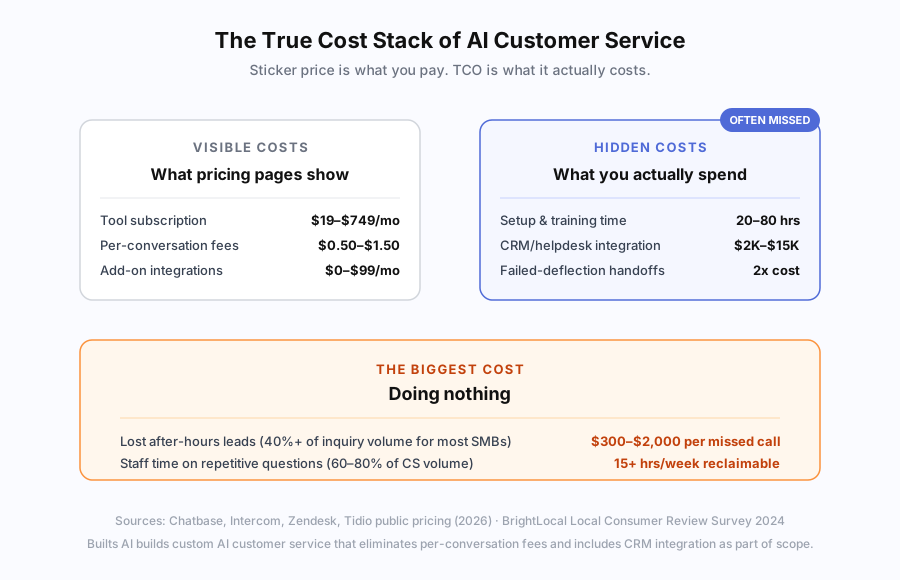
The most expensive AI customer service option is the one most SMBs default to: doing nothing. According to a 2024 BrightLocal Local Consumer Review Survey, 67% of customers will call the next business if you don’t pick up within 60 seconds. For service businesses, every missed after-hours call is $300–$2,000 in lost revenue. Across a year, that compounds into tens or hundreds of thousands of dollars that never appear on any pricing page.
The TCO comparison most pricing guides skip:
| What you don’t do | Cost per month (typical SMB) |
|---|---|
| Capture after-hours leads | $5,000–$30,000 in lost revenue |
| Free up staff from repetitive questions | 15+ hours/week of staff time |
| Respond to every inquiry in under 60 seconds | 21x lower qualification rate (per MIT lead-response study) |
Even the most expensive AI customer service option on this page (Intercom Fin at high volume, ~$5,000/month) costs less than the typical “do nothing” baseline for an SMB doing 30+ inquiries per day. The math almost always favors something — the question is just which something.
How do I evaluate AI customer service vendors honestly?
Before signing any contract, ask vendors three questions: (1) What does my actual volume cost per month at the tier you’re recommending? (2) What integrations are included vs add-on? (3) What’s the total cost if I exceed my plan limits? The answers separate honest vendors from those hiding bills in fine print.
A practical evaluation checklist for any AI customer service vendor:
- Get a real quote at your real volume — sticker prices use favorable assumptions
- Test the AI on your worst questions — most demos use cherry-picked queries
- Confirm integration scope in writing — “supports HubSpot” can mean five different things
- Ask what happens when you exceed limits — overage fees, throttling, or auto-upgrades?
- Check the off-ramp — can you export your training data and conversations if you switch?
- Calculate fully-loaded TCO over 24 months — not just sticker price for month one
If a vendor can’t answer those clearly, that’s data. If they can, you can compare apples to apples instead of sticker price to sticker price.
When custom-built makes financial sense
Custom-built AI customer service makes sense when (a) your monthly conversation volume exceeds 3,000, (b) you need real integration with CRM, helpdesk, calendar, or field service tools, (c) your industry has compliance requirements (PIPEDA, HIPAA, GDPR) that off-the-shelf tools don’t cleanly handle, or (d) you’ve already paid more in 6 months of SaaS subscriptions than a custom build would cost outright.
We build custom AI customer service systems at Builts AI for small and mid-sized businesses across Ontario and Canada. Pricing is transparent: $8,000–$30,000 CAD for the one-time Build Phase, plus $500–$2,500 CAD/month for optional Maintenance Phase. The free workflow audit produces a written scope and quote in 48 hours so you can compare against off-the-shelf options with real numbers, not estimates. For Toronto and GTA businesses specifically, our AI customer service Toronto page covers local deployment context and timeline expectations.
If you’re under 1,000 conversations a month, we’ll usually tell you to start with Chatbase or Tidio. If you’re at 3,000+ and integrating with the CRM and tools you actually use, custom is almost always cheaper TCO inside the first year.
For two related decision frameworks that pair with this cost analysis: our AI customer service vs offshore support comparison covers when each makes sense and includes a 6-month migration playbook, and our after-hours capture playbook walks through the highest-ROI use case for SMBs (the 40-60% of inquiries that arrive outside business hours). For the full service scope and delivery model, see our customer service automation solution page.
If you want a cost estimate for a custom-built system, book a free audit. We’ll size the build to your actual ticket volume, channels, and integrations and give you a written estimate in 48 hours.
The cheapest AI customer service is the one that fits your real volume and integration needs, not the one with the lowest headline price.