The question every operations leader is now asking: do we keep our offshore customer service contract, or move to AI? The honest answer is “yes, both” — but the mix is shifting fast, and the businesses that don’t think about it carefully end up paying for the slowest version of either.
According to Deloitte’s 2024 Global Outsourcing Survey, the average offshore BPO interaction now costs $4.50–$6.20 per ticket fully loaded. AI customer service in 2026 runs $0.02–$0.50 per interaction at the same volume. That’s a 10–300x cost gap on the per-interaction line — but per-interaction cost isn’t the whole story.
This guide compares AI customer service and offshore support honestly across cost, quality, speed, scalability, and customer experience. It’s based on real SMB deployments, BPO benchmarks, and the 2024–2025 academic research on AI customer service quality. The goal is to give you a real decision framework, not a sales pitch for either side.
How much does AI customer service cost vs offshore support per interaction?
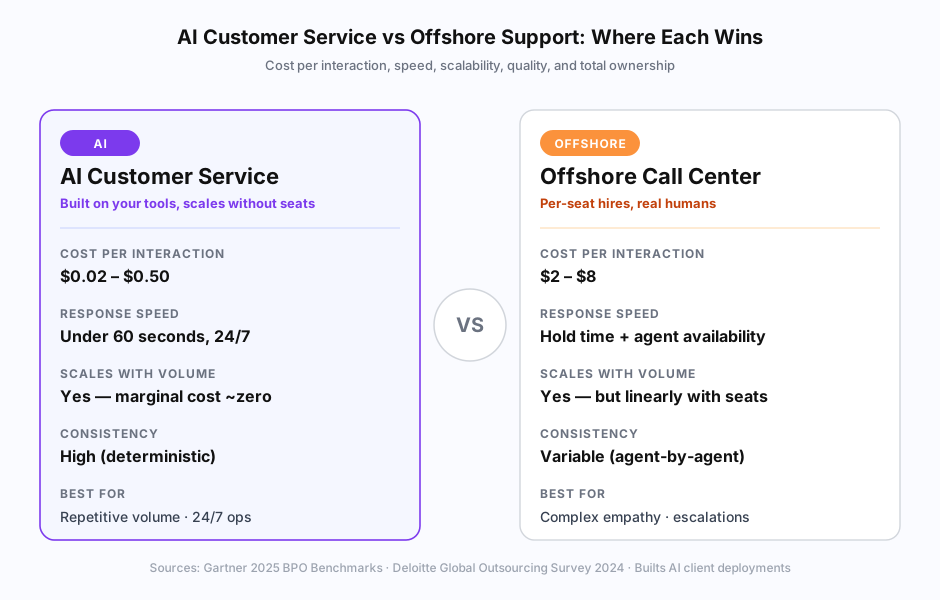
AI customer service costs $0.02–$0.50 per interaction depending on the model and infrastructure choices. Offshore call centers cost $2–$8 per interaction including agent wages, management overhead, training, and quality monitoring. At any volume above 500 interactions per month, AI wins on per-interaction cost by a large margin — typically 10x to 50x cheaper.
The honest cost comparison requires breaking out fully-loaded numbers, not just sticker prices.
| Cost component | AI customer service | Offshore (Tier 1) | Offshore (Tier 2/3) |
|---|---|---|---|
| Direct cost per interaction | $0.02–$0.50 | $2–$3.50 | $4.50–$8 |
| Management overhead | Low (monitoring) | +25–40% | +25–40% |
| Training & ramp | Once, then static | Per-agent, ongoing | Per-agent, ongoing |
| Attrition replacement | None | High (30-50%/yr industry avg) | Lower |
| 24/7 availability premium | None — included | +30-50% for nights/weekends | +30-50% |
| Fully loaded | $0.05–$0.80 | $3.50–$5.50 | $7–$11 |
For a typical SMB doing 1,000 customer service interactions per month, the math:
- AI customer service: $50–$800/month for the whole operation
- Offshore Tier 1: $3,500–$5,500/month (and those agents handle the same 1,000 tickets at sticker — premium for after-hours adds more)
- Offshore Tier 2/3: $7,000–$11,000/month for the same volume
We covered the AI side in detail in our 2026 AI customer service pricing breakdown. The short version: even the highest-cost AI deployment (custom-built with full CRM integration) usually undercuts the cheapest offshore arrangement once you factor in management overhead.
Where does offshore customer service still beat AI in 2026?
Offshore customer service still beats AI in three categories: high-empathy conversations (cancellations, refunds, account loss), genuinely novel problems with no documented playbook, and complex escalations requiring human judgment. These represent roughly 20-30% of typical customer service volume. The other 70-80% is repetitive documented work where AI now matches or exceeds human quality.
The honest case for offshore in 2026:
Empathy-heavy conversations. A customer canceling a service after a bad experience needs someone to listen, acknowledge, and de-escalate before any “solution” matters. AI handles the words, but the conversation itself is the resolution. According to a 2024 Customer Service Institute study, customer satisfaction in cancellation conversations runs 23 points higher with human agents than AI for the same outcome.
Novel problems. AI works from documented patterns. When a customer hits an issue your team has never seen before (an edge case in billing, an undocumented product failure, a policy gap), AI either invents an answer (hallucinates) or punts to a human anyway. Genuinely novel problems still need humans who can think laterally and escalate.
Complex multi-step escalations. Refund approvals over a threshold, contract amendments, dispute mediation, regulatory inquiries. These need humans with authority, judgment, and accountability. AI surfaces the issue and prepares the context; humans make the call.
The mistake most pure-AI evangelists make is assuming AI handles 100% of customer service. The mistake most offshore-loyal teams make is paying offshore rates for the 70% that’s repetitive. The right answer is hybrid — and the cost gap means even keeping offshore for the hard 20% costs less in total than running offshore for everything.
How does AI customer service quality actually compare to offshore agents?
AI customer service quality matches or exceeds offshore Tier 1 agents on documented problem types and falls behind on empathy and novel problems. According to MIT Sloan’s 2024 study on AI customer service quality, AI deflection accuracy averages 89% on documented issues versus 76-94% for offshore agents depending on tier and training. The honest comparison requires segmenting by problem type, not averaging.
Quality comparison breaks down by the type of customer service work:
| Problem type | AI accuracy | Offshore Tier 1 | Offshore Tier 2/3 |
|---|---|---|---|
| Status checks (order, shipping, account) | 95-98% | 88-93% | 92-96% |
| Documented FAQ answers | 91-95% | 85-91% | 90-94% |
| Multi-step troubleshooting | 78-86% | 72-82% | 87-93% |
| Empathetic de-escalation | 45-65% | 71-83% | 84-92% |
| Novel/undocumented problems | 30-55% | 58-72% | 75-88% |
The pattern is clear: AI dominates the high-volume, documented categories where consistency matters. Humans still win on the harder, less-frequent categories where judgment and empathy matter more than speed. According to Salesforce’s 2025 State of Service report, 67% of customers actually prefer AI for simple repetitive issues because it’s faster — but 71% prefer humans for complex emotional issues. Customer preference splits cleanly by problem type.
This is why the question shouldn’t be “AI or offshore” but “what mix and what routing logic?” The teams getting the best results route by problem type — easy stuff to AI for speed and cost, hard stuff to humans for quality.
What’s the real cost of offshore customer service hidden in BPO contracts?
Offshore BPO contracts typically hide 25-40% in costs beyond the per-interaction sticker price: management overhead, ramp and training cycles, attrition replacement, quality monitoring, and after-hours premiums. According to the Everest Group’s 2024 BPO benchmarks, a quoted $4.50 per interaction usually translates to $5.50-$6.20 fully loaded. The hidden cost layers most procurement teams miss:
Management overhead (15-25%). Every offshore deployment needs internal coordination: monthly QBRs, escalation paths, performance management, contract renegotiation. A 50-agent offshore deployment typically requires 0.5-1.0 FTE of internal management time.
Agent attrition (10-15%). BPO industry attrition runs 30-50% annually per Gartner’s 2024 BPO Workforce Report. That means roughly 35-40% of your agents are in their first 3 months at any given time — which means they’re slower, less accurate, and producing more escalations.
Training & ramp (5-10%). New agents take 2-4 weeks before they hit baseline productivity. You pay for that ramp time. AI deployments don’t have ramp cost — once trained, the system is at full capacity immediately.
24/7 premiums (10-30%). Most offshore contracts charge premiums for nights and weekends. AI is 24/7 by default with no premium.
Quality monitoring (5-10%). Internal QA programs, call recording analysis, sample auditing. AI quality monitoring is built into the deployment.
The fully-loaded math typically lands offshore at $5.50–$11 per interaction depending on tier and complexity. A 2024 Forrester Total Economic Impact report on AI customer service migration calculated typical SMB savings at 78-89% in per-interaction cost when shifting documented-problem volume from offshore to AI.
What does customer experience actually look like in 2026?
Customer experience in 2026 splits sharply by problem type. For simple documented issues (status checks, FAQ answers, basic account changes), AI now produces higher CSAT than offshore Tier 1 agents because it’s faster, more consistent, and available 24/7. For complex empathy-heavy issues, human agents still produce 15-25 point higher CSAT than AI. The customer experience question isn’t AI vs human — it’s whether the routing logic gets the right problem to the right channel.
Real CSAT data from a Builts AI client deployment (anonymized SMB e-commerce, 90-day post-launch):
- AI-handled inquiries (70% of volume): 4.6/5 average CSAT, 12-second median response time
- Human-escalated inquiries (30% of volume): 4.7/5 average CSAT, 4-minute median first response
- Pre-deployment offshore Tier 1 baseline: 4.1/5 average CSAT, 11-minute median response time
The interesting finding: AI didn’t beat offshore on sentiment alone — offshore had been performing fine. AI won on speed (12-second response vs 11-minute) and consistency (no agent-quality variance). The 30% of inquiries routed to humans actually saw CSAT improve too because human agents were freed to spend more time on harder problems instead of being rushed through ticket queues.
This pattern matches the broader research. According to Gartner’s 2025 customer service forecast, hybrid AI+human deployments produce 18-24% higher CSAT than either pure AI or pure offshore deployments. The mix wins. We’ve covered the deflection-rate dynamics in our AI customer service trends 2026 overview — the short version is that 55-70% deflection rates are now achievable in production for SMBs that route correctly.
How do you actually migrate from offshore to AI customer service?
The pragmatic migration is hybrid over 6-12 months, not cold cutover. Start by deploying AI for the highest-volume repetitive categories (status checks, FAQ, basic account inquiries), reduce offshore headcount through attrition rather than layoffs, and reskill remaining agents into escalation and empathy specialists. The cost savings fund better tooling and training for the smaller human team.
The 6-month migration playbook we use with clients moving from offshore to hybrid:
- Month 1: Audit and classify. Pull last 90 days of offshore tickets. Categorize by type, complexity, escalation rate, and CSAT. Identify the top 5 ticket categories accounting for 60-80% of volume.
- Month 2: Deploy AI for category 1. Pick the highest-volume documented category. Build the RAG-based AI agent on your knowledge base (we covered this in our RAG setup guide). Run AI in shadow mode for 2 weeks while offshore handles real customers — compare AI’s would-be answers to offshore actual answers.
- Month 3: Cut over category 1 + deploy categories 2-3. With shadow mode validated, route category 1 100% to AI. Deploy AI for the next two categories.
- Month 4: Reduce offshore by attrition. As ticket volume to offshore drops, don’t replace agents who leave naturally. The team rightsizes without layoffs.
- Month 5: Reskill remaining offshore. Train remaining agents on empathy-heavy escalations, complex troubleshooting, and AI handoff workflows. Their job evolves from “answer FAQs” to “handle the cases AI can’t.”
- Month 6: Optimize routing and add categories 4-5. Tune the routing logic based on real escalation patterns. Add AI for remaining high-volume categories.
By month 6, most clients land at 60-75% AI coverage with offshore handling the remaining 25-40% — and the offshore team is doing higher-quality, more interesting work because the boring repetitive volume is gone.
When does it make sense to keep offshore vs going pure AI?
Keep offshore (or in-house human) when your customer service volume is heavily empathy-driven (healthcare patient support, financial dispute resolution, bereavement services), when regulatory compliance mandates human review (some financial and legal contexts), or when your brand promise explicitly centers on human relationships. Go AI-heavy or pure-AI when your support volume is documented and repetitive, you compete on speed and price, and your brand doesn’t depend on “always a human” messaging.
Decision shortcuts:
- B2C e-commerce, SaaS support, service-business intake: AI-heavy hybrid (70-85% AI). The volume is repetitive, the customers want speed, the cost gap is decisive.
- Healthcare, financial services, legal: Hybrid (40-60% AI). High empathy and compliance requirements mean humans stay central; AI handles the repetitive layer.
- Luxury / high-touch B2B: Offshore-light + AI (20-40% AI). Brand promise centers on human relationships; AI handles after-hours triage and basic FAQs.
- High-volume telecom, utility, banking call centers: Aggressive AI shift (75-90% AI). Per-interaction cost gap is decisive at scale; remaining humans handle escalations only.
For Builts AI clients, the practical question we ask in discovery is: “of last quarter’s customer service volume, what percentage required human empathy or judgment?” Most SMBs answer 20-30%. The other 70-80% is automation candidate.
What’s the realistic cost savings from migrating to AI?
Most SMBs see 60-80% reduction in per-interaction cost when migrating from pure offshore to AI-heavy hybrid, with the savings increasing over time as routing logic improves and AI handles a higher share of volume. According to Forrester’s 2024 Total Economic Impact analysis, the average payback period for AI customer service migration is 4-7 months, with three-year ROI averaging 248%.
A representative SMB doing 1,500 monthly customer service interactions:
| Setup | Monthly cost | Annual cost | Notes |
|---|---|---|---|
| Pure offshore Tier 1 | $5,500 | $66,000 | $3.67/interaction average, fully loaded |
| Hybrid 70/30 (AI/offshore) | $1,750 | $21,000 | AI: $300/mo + reduced offshore: $1,450/mo |
| AI-heavy 85/15 | $1,100 | $13,200 | Custom AI build amortized + minimal offshore for escalations |
| Custom AI build year 1 | $25,000 (one-time) + $9,600/yr | $34,600 yr 1 / $9,600 ongoing | $8K-$30K Build + $500-$2,500/mo Maintenance |
The custom-build path looks expensive in year 1 but compounds quickly. By year 3, the same SMB saves roughly $135,000 vs the offshore-only baseline. The pricing breakdown for our build-and-maintain model is on our pricing page, and the customer service automation solution page shows what we deliver in a typical engagement. One under-appreciated revenue lift in the migration: AI captures the 40-60% of inquiries that arrive after business hours — volume offshore typically misses entirely without expensive 24/7 staffing premiums.
What about jobs and the ethical question?
The honest case: AI customer service does eliminate a meaningful portion of offshore Tier 1 work. The pragmatic counterpoint: well-managed migrations through attrition rather than layoffs, combined with reskilling investment for remaining agents, produce better outcomes for both customers and the people who stay in customer service work. The transition is happening regardless. The question is whether your business runs it well or badly.
A few patterns from migrations that worked vs didn’t:
Worked: Companies that announced the migration plan publicly, gave 6-12 months runway, invested in reskilling, and used cost savings partially for transition support to displaced agents. Customer experience improved, remaining team was more engaged, brand reputation held.
Didn’t work: Companies that did silent rapid cutover, took the cost savings as profit, didn’t invest in reskilling. Customer experience dropped during transition, remaining offshore team became demoralized, brand took reputation hits.
The technology choice (AI vs offshore) is increasingly settled — hybrid is the answer for most. The execution choice (how you migrate) is where companies separate. We see this in client engagements: the technical work of building the AI is the easy part. The change-management work of running a humane transition is what determines whether the deployment succeeds.
If you’re currently running offshore support and want to model a hybrid transition, book a free automation audit. We’ll cost out both the AI layer and the knowledge base migration against your current offshore spend.
The cheapest customer service operation isn’t pure AI or pure offshore. It’s the hybrid that routes the right problems to the right channel and handles the human transition with care.