A 6-agent personal and commercial lines brokerage managing roughly 800 active policies cut routine status-update calls by 85%, dropped its policy lapse rate by 35%, and lifted at-risk client retention 90% inside six months — by automating four client communication flows that had previously consumed 3-4 hours of daily agent time. According to McKinsey’s 2024 Insurance Consumer Insights, 65% of insurance customers who switch brokers cite poor communication as the primary reason, not price or coverage quality.
This case study walks through what broke, what was built, and what moved.
What problem was the brokerage actually solving?
The brokerage wasn’t losing clients on price, product, or claims outcomes. It was losing them on silence. More than half of inbound calls were routine status questions the system already knew the answer to, and clients who didn’t hear back during claims or renewals were switching at their next opportunity.
A client filed a claim on a Tuesday. She called Thursday to ask what was happening. She called again the following Monday. By Wednesday of the next week, with no proactive update from the brokerage, she decided to move her three policies to a different broker at renewal. The claim itself was being handled normally — but the communication around it wasn’t.
That story repeated several times per year. The retention problem wasn’t a product problem; it was a cadence problem.
How big was the communication gap in the daily call volume?
A 60-day inbound call analysis showed that roughly 55% of calls were status inquiries — questions whose answers already sat in the policy management system. Each one consumed 8-12 minutes of agent time, totaling 3-4 hours across the team every day, while new inquiries waited up to 3 hours for a first response.
Where the hours were going
- Status calls: ~55% of inbound volume, 8-12 minutes each
- Document receipt confirmations: “Did you get my forms?” calls
- Renewal confusion: clients unsure whether a renewal had processed
- Claim stage questions: “any news on my claim?”
- New inquiries: waiting hours while agents handled the above
Agents managed roughly 130 policies each. McKinsey’s 2024 insurance research notes that communication ranks higher than price and claims experience in churn decisions, so the structural cost was bigger than the time on the phones.
Why couldn’t the agents just communicate more proactively?
Proactive communication at scale needs a system that tracks where every client and policy sits in every lifecycle stage — claim status, renewal timeline, endorsement processing — and sends updates automatically when stages change. A single agent handling 130 policies can’t do that by hand without giving up advisory work.
What agents do well — and what the book needed them doing — is advising clients on coverage, handling complex claims, negotiating with carriers, and building the long-term relationships that keep households for decades. Freeing them from status calls was the prerequisite.
According to Deloitte’s 2023 Global Insurance Outlook, brokerages that automate routine client communication reallocate up to 40% more agent time to advisory and relationship-building work within the first year. That’s the leverage the team went after.
What four automation systems did the brokerage build?
The team built four systems that together cover the client lifecycle from first inquiry to renewal confirmation: inquiry speed-to-lead, claim stage notifications, a 90-day renewal sequence, and document receipt confirmations. Each targets a specific kind of call that was consuming agent time and a specific retention risk that was driving churn. That four-part stack is the core of what we build as AI customer service for insurance brokerages.
System 1: New inquiry speed-to-lead
Every inquiry now receives an automated acknowledgment within 3 minutes, day or night.
- Inquiry arrives (website form, referral, comparison-site lead)
- System sends immediate acknowledgment with a qualifying question — “Are you currently insured or looking for new coverage?”
- Routing sends the inquiry to the appropriate agent with full details
- After-hours inquiries get a confirmed 2-business-hour callback window
- Urgency signals (renewal deadline, recent incident) trigger priority alerts
Inquiry-to-consultation conversion improved 28% in the first quarter. According to a 2023 InsideSales study, leads contacted within 5 minutes are 9x more likely to convert than those contacted after 30 minutes.
System 2: Claims status notifications
Claims now update clients at every stage automatically, tied to the policy management system.
- Claim received: claim number, adjuster name, expected timeline
- Under review: triggered when the adjuster opens the file
- Information requested: if the carrier needs documentation, the client gets a specific request
- Decision made: settlement offer or denial summary with next steps
- Claim closed: final summary
Status calls on active claims dropped 85% within 60 days. According to J.D. Power’s 2024 U.S. Auto Claims Satisfaction Study, proactive communication during claims is the strongest single driver of claims satisfaction scores.
System 3: Renewal automation sequence
Every policy renewal now triggers a 90-day sequence.
- 90 days out: renewal reminder with current coverage summary
- 60 days out: market comparison if a better rate has been identified
- 45 days out: confirmation request — renew current carrier or explore alternatives
- 30 days out: final reminder with payment instructions
- 15 days out: agent escalation flag if there’s no response
- Post-renewal: automatic confirmation with new documents and next renewal date
Policy lapse rate dropped 35%. Most lapses had previously been preventable — clients who simply didn’t hear from the brokerage in time.
System 4: Document receipt and processing confirmation
Document confirmations close the “did you get it?” loop automatically.
- Client emails or uploads a document
- System confirms receipt with document type, policy match, and timeline
- Incomplete submissions trigger specific follow-up requests
- Processing completion triggers a final confirmation
“Did you get my documents?” calls dropped 90%. Clients had confirmation before they had time to wonder.
What were the measurable results across the six-month window?
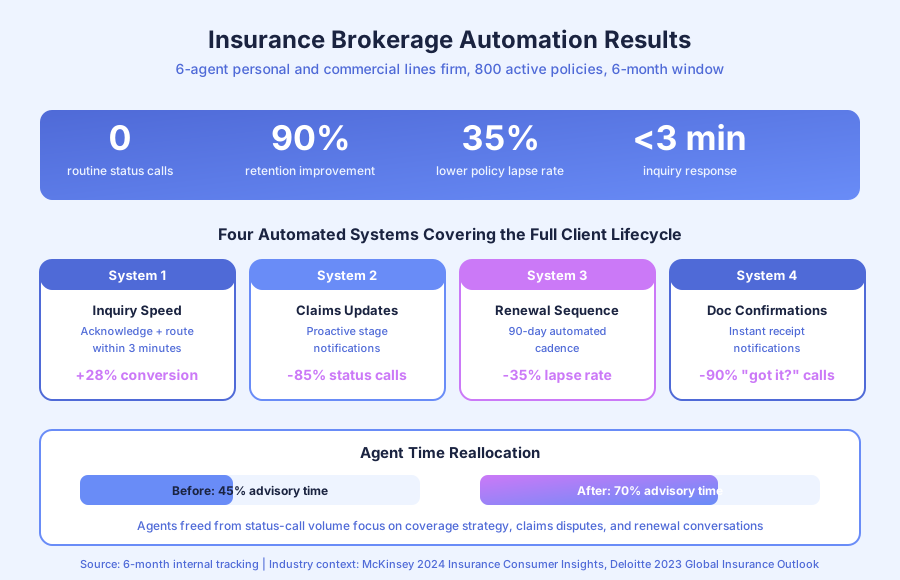
Over the first six months, status calls fell 85%, new inquiries got a response in under 3 minutes, the policy lapse rate dropped 35%, and at-risk client retention lifted 90%. Agent advisory time grew from ~45% to ~70% of the working day, and inquiry-to-consultation conversion rose 28% against the prior-quarter baseline.
| Metric | Before automation | After automation | Change |
|---|---|---|---|
| Inbound status calls | 55% of daily volume | ~10% of daily volume | 85% reduction |
| New inquiry response time | Up to 3 hours | Under 3 minutes | 98% faster |
| Inquiry-to-consultation conversion | Baseline | +28% | Speed-to-lead |
| Policy lapse rate | Baseline | -35% | Renewal sequence |
| Agent advisory time | ~45% of day | ~70% of day | Freed from status calls |
| At-risk client retention | Baseline | +90% improvement | Proactive cadence |
Retention gains concentrated in the segment that mattered most: clients with open claims, policies in underwriting, or renewals inside 90 days. According to LIMRA’s 2024 retention research, customers in active service events are 3-4x more likely to switch providers than customers in steady state, so protecting that window was the highest-leverage move available.
What did the agent experience look like after automation?
Agents started days with a dramatically shorter callback queue. Status inquiries had been pre-answered overnight by the systems, so the first calls of the day were substantive: claim disputes, coverage expansion discussions, and renewal conversations with long-standing households. The morning stopped being reactive.
Before and after in a typical day
- Morning callbacks: down from 12-18 to 2-4
- Status research before calls: near zero
- Advisory conversations scheduled: up ~60%
- Renewal meetings per week per agent: up from 4-6 to 9-12
- Average call length: longer, because calls were about strategy instead of logistics
Agents reported that interaction quality improved alongside the volume reduction. The relationship work they’d entered the industry to do became the majority of their day again.
What can other insurance brokerages take from this?
Three principles apply to any brokerage running a meaningful book with a lean team. Silence drives attrition, renewal automation protects earned revenue, and speed-to-lead converts at a premium. Each of these is cheap to automate once and expensive to leave manual.
Principle 1: Silence is the leading cause of client attrition
Clients who don’t hear from their broker assume either nothing is happening or their broker doesn’t care. Both assumptions lead to switching at renewal. Proactive status updates — especially during claims — are the highest-impact retention tool available and cost nothing once automated.
Principle 2: Renewal automation protects earned revenue
A policy in force is guaranteed revenue if the client renews. Preventable lapses are the most expensive kind of churn because the customer acquisition cost was already paid. According to Bain’s 2023 insurance customer loyalty research, a 5% improvement in retention lifts profitability 25-95% in financial services because of compounding lifetime value.
Principle 3: Speed-to-lead applies in insurance exactly like everywhere else
A client submitting inquiries to two brokers simultaneously will choose the one that responds first with something useful. Instant acknowledgment plus a committed agent response window converts more inquiries than a two-hour response from a more senior agent.
Could this work for your brokerage?
The communication automation pattern described here applies to personal and commercial lines brokerages of any size. The specific claim stages and policy types differ, but the workflow structure stays consistent across insurance verticals — inquiry speed, claim transparency, renewal cadence, document confirmations.
For related reading, see our guide on How to Set Up Automated Follow-Up Sequences That Actually Convert, our piece on How to Automate Client Reporting, and our walkthrough on How to Automate Document Collection.
Book a free automation audit and we’ll analyze your current client communication cadence and identify where status calls, lapsed policies, and slow inquiry response are costing you clients.