Small business owners spent an average of $2,340 on AI subscriptions in 2025, and according to Gartner’s July 2025 AI adoption survey, roughly 31% of those tools went unused within 90 days. The problem isn’t AI itself. It’s that every SaaS vendor bolted “AI-powered” onto their marketing between 2024 and 2026, and picking signal from noise now takes real work.
This guide skips the hype and lists the five AI tool categories that actually earn their price for a small business in 2026, the specific products worth paying for in each, and the ones to cut from your budget.
What makes an AI tool worth paying for in 2026?
Answer capsule: A worthwhile AI tool saves measurable time or money, integrates with your existing systems, and solves a problem your team faces weekly. Tools that duplicate capabilities you already have, require heavy setup, or produce output your team doesn’t trust without review fail the test. The rule: one hour saved per week justifies $20 per month.
According to Salesforce’s 2025 Small and Medium Business Trends Report (published December 2024), 75% of SMBs now use AI in some form, up from 49% in 2023. But the same report found that businesses running 3-5 well-integrated tools reported 2x the productivity gains of those running 10 or more fragmented apps.
Integration compounds value. An isolated AI writer speeds up writing. An AI assistant wired into your email, CRM, and calendar speeds up everything around writing too. That’s the difference between spending $500 a month and wasting $500 a month.
How much should a small business spend on AI tools?
Answer capsule: Plan for $65-300 per month for the full 5-layer stack, depending on team size and support volume. Solo founders can run it for under $100. A 10-person services firm usually lands at $150-250. Avoid the $1,000+ enterprise tiers. Most vendors price those for companies 10x your size.
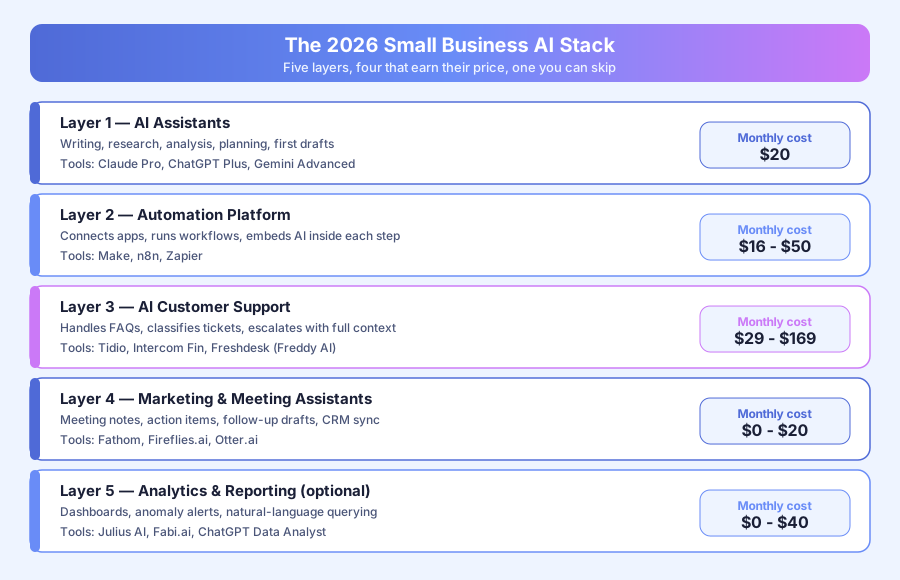
Here’s how the budget breaks down for a typical 10-person small business:
| Layer | Typical spend | What you get |
|---|---|---|
| AI assistant (1-3 seats) | $20-60 | Writing, research, analysis |
| Automation platform | $16-50 | 3-10 running workflows |
| Customer support AI | $29-169 | Inbox, chatbot, routing |
| Meeting assistant (3-5 seats) | $0-60 | Notes, action items |
| Analytics (optional) | $0-40 | Dashboards, NL queries |
| Total monthly | $65-379 | Full stack |
HubSpot’s 2025 State of AI in SMB report found the median monthly AI spend among profitable small businesses was $187. Teams that spent significantly more rarely saw proportional returns.
Layer 1: Which AI assistant should a small business pay for?
Answer capsule: Claude Pro or ChatGPT Plus at $20 per month covers 90% of small business writing, research, and analysis needs. Claude is stronger on long documents and careful reasoning. ChatGPT is stronger on image generation and broader integrations. Pick one. Don’t subscribe to both unless you have a specific workflow that needs features unique to each.
The three real contenders
| Tool | Cost | Best for |
|---|---|---|
| Claude Pro | $20/mo | Long-form writing, document analysis, nuanced reasoning |
| ChatGPT Plus | $20/mo | General use, image generation, custom GPTs, coding |
| Gemini Advanced | $22/mo | Google Workspace teams that live in Gmail and Docs |
According to a16z’s December 2025 Top 100 Gen AI Consumer Apps report, ChatGPT still leads on active users while Claude grew fastest in enterprise and professional use cases. For a full side-by-side comparison, see our ChatGPT vs Claude for business guide.
What to use an AI assistant for
First drafts of proposals, emails, and blog posts. Meeting prep and research summaries. Analyzing PDFs and spreadsheets. Writing SOPs. Brainstorming frameworks. Debugging short scripts. Translating between languages.
What not to expect
Real-time facts without web access. Direct integration with your other apps (that’s the automation platform’s job). Output you can publish without review. Treat the assistant as a fast junior analyst, not a replacement for judgment.
Layer 2: What is the best automation platform for small businesses?
Answer capsule: Make is the best value for most small businesses at $16 per month, with 1,900+ integrations and built-in AI modules for Claude and GPT. n8n is the right pick if you need self-hosted deployment for compliance. Zapier is easiest to learn but 2-3x more expensive at comparable volumes. All three can embed AI inside a workflow step.
Side-by-side comparison
| Platform | Starting price | Integrations | AI modules | Self-host |
|---|---|---|---|---|
| Make | $9-16/mo | 1,900+ | Yes (Claude, GPT) | No |
| n8n Cloud | $24/mo | 400+ native, 1,000+ via HTTP | Yes (all major) | Yes (free) |
| Zapier | $19.99-69/mo | 7,000+ | Yes (limited) | No |
According to Make’s public case study data (November 2025), users save an average of 13 hours per month per active scenario. n8n’s 2025 state of automation report found self-hosted deployments grew 3.4x year over year as data residency rules tightened in the EU and UK.
Example workflows that pay for the tool
A lead form submits, the workflow enriches the contact via Clearbit, scores the lead with Claude, creates a HubSpot record, sends a Slack alert, and schedules a follow-up task. That single workflow saves 10 to 15 minutes per lead. For 20 leads a week, that’s 4 hours of time back.
For a deeper look at Make’s specifics, see our Make.com review for 2026.
Layer 3: Which AI customer support tool should small businesses use?
Answer capsule: For under 50 employees, Tidio at $29-79 per month delivers strong value with fast setup. Intercom Fin costs more ($0.99 per resolved conversation plus $74-169/mo base) but resolves a higher share of tickets. Freshdesk with Freddy AI fits teams already on Freshdesk. Skip custom chatbots unless you need full control of the model’s behavior.
Pick by stage
| Tool | Price | Best for |
|---|---|---|
| Tidio | $29-79/mo | SMBs under 50, fast setup, good value |
| Intercom Fin | $74-169/mo + $0.99/resolution | Higher resolution rates, CRM-heavy teams |
| Freshdesk (Freddy AI) | $15-79/agent/mo | Teams already on Freshdesk |
| Custom GPT bot via Make | $50-150/mo | Full model control, niche use cases |
Intercom’s 2025 Fin performance report claimed a 51% AI resolution rate across thousands of business customers. Tidio’s 2025 benchmark found small businesses using their AI bot cut first-response time by 80% on average.
The ROI math
If you handle 100 support messages per week and AI deflects 60%, that’s 60 messages your team skips. At 5 minutes each, that’s 5 hours of time saved weekly. Even a $169/month tool pays back in the first week of that month. Below 15 messages per week, a well-written FAQ page and template library handles the same load without the subscription.
For a full comparison of chatbot platforms, read our guide on the best AI chatbot builders for small business.
Layer 4: What is the best AI meeting assistant for small teams?
Answer capsule: Fathom has the strongest free tier in 2026, with unlimited recordings and summaries for individual users. Fireflies.ai at $10 per month adds CRM sync and searchable meeting history. Otter.ai at $16.99 per month offers the best transcription accuracy for interview-heavy workflows. All three join Zoom, Google Meet, and Microsoft Teams automatically.
Quick comparison
| Tool | Free tier | Pro tier | Stand-out feature |
|---|---|---|---|
| Fathom | Unlimited recordings (individual) | $19/mo | Best free plan |
| Fireflies.ai | 800 min/mo | $10-19/mo | CRM sync, searchable archive |
| Otter.ai | 300 min/mo | $16.99/mo | Most accurate transcription |
According to Zoom’s 2025 Work Trends Report, workers attend an average of 21 meetings per week and report spending 40 minutes on notes and follow-ups per day. A meeting assistant that shaves 15 minutes off that time per meeting saves 5 hours per week per person. At $10-19 per month, the return is obvious.
How to get the full value
Connect the meeting assistant to your CRM and project tool. Action items flow directly to the right place instead of living in a summary email nobody revisits. For client-facing teams, the post-call email with a summary and action items also reduces “what did we agree to” confusion by a large margin.
Layer 5: Are AI analytics tools worth it for small businesses?
Answer capsule: Optional in 2026. Julius AI and Fabi.ai let non-technical users ask plain-English questions of their spreadsheets and databases. ChatGPT’s Data Analyst mode covers similar ground for free on the Plus plan. Skip dedicated analytics tools until you have cleaned data in a warehouse. Below that, the output will be garbage no matter how polished the interface.
When to add this layer
Add AI analytics once you have a reasonably clean CRM, a connected e-commerce or billing system, and at least one team member asking “why did X change last month” weekly. Before that, the data quality won’t support reliable answers.
| Tool | Cost | Fit |
|---|---|---|
| Julius AI | $0-20/mo | Spreadsheet-driven small businesses |
| Fabi.ai | $0-40/mo | Teams with Postgres, BigQuery, or warehouses |
| ChatGPT Data Analyst | Included with Plus | Ad-hoc file analysis |
Fabi.ai’s March 2025 launch note reported a 60% reduction in time from question to chart for early users. That’s genuine, but only if your data is already structured.
What AI tools should small businesses NOT pay for in 2026?
Answer capsule: Skip standalone AI social media schedulers, AI SEO tools that mostly do keyword density checks, single-purpose AI image generators if you have ChatGPT Plus, and “AI email marketing” platforms that charge a premium for GPT-generated subject lines. Most of these features duplicate what Claude or ChatGPT already do for a fraction of the price.
The skip list and why
AI social media schedulers. Most are scheduling tools with a GPT wrapper on the post generator. Your $20 AI assistant writes better captions. A $6/month scheduler like Buffer handles the posting. Combined cost: $26 vs $50-99 for the “AI” version.
Standalone AI SEO tools. Tools like Surfer SEO still have real value for competitive content. But the “AI” component is usually keyword density and topic modeling, which your general assistant handles adequately for most small business needs.
Dedicated AI image generators. Midjourney and Ideogram produce beautiful images. Unless you publish visual content daily, ChatGPT Plus’s built-in image generation covers 95% of small business needs for no extra cost.
AI email marketing tools. Most are standard email platforms with one AI feature (subject lines). You can write subject lines in Claude in 30 seconds. Don’t pay $199 a month for that wrapper.
How do these AI tools work together in practice?
Answer capsule: Your automation platform is the glue. It connects your AI assistant’s output to your CRM, your chatbot to your helpdesk, your meeting assistant to your project tool, and your analytics queries to the right data source. Without the automation layer, each tool is an island. With it, the stack runs as a single system.
A real example workflow
A customer emails support. Tidio classifies the message and either answers or routes to a human. If routed, Make creates a ticket in HubSpot, pulls the customer’s history, asks Claude to draft a reply, and posts it to the agent for review. The agent approves or edits. Make sends the reply, updates HubSpot, and logs the outcome for analytics.
Four tools, one workflow, 3 minutes of human time per ticket instead of 12. That single process alone justifies the full stack for most small businesses.
For implementation guidance, see our guides on how to set up an AI chatbot for your website and what AI agents are in plain English.
The 2026 core stack recommendation
Answer capsule: For a 5-25 person small business, the core stack is Claude Pro or ChatGPT Plus ($20/mo), Make ($16/mo), Tidio or Intercom Fin ($29-169/mo), and Fathom ($0-19/mo). Total: $65-224 per month. Add AI analytics later once your data is clean. This covers the four highest-ROI AI use cases without creating tool sprawl.
The short list
- AI assistant — Claude Pro or ChatGPT Plus, $20/month
- Automation — Make, $16/month
- Customer support — Tidio ($29-79) or Intercom Fin ($74-169+)
- Meeting assistant — Fathom ($0-19) or Fireflies ($10-19)
- Optional analytics — Julius or Fabi, $0-40/month
If your CRM is also due for a refresh, our best CRM for small business in 2026 guide covers which options play well with this stack.
Small business AI in 2026 isn’t about picking the trendiest tool. It’s about picking five that fit together, cost less than one part-time hire, and actually get used every week. The stack above does that.
Book a free automation audit and we’ll review your current tools, identify where AI would cut the most time, and recommend the exact configuration worth paying for in your specific situation.