Eighty-five percent of customer service interactions won’t involve a human agent by the end of 2026, according to Gartner’s Customer Service Technology forecast. That’s not a prediction about enterprise companies with million-dollar support budgets. It applies to the bakery with an online ordering page, the SaaS startup with 200 users, and the e-commerce store running on Shopify.
The question isn’t whether your small business needs an AI chatbot. It’s which builder actually delivers on the promise without eating your budget or requiring a developer on retainer.
I’ve tested all four of the platforms below with real client implementations at Builts AI. Here’s what I found after configuring, deploying, and measuring each one across dozens of small business use cases.
What Are the Four Best AI Chatbot Builders for Small Business?
The four chatbot builders that consistently separate themselves from the pack are Tidio, Crisp, Intercom, and custom GPT-powered solutions built on OpenAI or Anthropic APIs. Each serves a different budget, technical capacity, and support complexity. The right choice depends on your monthly conversation volume, integration needs, and how much AI sophistication your business actually requires.
Tidio is an SMB-focused live chat and chatbot platform with Lyro AI for automated FAQ responses. It’s the strongest value option under $100/month.
Crisp is a European-founded team messaging platform with the most generous free tier in the market. Less AI-sophisticated than Tidio but unbeatable at entry pricing.
Intercom is a full customer communications platform with Fin AI, the most capable pre-built conversational AI available. It commands a significant price premium.
Custom GPT chatbots are built on OpenAI’s GPT-4o or Anthropic’s Claude API, deployed via widgets like Botpress or custom code. They offer full control over AI behavior and knowledge base design.
According to Drift’s 2025 Conversational Marketing Report, businesses with AI chatbots respond to 100% of website visitors compared to 30-40% with live chat alone, resulting in 25-40% more qualified leads captured. The gap between these four tools lies in how well they convert those responses into actual resolutions.
How Do These Chatbot Builders Compare on Pricing?
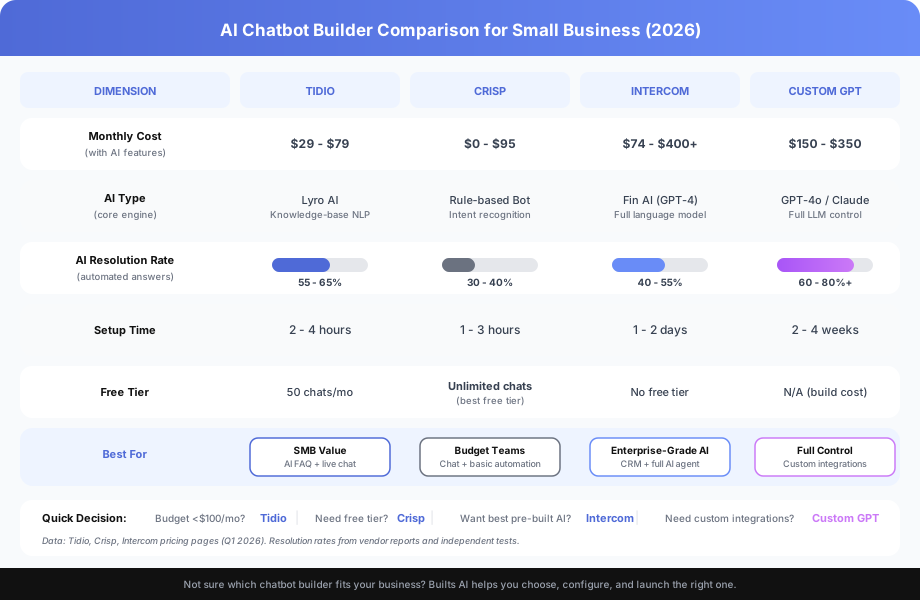
Pricing is the first filter for most small businesses, and the spread here is enormous. Crisp starts at $0/month with unlimited chats; Intercom can reach $400+/month at scale. The table below breaks down what you’ll actually pay once AI features are enabled, not just the headline number on the pricing page.
| Feature | Tidio | Crisp | Intercom | Custom GPT |
|---|---|---|---|---|
| Free tier | Yes (50 chats/mo) | Yes (unlimited chats) | No | N/A |
| Entry paid plan | $29/month | $25/month (Essential) | $74/month (Essential) | $2,000-$6,000 build |
| AI-enabled plan | $79/month (Tidio+) | $95/month (Business) | $74/month + $0.99/resolution | $150-$350/month ongoing |
| Cost at 500 chats/mo | $79 | $95 | $174-$320 | $180-$280 |
| Cost at 2,000 chats/mo | $79-$100 | $95 | $350-$500+ | $250-$350 |
| Annual discount | ~20% | ~20% | ~15% | N/A |
According to Capterra’s 2025 SMB Software Spending Survey, the average small business spends $127/month on customer support tools. That puts Tidio and Crisp comfortably within budget and Intercom at the upper edge.
Intercom’s per-resolution pricing model deserves attention. At $0.99 per automated resolution, a business with 500 monthly conversations where Fin resolves 50% pays roughly $248/month ($74 base + $248 in Fin fees). That’s 3x Tidio’s flat rate for comparable AI capability.
How Does AI Capability Differ Across These Platforms?
AI capability is the dimension that matters most and where these tools differ the widest. The gap between Crisp’s rule-based bot and a custom GPT-4o implementation is the gap between a phone tree and a conversation with a knowledgeable support agent. Understanding exactly where each tool falls on that spectrum determines whether your chatbot resolves issues or just frustrates visitors.
What Can Tidio’s Lyro AI Actually Do?
Lyro is Tidio’s AI assistant, trained on a knowledge base you upload. It answers natural language questions from your FAQs, policies, and product information. According to Tidio’s 2025 product benchmarks, Lyro resolves 55-65% of incoming queries without human intervention when the knowledge base covers the business’s top 50 question categories.
| Lyro AI Metric | Performance |
|---|---|
| Resolution rate | 55-65% (well-configured) |
| Language understanding | Good; handles phrasing variations |
| Multi-turn conversation | Basic; 2-3 turns, struggles with complex multi-part queries |
| Escalation | Smooth handoff to live agent |
| Training method | Upload FAQ docs and product pages |
| Response latency | 1-3 seconds average |
A real example: one of our e-commerce clients using Lyro reduced their support ticket volume by 47% within 30 days of deployment. Their knowledge base covered 120 FAQ entries across shipping, returns, and product sizing. Lyro handled all the repetitive questions, freeing their two-person support team to focus on complex order issues.
The limitation is multi-turn depth. When a customer asks a shipping question, then follows up about a return on the same item, then asks about a size exchange, Lyro often loses context by the third turn. For businesses with simple, high-volume FAQ patterns, that doesn’t matter much. For those with complex support journeys, it’s a real constraint.
How Does Crisp’s Bot Builder Compare?
Crisp’s bot builder is primarily rule-based with some NLP intent detection layered on top. It’s not a full language model. It recognizes intent categories but doesn’t generate free-form responses from a knowledge base the way Lyro or Fin AI do.
| Crisp Bot Metric | Performance |
|---|---|
| Resolution rate | 30-40% (structured decision trees) |
| Language understanding | Intent recognition (limited categories) |
| Multi-turn conversation | Good within defined paths |
| Escalation | Built-in live chat handoff |
| AI capability | Rule-based core; AI features added 2025 |
| Response latency | Instant (pre-defined responses) |
Crisp introduced AI-powered features in late 2025, but the core remains rule-based. The advantage is predictability: a Crisp bot says exactly what you program it to say. The disadvantage is brittleness. When a customer phrases a question outside the expected patterns, the bot fails.
According to Crisp’s public case studies, businesses using their bot builder alongside live chat reduce average response time from 4.2 minutes to under 30 seconds for the 35-40% of queries the bot handles directly.
The real selling point isn’t AI sophistication. It’s the free tier. Crisp offers unlimited conversations, live chat, and basic automation at $0/month. For a startup validating product-market fit that just needs a chat widget, that’s hard to beat.
What Makes Intercom’s Fin AI Different?
Fin is Intercom’s AI agent and the most capable conversational AI among pre-built platforms. It’s built on GPT-4 and trained on your help center articles, support documentation, and conversation history. According to Intercom’s 2025 AI Report, Fin achieves up to 50% automated resolution across their customer base, with well-configured implementations reaching 55%.
| Fin AI Metric | Performance |
|---|---|
| Resolution rate | 40-55% (real-world range) |
| Language understanding | Excellent; complex, multi-part questions |
| Multi-turn conversation | Strong; maintains context across long threads |
| Escalation | Full conversation context passed to agent |
| Training method | Help articles, URLs, support history |
| CRM integration | Native; uses customer data in responses |
What separates Fin from Lyro is contextual awareness. Fin can pull a customer’s subscription status, last order, or account type and tailor its response accordingly. A customer asking about billing gets a different answer based on whether they’re on a free trial or an enterprise plan.
For a detailed breakdown of Fin’s capabilities and real-world performance, see our Intercom Fin AI review.
The catch is cost at scale. One Builts AI client running Intercom with 1,200 monthly conversations saw their Fin bill reach $380/month (base + resolutions). They switched to a custom GPT chatbot and brought ongoing costs to $220/month while increasing resolution rate from 48% to 72%.
When Does a Custom GPT Chatbot Make Sense?
A custom chatbot built on OpenAI’s GPT-4o or Anthropic’s Claude API offers the full capability of frontier language models. According to OpenAI’s 2025 enterprise deployment data, businesses using custom GPT-4o implementations report resolution rates between 60-80% when the knowledge base and prompt engineering are well-designed.
| Custom GPT Metric | Performance |
|---|---|
| Resolution rate | 60-80%+ (depends on configuration) |
| Language understanding | State-of-the-art; best available |
| Multi-turn conversation | Full capability; handles complex threads |
| Escalation | Custom-designed for any channel |
| Training method | Full control over knowledge base and prompts |
| Integration depth | Any system via API (CRM, orders, inventory) |
The key advantage is integration depth. Pre-built platforms can answer questions from your help articles. A custom GPT chatbot can look up a customer’s order status in your Shopify admin, check inventory in your warehouse system, and initiate a return in your CRM, all within the same conversation.
A concrete example: we built a custom GPT chatbot for a specialty food retailer that integrated with their Shopify store, ShipStation tracking, and Freshdesk ticketing system. The bot resolved 73% of incoming queries, including order tracking, product availability, and return initiation, without any human involvement. Monthly API costs averaged $185.
The tradeoff is implementation complexity. You need a developer (or a team like Builts AI) to build, deploy, and maintain it. Implementation runs $2,000-$6,000 depending on integration depth.
Which Channels Does Each Chatbot Support?
Channel coverage determines where your chatbot can meet customers. If 40% of your support volume comes through Instagram DMs, a platform that doesn’t cover Instagram is immediately disqualified. According to Salesforce’s 2025 State of Service report, the average consumer uses 3.2 channels to contact a business, up from 2.1 in 2022.
| Channel | Tidio | Crisp | Intercom | Custom GPT |
|---|---|---|---|---|
| Website widget | Yes | Yes | Yes | Yes (custom build) |
| Yes | Yes | Yes | Via integration | |
| Instagram DMs | Yes | Yes | Yes | Via integration |
| Facebook Messenger | Yes | Yes | Yes | Via integration |
| Tidio+ plan | Yes (free tier) | Yes | Via integration | |
| SMS | No | No | Yes | Via integration |
| Slack | No | Yes | Yes | Via integration |
Crisp stands out on channel coverage relative to price. WhatsApp support on the free tier is a significant differentiator for businesses serving international customers. According to Meta’s 2025 Business Messaging Report, WhatsApp has 2.78 billion monthly active users globally and is the primary customer communication channel in 58 countries.
For businesses managing multi-channel support, Intercom offers the most unified experience: one inbox, one AI engine, one conversation thread regardless of channel. Custom GPT chatbots can cover any channel but require separate integration work for each.
How Quickly Can You Deploy Each Chatbot?
Setup complexity is the hidden cost that most comparison articles ignore. A $29/month chatbot that takes 2 hours to deploy has a fundamentally different total cost than a $29/month chatbot that requires a week of configuration work.
| Tool | Time to First Working Chatbot | Technical Requirement | Knowledge Base Setup |
|---|---|---|---|
| Tidio | 2-4 hours | None | Upload FAQs, 1-2 hours |
| Crisp | 1-3 hours | None | Configure flows, 1-3 hours |
| Intercom | 1-2 days | Low-moderate | Train Fin on help center, 2-4 hours |
| Custom GPT | 2-4 weeks | Developer required | Full knowledge base design, 1-2 weeks |
According to Tidio’s 2025 customer onboarding data, 78% of new users have a functioning chatbot live within their first day. Crisp reports similar numbers. Intercom’s longer setup reflects the depth of its AI training process: Fin needs to ingest your entire help center and support history before it performs well.
For custom GPT builds, the 2-4 week timeline breaks down roughly as: week one for knowledge base design and prompt engineering, week two for API integration and widget development, weeks three and four for testing, refinement, and deployment. See our guide on How to Set Up an AI Chatbot for Your Website for a detailed walkthrough of the implementation process.
What Are the Key Limitations of Each Platform?
Every platform has blind spots. Knowing the limitations upfront saves you from a painful migration six months later.
| Platform | Primary Limitation | Impact |
|---|---|---|
| Tidio | Multi-turn conversation depth limited to 2-3 turns | Complex support journeys require human escalation |
| Crisp | Rule-based core limits AI capability | Can’t handle unexpected question phrasing |
| Intercom | Per-resolution pricing inflates costs at scale | High-volume businesses may pay $400+/month |
| Custom GPT | Requires technical resources to build and maintain | Not viable without a developer or implementation partner |
Tidio’s Lyro can’t access external systems. It answers from its knowledge base only. If a customer asks about their specific order status, Lyro can’t look it up; it can only provide general shipping policy information.
Crisp’s rule-based architecture means every new question type requires manual programming. According to Forrester’s 2025 Chatbot Market Analysis, rule-based bots require 3-5x more ongoing maintenance than AI-based alternatives because every edge case needs explicit handling.
Intercom’s Fin occasionally generates confident but incorrect answers, a known limitation of GPT-4-based systems. Intercom addresses this with citation links to source articles, but businesses with complex or nuanced products should monitor Fin’s accuracy closely during the first 30 days.
Custom GPT chatbots carry the highest maintenance burden. API model updates, knowledge base refreshes, and prompt tuning require ongoing attention. Budget 2-4 hours per month for maintenance, or work with a managed implementation partner.
How Should You Choose the Right Chatbot for Your Business?
The right chatbot isn’t the one with the most features. It’s the one that matches your support volume, technical capacity, and budget. A solo founder with 50 monthly support conversations doesn’t need Intercom. A growing SaaS with 2,000 monthly conversations and complex account-specific queries shouldn’t be on Crisp’s free tier.
Should You Pick Tidio?
Choose Tidio ($29-$79/month) if: your budget is under $100/month, you want AI-powered FAQ deflection without enterprise complexity, you have a well-defined set of common customer questions, and fast setup matters. Tidio is the right choice for roughly 60% of small businesses we evaluate at Builts AI.
Should You Pick Crisp?
Choose Crisp ($0-$95/month) if: you want the lowest possible entry cost, your support can be handled with structured decision trees and live chat, you need WhatsApp on a free plan, or you’re testing product-market fit and don’t want to commit to a paid tool yet.
Should You Pick Intercom?
Choose Intercom ($74-$400+/month) if: you want the most capable pre-built AI, CRM-connected conversation context is critical, your monthly support volume exceeds 500 conversations, and you want a single platform for chat, email, and customer communications.
Should You Pick a Custom GPT Chatbot?
Choose a custom GPT chatbot ($150-$350/month ongoing) if: you need AI that connects to your internal systems (order data, CRM records, inventory), your knowledge base is complex enough that pre-built AI produces too many escalations, you want full control over AI behavior, or your business has unique conversation requirements that template platforms can’t accommodate.
For additional context on platform selection, see our article on Intercom vs Zendesk vs Tidio: Which Customer Service Platform Fits a Small Business?.
What Does the ROI Look Like for Each Option?
According to Juniper Research’s 2025 AI in Customer Service study, AI chatbots save businesses an average of $8 per customer interaction compared to human-only support. For a business handling 500 monthly conversations, that’s $4,000/month in potential savings, far exceeding the cost of any option on this list.
| ROI Metric | Tidio | Crisp | Intercom | Custom GPT |
|---|---|---|---|---|
| Monthly cost | $79 | $0-$95 | $174-$320 | $180-$280 |
| Resolution rate | 55-65% | 30-40% | 40-55% | 60-80% |
| Resolutions at 500 chats | 275-325 | 150-200 | 200-275 | 300-400 |
| Savings at $8/resolution | $2,200-$2,600 | $1,200-$1,600 | $1,600-$2,200 | $2,400-$3,200 |
| Net monthly ROI | $2,121-$2,521 | $1,105-$1,600 | $1,280-$2,026 | $2,120-$3,020 |
Custom GPT chatbots deliver the highest net ROI for businesses with sufficient conversation volume to justify the implementation investment. The break-even point on build cost ($2,000-$6,000) arrives at 3-6 months for most implementations.
Tidio offers the best ROI-to-effort ratio. You’re live in hours with strong resolution rates and no implementation cost.
What’s the Bottom Line on AI Chatbots for Small Business in 2026?
The chatbot builder market in 2026 offers genuinely useful AI at every price point. The days of chatbots being glorified FAQ pages are ending. Even Tidio’s $79/month plan delivers AI that handles the majority of routine customer questions without human involvement.
The decision comes down to three factors: budget, technical capacity, and integration needs. If you want the fastest path to AI-powered customer support under $100/month, Tidio is the answer. If you want the most capable pre-built AI and can justify $200+/month, Intercom’s Fin is the best option. If you need AI that talks to your internal systems, a custom GPT chatbot is the only path. (That’s the exact build we’re doing free for five businesses right now in exchange for case studies.)
Book a free automation audit and we’ll map your support volume, question categories, and integration requirements, then recommend the chatbot configuration that maximizes automated resolution at the right investment level.