According to Stridec’s 2026 AI Adoption Survey, 86% of businesses now use AI in at least one customer-facing function, and the website chatbot is the most common starting point. Most of those bots were set up by someone who isn’t a developer. I’ve helped dozens of small teams deploy chatbots, and the ones that succeed share one pattern: they train the bot on real data, wire it to their systems, and define clear handoff rules. This guide walks through the exact 6-step setup that took KwikUI from inbox chaos to 65% auto-resolution across 3,000+ users, using only no-code tools and around 3 hours of hands-on work.
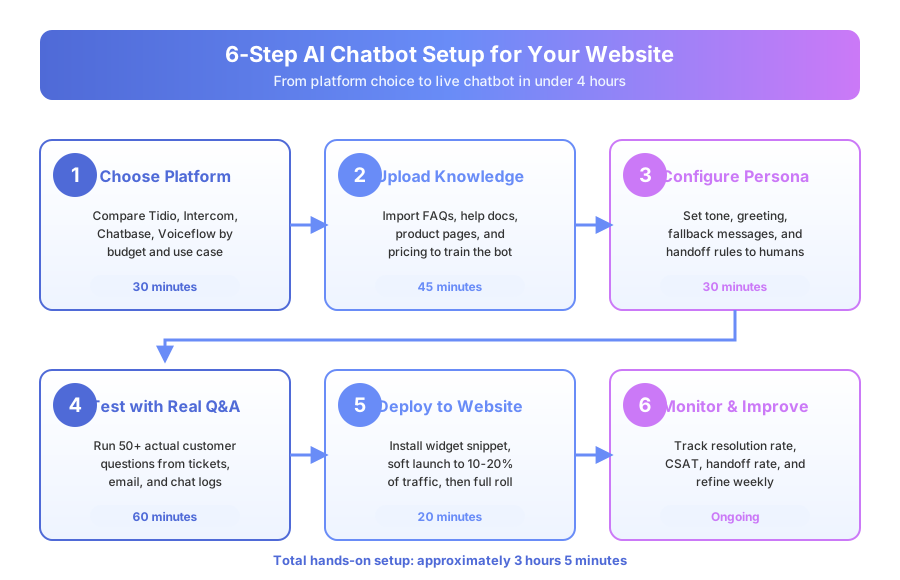
What kind of chatbot should you pick for your website?
Pick a hybrid bot that combines rule-based flows with an AI model trained on your knowledge base. Rule-only bots break when customers rephrase. Pure AI bots sometimes hallucinate. Hybrid setups handle common questions with AI retrieval and route edge cases to a human.
There are three categories. Rule-based bots follow scripted decision trees. AI-powered bots use large language models like OpenAI GPT-4o or Anthropic Claude to parse natural language. Hybrid bots combine both, using structured flows for ordering or booking and AI for open-ended questions.
For most small businesses in 2026, hybrid wins. According to Zendesk’s 2025 CX Benchmark, companies using AI-assisted support saw a 15% lift in resolution rates and an 11% drop in churn. For a SaaS company with 3,000 users, that’s hundreds of retained customers per year.
One quick decision rule: if your support volume is under 100 conversations per month, start with a free or freemium plan. If you’re above 500, jump straight to a platform with per-resolution pricing so costs track outcomes, not seats.
Which chatbot platforms work best for small teams?
Tidio and Crisp cover free and startup tiers. Intercom Fin wins for SaaS with per-resolution pricing. Drift fits enterprise B2B sales. Chatbase is the fastest no-code option, and Voiceflow or Botpress give agencies full LLM control without coding.
For a deeper feature breakdown, our guide to the best AI chatbot builders for small business ranks platforms by use case and budget. Here’s what we’ve seen across actual client deployments.
| Platform | Starting Price | AI Model | Integrations | Best For |
|---|---|---|---|---|
| Tidio | Free (100 convos) | Tidio AI + OpenAI | Shopify, WordPress, HubSpot | E-commerce, small sites |
| Intercom Fin | $0.99/resolution | OpenAI GPT-4o | Salesforce, HubSpot, Zendesk | SaaS, mid-market |
| Drift | $2,500/month | Proprietary | Salesforce, Marketo, HubSpot | Enterprise B2B sales |
| Crisp | Free (2 seats) | MagicReply AI | Slack, WordPress, Shopify | Startups, budget teams |
| Zendesk AI | $55/agent/month | Proprietary + OpenAI | 1,200+ apps | Existing Zendesk users |
| Chatbase | $40/month | OpenAI GPT-4o, Claude | Zapier, API, webhooks | No-code knowledge bots |
| Voiceflow | Free (sandbox) | Any LLM (OpenAI, Claude) | API-based, flexible | Custom bot builders |
| Botpress | Free (self-hosted) | OpenAI, custom LLMs | REST APIs, webhooks | Developers, agencies |
If you run under 1,000 monthly visitors, Tidio or Crisp gets you live free. Above 3,000 active users, Intercom Fin’s per-resolution pricing means you only pay when the bot solves something. According to MuleSoft’s 2023 Connectivity Benchmark Report, the average enterprise uses 1,061 applications, so integration depth matters more than most teams realize.
How do you train a chatbot on your knowledge base?
Gather every FAQ page, help article, and product document. Upload them through the platform’s knowledge importer or point the bot at your help center URL. Then test with 50+ real customer questions pulled from your actual support tickets, not questions you make up yourself.
This is where 80% of chatbot projects succeed or fail. A bot without proper training is just a fancy search bar. Training means feeding it your real content so it can answer real questions accurately.
Step 1: Gather your content. Collect every FAQ page, help article, product doc, pricing page, and onboarding guide. Export as text, PDF, or HTML. Most platforms accept all three formats and handle embedding automatically.
Step 2: Upload to your platform. Intercom Fin, Tidio, Chatbase, and Voiceflow have knowledge base importers. Upload docs, point the bot at your help center URL, or connect it to Notion or Confluence. For a hands-on look at one of the most popular no-code platforms, see our Chatbase review for business use cases.
Step 3: Test with real questions. Don’t test with your own carefully worded queries. Pull actual questions from your email inbox, live chat history, and support tickets. Real customers ask things differently than you’d expect.
According to a Harvard Business Review study (Oldroyd, 2011; updated by Drift, 2023), responding to a lead within 5 minutes makes you 100x more likely to connect than waiting 30 minutes. A trained chatbot responds in under 2 seconds. That’s the speed advantage no human team can match.
How do you connect a chatbot to your CRM and database?
Use native integrations for HubSpot, Salesforce, or Intercom. For custom databases, call your API mid-conversation through Voiceflow, Botpress, or n8n. A connected bot sees plan, billing, and order history so it can answer personalized questions without asking customers for account numbers.
A chatbot that can’t look up customer data is limited to generic answers. Wiring it into your CRM or backend turns it into a personalized assistant that already knows who’s asking.
For Intercom Fin: Native CRM integration pulls customer data automatically. The bot sees plan type, purchase history, and previous conversations without any setup beyond connecting the account.
For Tidio: Built-in integrations for HubSpot and Salesforce sync customer properties in real time. You can use merge tags like {{customer.plan}} inside bot responses.
For custom setups: Voiceflow, Botpress, and n8n use API calls to query your database mid-conversation. When a user asks “What’s my order status?”, the bot calls your API, pulls the data, and returns a specific answer.
KwikUI connected their chatbot to their user database. When a customer asked about their account, the bot already knew their plan, usage stats, and billing status. No “Can you give me your account number?” back-and-forth. The result: 65% of support tickets resolved automatically. Two founders. Zero dedicated support staff. Over 3,000 active users supported.
How should you set up handoff to human agents?
Define handoff triggers: customer asks for a human, bot confidence drops below 70%, billing disputes, or repeated frustration. Route to the right person by tag, not a shared inbox. Always pass the full conversation transcript. Salesforce’s 2024 State of Service Report found 72% of customers expect agents to already know their issue.
Define handoff triggers. Set specific conditions: the customer asks to speak to a human, the bot’s confidence drops below 70%, the conversation hits a billing dispute, or frustration is detected twice. Most platforms (Intercom, Zendesk, Tidio, Chatbase) let you configure these rules visually.
Route to the right person. Don’t dump every escalation into a single inbox. Route billing to your finance person, technical issues to engineering, and sales inquiries to your closer. n8n and Make automate this routing based on conversation tags.
Preserve context. The handoff must include the full transcript. Nothing kills trust faster than repeating yourself. Intercom Fin and Zendesk handle this natively. For Botpress or Voiceflow builds, pass the log through a webhook to your ticketing system.
KwikUI’s chatbot handles 65% of questions end-to-end. The remaining 35% route to one of two founders with full context attached. That’s how a 2-person team supports over 3,000 users without burning out.
How do you measure chatbot performance?
Track five metrics weekly for the first month: resolution rate, CSAT, handoff rate, average resolution time, and churn correlation. Industry average resolution sits at 40-50%, and well-trained bots hit 60-70%. Watch CSAT below 80% and retrain immediately.
Resolution rate. What percentage of conversations does the bot resolve without human intervention? Industry average is 40-50% per Zendesk’s 2025 CX Benchmark. Well-trained bots hit 60-70%. KwikUI reached 65% within their first quarter.
Customer satisfaction (CSAT). Add a thumbs-up/down after each bot interaction. If CSAT drops below 80%, your training data needs updating.
Handoff rate. How often does the bot escalate? A decreasing handoff rate over time means the bot is learning from added content.
Average resolution time. Bot-resolved conversations should close in under 2 minutes. Human-assisted chats that started with the bot should still resolve faster than fully human ones because the bot pre-qualifies and gathers context.
Churn correlation. Zendesk’s 2025 CX Benchmark found a 15% lift in AI-assisted resolutions correlates with an 11% reduction in churn. Track churn before and after deployment to confirm the pattern holds for your business.
According to Forrester’s 2024 Total Economic Impact studies, the average ROI on business process automation is 200% within the first year. Chatbots are one of the fastest paths there because they cut support costs while improving response speed simultaneously.
What mistakes should you avoid when deploying a chatbot?
Don’t skip testing with real customer questions, don’t use “I don’t understand” as a fallback, don’t hide the human option, and don’t set it and forget it. Review unanswered questions weekly and feed them back into your knowledge base so the bot improves every week.
I’ve watched the same five mistakes sink chatbot projects. Avoiding them saves weeks of frustration.
Mistake 1: Going live without testing. Test with 50+ real customer questions from actual tickets and emails, not your own carefully worded queries.
Mistake 2: No fallback message. “I don’t understand” is unacceptable. Set a fallback like “I’m not sure about that. Let me connect you with someone who can help” and trigger handoff.
Mistake 3: Hiding the human option. Some teams bury the “talk to a person” option to inflate bot resolution stats. This backfires. Customers who can’t reach a human leave.
Mistake 4: Set it and forget it. Review unanswered questions weekly. Every gap is a training opportunity. Add the correct answer to your knowledge base and the bot gets smarter.
Mistake 5: No personalization. Generic bots feel robotic. Connect to your CRM so the bot greets returning customers by name. According to McKinsey’s 2024 Global Survey on AI and Automation, 60% of all occupations have tasks that benefit from AI personalization, and customer support is near the top.
What does a complete 4-week deployment plan look like?
Week 1 covers platform choice and content upload. Week 2 handles CRM integration and testing. Week 3 is a soft launch to 10-20% of traffic. Week 4 is full rollout with weekly reporting. Budget around 3 hours of hands-on work in week 1 and 2-4 hours weekly after launch.
Week 1: Platform and content. Choose your platform using the table above. Export your knowledge base. Upload documents and connect your help center URL. Estimated work: 2 hours.
Week 2: Integration and training. Connect to HubSpot, Salesforce, or your custom database. Test 50+ real questions. Refine answers. Set up handoff rules and routing logic. Estimated work: 3 hours.
Week 3: Soft launch. Deploy to 10-20% of traffic. Monitor resolution rate, CSAT, and handoff rate daily. Fix gaps in training data. Estimated work: 1 hour daily.
Week 4: Full deployment. Roll out to 100% of traffic. Set up weekly reporting. Schedule monthly knowledge base reviews. Estimated work: 2 hours setup, 1 hour weekly afterward.
Thompson Career College followed this timeline. They went from 1-2 business day response times to under 60 seconds. Admissions inquiries that sat unanswered for hours now get instant, accurate replies. The result: 300+ additional inquiries handled, admissions calls tripled, and 80% of routine questions resolved without human involvement.
That’s the difference between installing a chatbot widget and building a chatbot system. The widget is a button. The system is an engine that runs your support operation around the clock, learns from every conversation, and only asks for help when it genuinely needs a human.
If your chatbot needs extend to full customer support, our comparison of Intercom, Zendesk, and Tidio evaluates these platforms as complete support stacks beyond just chatbots.
You don’t need a developer for this. You need a clear knowledge base, the right platform, and 2-3 weeks of focused setup. The tools are ready. The question is whether you’re still making customers wait.
Ready to deploy a chatbot that resolves 60-70% of your support questions without hiring? Get in touch with our team and we’ll map your knowledge base, pick the right platform, and have your bot live within two weeks.