Small business marketing teams using AI in 2026 recover 12-18 hours per week, according to Gartner’s 2026 AI Marketing Benchmark published in February. The catch: those savings only show up when humans edit AI output. Teams that publish raw AI drafts see engagement drop 3.4x compared to edited content, and the extra rework wipes out most of the time savings.
This guide covers the five AI marketing workflows that actually save time for small teams in 2026, the stack that delivers those savings for $80-180 per month, and the traps that still catch small businesses buying the hype.
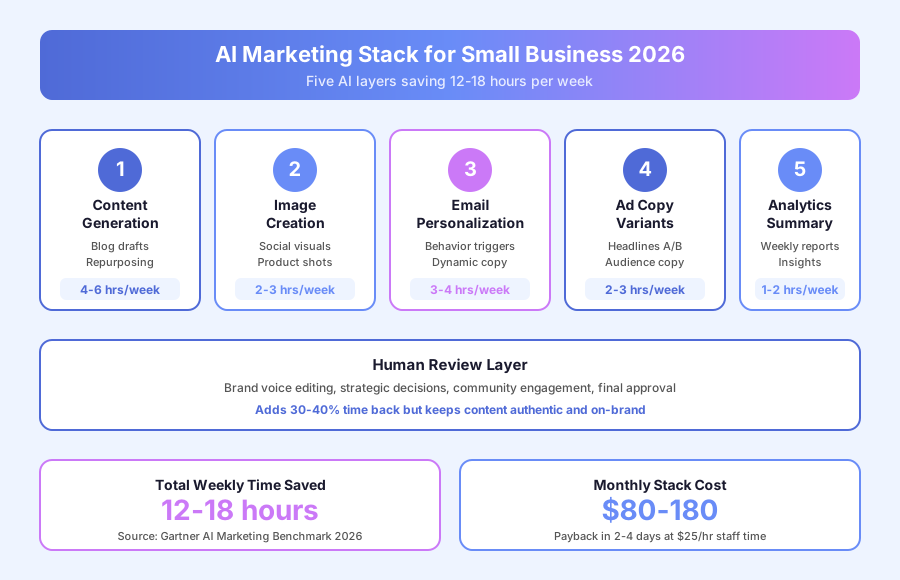
What AI marketing workflows are saving the most time in 2026?
Five workflows dominate the time-savings data: content first drafts, image creation, email personalization, ad copy variants, and analytics summaries. Together they recover 12-18 hours per week for a typical one-to-two-person marketing team. The common thread is narrow, repetitive work where AI produces a draft and a human refines it.
How much time does each workflow save?
The Gartner 2026 benchmark broke down time savings by workflow across 1,400 small business marketing teams surveyed between October 2025 and January 2026.
| Workflow | Hours saved/week | Primary tools |
|---|---|---|
| Content first drafts | 4-6 | Claude, ChatGPT, Jasper |
| Image creation | 2-3 | Midjourney, Ideogram, Canva Magic |
| Email personalization | 3-4 | Klaviyo, ActiveCampaign |
| Ad copy variants | 2-3 | ChatGPT, AdCreative.ai |
| Analytics summaries | 1-2 | Fathom, GA4 Insights |
Content drafting saves the most hours because writing is the single biggest time sink for small marketing teams. Image creation saves less time per week but unlocks work that didn’t happen before, because design used to require freelancer coordination.
Why do AI content drafts save 4-6 hours per week?
AI cuts blog and long-form content production time by roughly 60% when a human edits the output. A 1,500-word post that took 3 hours now takes 60-75 minutes. Editing is still required for voice, accuracy, and original examples, but the blank page problem disappears and most structural work moves into the prompt phase.
What does the AI drafting process look like in practice?
The workflow that delivers consistent savings has three steps: outline, draft, edit.
Outline: Feed the AI your target audience, keyword, angle, and three to five examples of your past top-performing posts. The AI returns a structured outline with H2s, key points, and data references. This takes 5 minutes.
Draft: Ask the AI to expand the outline into a full draft using your house style rules. The draft arrives in 2-3 minutes and covers 80% of the structure you need.
Edit: A human edits for voice, adds original examples, verifies every data point, and cuts generic filler. This takes 40-50 minutes. According to HubSpot’s State of Marketing 2026 report, teams that skip the editing step see a 58% drop in organic engagement compared to teams that edit.
The editing bottleneck is real. The rewrite tax is why AI content savings are 60%, not 95%.
How does AI image creation fit into a small business stack?
AI image tools like Midjourney, Ideogram, and Canva’s Magic Studio generate social visuals, blog hero images, and product mockups in seconds. They save 2-3 hours per week for teams that previously relied on stock photos or freelance designers. The limitation is brand consistency, which still requires a human to enforce style guidelines across outputs.
Which AI image tools work best for small business marketing?
Different tools win at different jobs in 2026. No single tool covers every use case.
- Midjourney v7: Best for hero images and conceptual visuals. $10-30/month.
- Ideogram 3.0: Best for images with readable text like quote cards and infographics. $8-20/month.
- Canva Magic Studio: Best for on-brand social graphics with templates. $15/month.
- Adobe Firefly: Best for commercial-safe imagery when licensing matters. $5-23/month.
According to Canva’s 2025 Design Trends report, 68% of small business marketers now use AI images for at least half their social content, up from 23% in 2024. The quality gap that made AI images obvious in 2023 has mostly closed, except for images featuring human hands and product packaging with legible logos.
Why is AI email personalization the highest-value automation?
AI email tools drive 35-55% higher open rates and 2-3x click-through rates within 90 days, according to Klaviyo’s 2025 benchmark report. The value comes from two capabilities small teams couldn’t run manually: behavioral triggering and per-contact content personalization. Both turn a 500-contact list into a meaningful revenue channel without adding staff hours.
How do behavioral triggers change small business email?
Traditional small business email is scheduled: a newsletter goes out every Thursday to everyone. Behavioral email sends based on what each contact does. Someone who visits the pricing page three times this week gets a different email from someone who hasn’t opened anything in 60 days.
Klaviyo’s 2025 data shows behavioral sequences generate 4.7x more revenue per send than scheduled broadcasts for ecommerce, and 2.1x more for B2B services. Setup takes 2-4 hours per sequence but runs indefinitely after that.
For a deeper comparison of email platforms, see our Klaviyo vs ActiveCampaign vs Mailchimp breakdown.
What content personalization actually works?
AI personalizes three things reliably: subject lines (tested per segment), product recommendations (based on purchase or browsing history), and paragraph-level copy (swapped based on industry or lifecycle stage). Name substitution is table stakes and doesn’t move metrics anymore.
The teams getting the biggest lifts treat personalization as segmentation first, AI second. AI generates the copy variants, but a human decides which segments matter. A 2026 Litmus study of 3,200 senders found segmented-plus-AI-personalized emails outperformed AI-only personalization by 41% on click-through.
How much does a working AI marketing stack cost in 2026?
A complete stack runs $80-180 per month for a small business marketing one or two products. The range depends on email list size and whether you need commercial image licensing. Compared to the 12-18 hours per week the stack recovers at $25-40 per hour in staff time, payback takes 2-4 days. After that, the stack is pure time savings.
What’s in the reference stack?
| Tool | Role | Monthly cost |
|---|---|---|
| Claude Pro or ChatGPT Plus | Drafts, repurposing, email copy | $20 |
| Klaviyo or ActiveCampaign | Email automation with AI | $30-80 |
| Buffer AI or Later | Social scheduling and captions | $15-25 |
| Midjourney or Ideogram | Visual content | $10-30 |
| Fathom | Meeting-to-content capture | Free |
| Total | $75-155 |
Add AdCreative.ai ($21-29) if you’re running paid ads, and the upper bound moves to $180. Need a CRM underneath all this? Our best CRM for small business guide covers the options that integrate cleanly with this stack.
What AI marketing claims are still overhyped in 2026?
Three categories still disappoint small business buyers: fully autonomous social media, zero-edit content platforms, and AI strategy tools. These products pitch themselves as replacements for marketing labor but deliver work that still needs human rework. Buying them costs more in rework time than they save in drafting time.
Why autonomous social media doesn’t work
Fully autonomous social tools promise to generate, schedule, and publish content without human review. In practice, they post generic AI content that underperforms against your manually-posted content by 40-60% on engagement, according to Buffer’s 2026 Social Trends Report. They also miss trends, miss brand tone shifts, and occasionally post content that requires deletion.
The working model is assisted, not autonomous. AI drafts, a human approves, the platform publishes.
What AI strategy tools promise vs deliver
Tools that claim to produce “AI-powered marketing strategy” mostly generate generic playbooks you could find in any marketing textbook. They can’t understand your specific customers, your local market, or why your Tuesday morning posts outperform your Friday posts. Strategic thinking remains a human task. AI tools support execution.
How should a small business roll out AI marketing tools?
Start with one tool, learn it thoroughly, then add the next. The single biggest reason small teams abandon AI marketing stacks is adopting five tools in one month and half-configuring all of them. A staggered 4-6 week rollout lets each tool integrate into real workflows before the next arrives.
What’s the recommended rollout sequence?
Weeks 1-2: Writing tool. Add Claude Pro or ChatGPT Plus. Use it for every piece of content you produce. Learn what prompts match your brand voice. Our AI prompts for business guide covers the patterns that work.
Weeks 3-4: Email automation. Pick one sequence (welcome series or post-purchase) and launch it. Measure open rates and clicks against your previous manual emails. Add a second sequence only after the first runs cleanly.
Weeks 5-6: Social and images. Add social scheduling with AI captions and an image tool that fits your content needs. Review every scheduled post before publish for the first month.
By week 7, the stack is running. By month 3, it’s saving 12-18 hours per week. Teams that compress this into two weeks typically lose 3-4 months to tool fatigue before trying again.
For related reading, see our articles on the small business AI stack and how to automate follow-up sequences.
Ready to build your AI marketing stack?
The tools are cheap. The time savings are real. The trap is implementation speed. Small teams that win with AI marketing in 2026 treat it as incremental tooling, not a replacement for marketing labor. They edit every draft, review every scheduled post, and keep humans in charge of strategy and community.
Book a free automation audit and we’ll map your current marketing workflow, flag where AI tools would save the most hours, and recommend the exact stack for your content volume and team size.