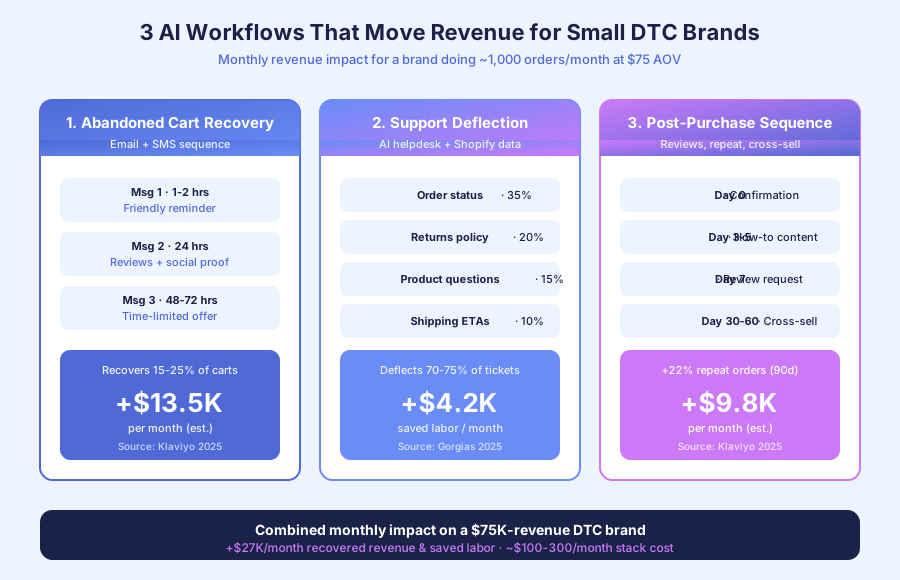
A 3-person DTC brand pulling $75,000 per month on Shopify is leaving roughly $27,000 per month on the table if they haven’t shipped three specific AI workflows. According to Klaviyo’s 2025 E-commerce Benchmark Report, automated cart recovery sequences win back 15-25% of abandoned carts, post-purchase sequences drive 22% more repeat orders within 90 days, and Gorgias’s 2025 customer data shows AI support deflects 70-75% of common tickets. Together these three workflows typically lift revenue 20-30% from the same traffic, with no new ad spend. The stack to run them costs $100-300/month. Here’s exactly what works, what doesn’t, and what to build first.
Why do most DTC brands leave money on the table?
Most small DTC brands lose revenue in three predictable places: abandoned carts, repetitive support tickets, and single-purchase customers who never come back. Each gap is small on its own, but together they bleed 20-30% of potential revenue every month. AI workflows close all three without new ad spend.
The numbers are brutal and well-documented. Baymard Institute’s 2025 cart abandonment research pegs the average e-commerce cart abandonment rate at 70.19% across 48 studies. For every 100 shoppers who add to cart, 70 walk away. Klaviyo’s 2025 Benchmark Report shows the average small DTC brand handles 150-200 support tickets per 1,000 orders, and only 28% of first-time buyers return within 90 days without a post-purchase sequence in place.
That’s the starting point. It’s also the opportunity.
What’s the biggest revenue leak: abandoned carts?
Yes. Cart abandonment is the single largest recoverable revenue leak for most small DTC brands. Baymard Institute’s 2025 data puts the average rate at 70.19%. Automated recovery sequences win back 15-25% of those carts according to Klaviyo’s 2025 Benchmark Report, which for a typical small brand translates to $11K-$19K per month in recovered revenue.
Here’s what the math looks like for a $75K/month brand:
| Metric | Value | Source |
|---|---|---|
| Monthly sessions | ~15,000 | Shopify benchmark |
| Added to cart | ~1,500 (10%) | Industry average |
| Abandoned | ~1,050 (70%) | Baymard 2025 |
| Recoverable at 20% | 210 orders | Klaviyo 2025 |
| Avg order value | $75 | DTC benchmark |
| Monthly revenue recovered | ~$15,750 | Calculation |
That’s revenue from shoppers who already wanted to buy. They got distracted, had a sizing question, or hit a shipping cost that made them pause. A well-timed sequence brings them back.
How does a high-converting cart recovery sequence work?
A three-message sequence covers the three reasons shoppers abandon: distraction, hesitation, and price sensitivity. Message 1 is a gentle reminder 1-2 hours after abandonment. Message 2 adds social proof at 24 hours. Message 3 offers a time-limited discount at 48-72 hours, but only to shoppers who didn’t convert from the first two.
Message 1: The reminder (1-2 hours)
Goal: catch the shopper who was interrupted. Content: their cart items with product images, a one-click link back to checkout, and a simple “you left something behind” message. No pressure. No discount. This message alone converts 40-50% of recoverable carts per Klaviyo’s 2025 data, because most abandoners were just distracted.
Message 2: Social proof (24 hours)
Goal: convert the shopper who was hesitating. Content: reviews and star ratings for the exact items left behind, bestseller tags where applicable, and a free-shipping reminder. Still no discount. This addresses the “is it worth it?” hesitation without training customers to wait for a sale.
Message 3: The incentive (48-72 hours, optional)
Goal: close the price-sensitive holdouts. Content: a 10-15% discount or free shipping, expiring in 24-48 hours. Only sent to non-converters from messages 1 and 2. Used sparingly so regular buyers don’t game the sequence. Klaviyo’s 2025 benchmarks show brands that skip discounts in messages 1-2 hold 18% higher margins on recovered orders.
Can AI really handle 70% of customer support?
Yes, for structured questions that pull from Shopify data. Gorgias’s 2025 customer data shows AI helpdesks deflect 70-75% of typical e-commerce tickets when connected to order data and a policy knowledge base. The deflected tickets are order status, returns, product specs, and shipping estimates. Humans still handle complaints, damaged goods, and judgment calls.
Here’s the ticket distribution for a typical $75K/month DTC brand, drawn from Gorgias’s 2025 benchmark data across 10,000+ Shopify stores:
| Ticket Type | % of Volume | AI-handled? |
|---|---|---|
| Order status / tracking | 35% | Yes |
| Returns and exchanges | 20% | Yes |
| Product / sizing questions | 15% | Yes |
| Shipping estimates | 10% | Yes |
| Discount code issues | 5% | Yes |
| Complaints / damaged items | 10% | Human |
| Other / judgment calls | 5% | Human |
A support automation connected to Shopify handles the first five categories without staff involvement. The customer gets answers in seconds, not hours. The remaining 15% reaches a human with the full order context already attached, so the human spends 2-3 minutes resolving what used to take 10-15.
The operational impact is real. A 3-person brand overwhelmed at $75K/month can scale to $150K-$200K/month without a dedicated support hire, freeing two roles for product and growth work instead of answering “where’s my order?” for the hundredth time.
What does a post-purchase sequence look like?
A post-purchase sequence is a timed series of messages sent after someone buys, designed to drive reviews, repeat orders, and referrals. The 6-message structure runs from day 0 to day 60. Klaviyo’s 2025 data shows brands running a full post-purchase sequence generate 22% more repeat orders within 90 days compared to brands that don’t.
The 6-stage post-purchase flow
- Day 0, immediately post-purchase: Order confirmation with tracking, delivery expectations, and a personal note from the founder
- Day of estimated delivery: “Your order should arrive today” message with what to do if it doesn’t show up
- Day 3-5 post-delivery: How-to content, styling guide, or setup instructions for the product category
- Day 7: Review request with a direct link and a small incentive (loyalty points, not a discount)
- Day 30: Repurchase reminder for consumables, or cross-sell recommendation based on purchase history
- Day 60-90: Win-back for lapsed buyers, often with a loyalty reward or exclusive offer
Repeat customers are 5x cheaper to acquire than new ones and spend 67% more per order according to Adobe Digital Insights 2025. That’s the lever a post-purchase sequence pulls, systematically, for every single buyer.
Why the order matters
Sequence timing is load-bearing. Review requests sent too early (day 1-2) arrive before the product has been used and generate shallow reviews. Requests sent too late (day 14+) miss the peak satisfaction window. Klaviyo’s 2025 data shows day 7 is the sweet spot for review requests, delivering 3.2x the response rate of day-1 requests and 2.1x the response rate of day-14 requests.
Cross-sell timing follows the same logic. Day 30 lets the first purchase sink in without feeling pushy. Day 60-90 reactivates customers before they drift to competitors.
What AI stack does a small DTC brand actually need?
The minimum viable stack for a small Shopify brand is three tools: Klaviyo for email and SMS ($45-150/month), Gorgias or Tidio for AI support ($30-90/month), and Make for custom workflows ($16/month). Total cost runs $91-256/month depending on list size and order volume. All three integrate natively with Shopify.
| Tool | Function | Monthly Cost |
|---|---|---|
| Klaviyo | Email + SMS: cart recovery, post-purchase flows — see our Klaviyo vs ActiveCampaign vs Mailchimp comparison | $45-150 |
| Gorgias or Tidio | AI support with Shopify order data — see our Intercom vs Zendesk vs Tidio comparison | $30-90 |
| Make | Custom workflows beyond platform defaults | $16 |
| Total | $91-256/month |
The cart recovery workflow alone typically covers the full stack cost within the first week of going live. Everything else is incremental margin on a cost that’s already paid for itself. If you’re sorting out your accounting stack at the same time, our QuickBooks vs Xero vs FreshBooks comparison covers the best fit for Shopify merchants.
Where does AI fall short for DTC brands?
AI struggles with brand voice at scale, editorial product recommendations, and emotional complaint handling. Raw AI-generated copy sounds generic without human editing. Recommendation engines handle broad patterns but miss curated style calls. Frustrated customers need a human, not a chatbot. The best brands use AI for drafts and automation, humans for voice and resolution.
Brand voice. AI email copy drifts toward generic “shop now” language without significant prompt engineering and editing. Top-performing brands use AI for first drafts and human review for tone. See our guide on how to write AI prompts that actually work for business for prompt patterns that preserve brand voice.
Editorial recommendations. AI recommendation engines like LimeSpot and Rebuy work well for “customers also bought” patterns. Curated recommendations that reflect a brand’s point of view on style, seasonality, or use case still need human merchandising judgment.
Complaint handling. A customer with a damaged item is frustrated and needs empathy. AI can draft a polite first response and classify the issue, but resolution and relationship repair require a human. Trying to automate this end-to-end generates bad reviews and refund requests that cost more than the labor saved.
How fast can a small brand actually ship this?
A motivated solo operator can ship cart recovery in a weekend, support automation in 1-2 weeks, and a full post-purchase sequence in 2-3 weeks. A complete build across all three workflows takes 4-6 weeks end-to-end. Most of the revenue impact lands in the first 30 days live, as soon as the sequences start firing on real customer behavior.
The sequencing matters. Ship cart recovery first because it has the shortest time-to-revenue. Support automation next, because it frees up your team’s time to work on everything else. Post-purchase last, because it requires the most content (how-to guides, review requests, cross-sell logic) and benefits from seeing real customer data first.
Track three numbers weekly: cart recovery rate (target: 15-25%), ticket deflection rate (target: 65-75%), and 90-day repeat purchase rate (target: +22% vs baseline). If any metric lags after 30 days, it’s usually a content problem, not a platform problem. Rewrite the messages, not the stack.
For deeper reading, see our case study on how a small e-commerce brand automated support and recovered 22% of abandoned carts and our guide on how to set up automated follow-up sequences that actually convert.
Ready to find the biggest revenue leak in your store?
Book a free automation audit and we’ll review your Shopify order data, support volume, and email flows, then identify the single workflow that moves the needle most for your brand. You’ll leave with a prioritized 30-day plan and an honest estimate of monthly revenue recovery, whether you work with us or build it yourself.