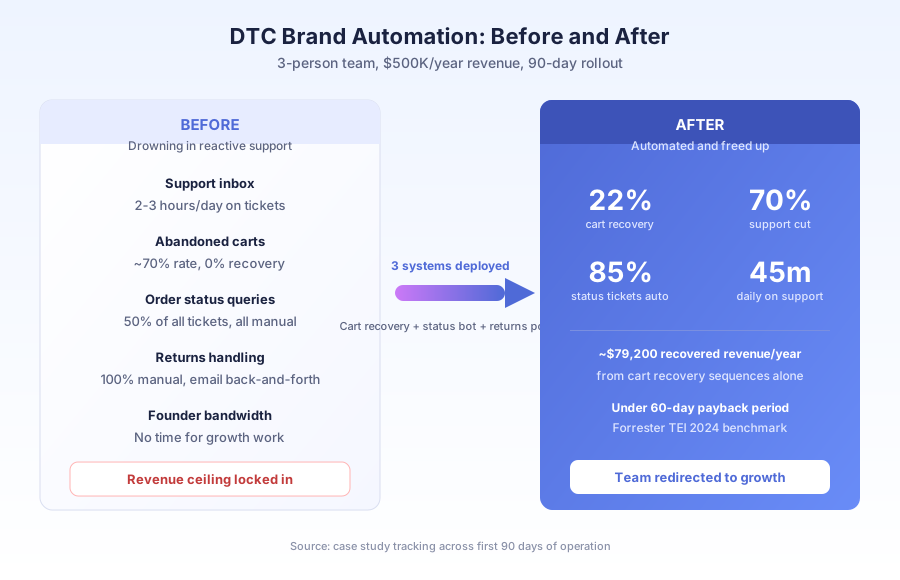
A 3-person DTC brand doing $500K in annual revenue recovered 22% of abandoned carts, cut support ticket volume by 70%, and automated 85% of order-status queries inside 90 days. The cart recovery sequence alone generated roughly $79,200 in annual revenue from traffic the team had already paid to acquire. Support hours dropped from 2-3 hours per day to under 45 minutes. This is the full breakdown of what they built, what it cost, and why the math works for any lean DTC team hitting the same wall.
What were the headline results after 90 days?
Answer capsule: Cart recovery moved from 0% to 22%, adding roughly $79,200 in annual revenue. Support tickets requiring a human dropped 70%. Order-status automation now handles 85% of tracking queries without human touch. Team time on reactive support fell from 2-3 hours per day to under 45 minutes, redirected entirely toward growth work.
The numbers below are tracked across the first 90 days of operation, measured against the 90 days prior to launch.
| Metric | Before | After | Change |
|---|---|---|---|
| Abandoned cart recovery rate | ~0% (no system) | 22% | +$6,600/mo revenue |
| Support tickets needing a human | 100% | ~30% | 70% automation |
| Order-status tickets handled by bot | 0% | 85% | Zero-touch status |
| Returns requiring manual handling | 100% | ~15% | Self-serve covers most |
| Team hours on reactive support | 2-3 hrs/day | Under 45 min/day | ~2 hrs/day reclaimed |
According to Forrester’s 2024 Total Economic Impact research on e-commerce automation, brands implementing cart recovery and automated service workflows typically see payback under 60 days. This brand hit payback in week 4.
Why did cart recovery alone generate $79,200 per year?
Answer capsule: The brand had roughly 400 cart abandonment events per month. At a $75 average order value, a 22% recovery rate translates to about 88 additional completed orders per month, or $6,600 monthly. Annualized, that’s $79,200 from customers the brand had already paid to acquire through paid and organic traffic.
The important framing: this revenue came from traffic the brand had already spent to acquire. The recovery sequences didn’t add new customers — they converted more of the visitors who had already reached checkout intent.
According to Klaviyo’s 2024 E-commerce Benchmarks, abandoned cart flows generate an average of $5.81 per recipient across the full sequence. For any brand with steady traffic and no recovery system in place, this sits among the most underused revenue levers in DTC.
The first email alone recovered roughly 12% of sequence entries. SMS at the 24-hour mark added another 6%. The discount-bearing final email picked up the remaining 4%. The compounding matters — removing any single message from the sequence would have cut total recovery by 25-50%.
What was the original scope of the problem?
Answer capsule: Two problems were compounding each other — a support inbox dominated by five repeat question types and a cart abandonment rate sitting at the industry average of 70% with zero recovery system. The founders were burning 2-3 hours daily on reactive work that required no specialized judgment.
Support volume broke down cleanly into categories. About 50% of incoming tickets were order-status inquiries: “Where is my order?” “When will it ship?” “My tracking isn’t updating.” Another 20% were return and exchange requests. The remaining 30% were the genuine product questions, complaints, and edge cases that actually required human attention.
The founders were answering all of it personally. The real 30% deserved real attention. The other 70% took just as much time but required no expertise — just the ability to look up a tracking number or forward a return label.
According to Baymard Institute’s 2024 research, the average e-commerce cart abandonment rate is 70.19%, and the most common reasons are non-purchase-intent browsing and friction at checkout from unexpected costs or account requirements. A meaningful slice of every brand’s abandoned carts represents customers who intended to buy but got interrupted — and those are the ones recoverable with the right sequence.
Why hadn’t they already fixed this with existing tools?
Answer capsule: Both problems had obvious solutions — cart recovery emails exist in every major ESP and status bots exist for Shopify. The blocker was time, not awareness. At $500K revenue with 3 people, every configuration task competes with everything else, and setup work kept getting deprioritized in favor of whatever was urgent that day.
This is the trap that keeps small DTC brands stuck at a growth ceiling. The tools that would free up time require time to set up. The revenue that would justify the investment hasn’t arrived yet because the team is too busy managing operations to chase growth. The setup kept slipping to “next week.”
The breakthrough was treating the automation build as a single 3-week project instead of parallel optimization work. Blocking 22 hours across three weeks and committing to shipping all three systems forced the prioritization conversation the team had been avoiding for months.
What three systems did the brand actually deploy?
Answer capsule: Three automation layers now handle the pattern-based work. An abandoned cart recovery sequence combines email and SMS across 72 hours. An order-status bot connects to Shopify and the shipping integration for zero-touch tracking responses. A self-serve returns portal handles the returns process end-to-end without team involvement.
How does the cart recovery sequence work?
Answer capsule: The recovery sequence sends three messages across 72 hours. Email one arrives one hour after abandonment with a product reminder and no discount. SMS two arrives at 24 hours with a conversational nudge. Email three arrives at 72 hours with a 10% discount code and a clear expiration. Combined recovery rate: 22%.
The full sequence:
-
1 hour after abandonment — Email. Subject references the specific product (“Still thinking about [product name]?”). Body shows the product photo, cart summary, and one button to complete checkout. No discount yet — this message is framed as a helpful reminder, not a sales pitch.
-
24 hours after abandonment — SMS. Short and conversational: “Hey — you left something in your cart. Still interested? [link]” The SMS channel plus the 24-hour gap catches customers who never opened the first email.
-
72 hours after abandonment — Email with offer. Final message carries a 10% discount code with expiration. Subject creates urgency without pressure (“Your cart is expiring + 10% off if you’re still interested”).
Exclusions matter: Customers who completed a purchase after abandoning are removed from the sequence automatically. Opt-outs only receive transactional messages. Products that went out of stock during the recovery window aren’t featured in later messages.
How does the order-status bot work?
Answer capsule: The bot connects to Shopify and the shipping integration to read real-time tracking data. When a customer submits a support request, the system checks for status keywords, matches their email or order number to the shipping record, and returns the current status and tracking link automatically — handling 85% of status queries without human touch.
The routing logic:
- Customer submits a support request via email or chat widget
- System checks whether the message contains order-status signals (order number, “tracking,” “shipping,” “where is my”)
- If order-status inquiry: system looks up the order by email or order number, pulls current tracking status, and responds automatically with the status and link
- If returns inquiry: system responds with the returns portal link and process instructions
- If neither: ticket routes to the team for human response
What the bot handles automatically: order confirmation inquiries, tracking link requests, delivery window questions, basic return initiation (routes to portal).
What escalates to the team: damaged or missing item reports, exchange requests requiring inventory checks, billing disputes, complaints requiring judgment or goodwill.
How does the self-serve returns portal work?
Answer capsule: The portal lets customers initiate returns without contacting the team. They enter their order number, select items, pick a return reason, and receive a return label instantly by email. Refunds trigger automatically when the package is scanned at the carrier. Only damaged items, out-of-window returns, and out-of-stock exchanges still reach a human.
- Customer accesses the portal from the support page or bot response
- Customer enters order number and selects items to return
- System validates the return is within window and the items are eligible
- Customer picks a reason from a structured list (changed mind, wrong size, defective, etc.)
- Return label generates automatically and emails to the customer
- Customer ships the item; tracking updates the return status
- Refund or exchange triggers automatically when the return scans at the carrier
The three escalation paths: items outside the return window (judgment call on goodwill exceptions), items reported as damaged (photo review required), and exchange requests where the desired variant is out of stock.
What did the rollout actually cost?
Answer capsule: Total active build time ran roughly 22 hours across three weeks. Software costs came in under $400/month for the full stack — Shopify, Klaviyo for email and SMS, the chatbot integration, and Loop Returns for the portal. Payback landed in week 4 from cart recovery revenue alone, well ahead of the Forrester 2024 TEI benchmark of 60 days.
| Build phase | Hours | Software |
|---|---|---|
| Cart recovery sequence (email + SMS) | 4 hrs | Klaviyo |
| Order-status bot + support routing | 10 hrs | Chatbot + Shopify integration |
| Self-serve returns portal + policy review | 8 hrs | Loop Returns |
The bulk of the monitoring time in weeks 5-12 went to tuning copy based on early open and conversion rates, adjusting the SMS send window after timezone data came in, and refining the bot’s fallback responses when customers asked questions outside its trained vocabulary.
What lessons apply to any small DTC brand?
Answer capsule: Three principles transferred cleanly. First, segment support by whether it requires judgment — that distinction is the difference between 100% manual and 30% manual. Second, cart recovery is the highest-ROI automation for any brand with traffic. Third, returns friction damages brand perception more than returns volume does, so make the self-serve path frictionless.
1. Segment support by whether it requires judgment. Most small brands treat every ticket as equivalent work. The line between “order status inquiry” (no judgment, answer sits in shipping data) and “damaged item complaint” (judgment required, response varies by situation) is exactly where automation belongs.
2. Cart recovery is the highest-ROI automation available. The revenue already exists — customers who found your site, found your product, and started checkout. Recovery captures a share of revenue from customers you’ve already paid to acquire. Setup runs 2-4 hours. Payback typically lands within the first month.
3. Returns friction damages brand perception more than returns volume. A smooth self-serve path builds trust. A clunky return process requiring multiple emails drives negative reviews. Making returns easy retains more customers than making returns difficult.
Could this stack work for your brand?
Answer capsule: Yes, if you’re on a major e-commerce platform (Shopify, WooCommerce, BigCommerce) with enough traffic to generate meaningful abandoned carts and support volume. The three-system stack scales cleanly from $150K to multi-million-dollar brands — only the integrations change, not the underlying structure.
For related reading, see the E-commerce Customer Support Automation Playbook and our guide to automating review collection and reputation management. For the email platform comparison referenced in this case study, see Klaviyo vs ActiveCampaign vs Mailchimp.
Book a free automation audit and we’ll map your support volume and cart abandonment data to identify the sequences with the fastest payback for your brand.