Two terms dominate every business technology conversation right now, and most teams use them interchangeably when they shouldn’t.
Generative AI and workflow automation solve different problems with different mechanics. Mixing them up leads to investing in the wrong layer first, missing the ROI you should have captured, or building something that breaks in ways a rule-based system never would.
McKinsey’s 2025 State of AI survey of more than 1,400 firms found that small and mid-sized companies report 3 to 5 times faster payback from workflow automation than from generative AI projects. That gap exists because most time losses in a 10 to 50 person business are rule-based, not language-based.
Here’s the clear distinction, and a framework for deciding which one your business needs first.
What is generative AI in plain terms?
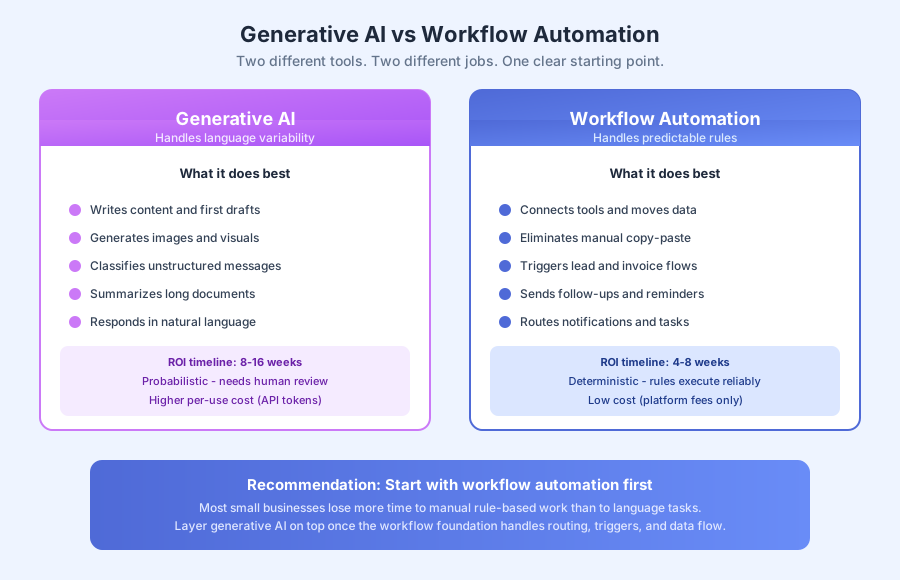
Generative AI is software that produces content (text, images, code, audio) and interprets natural language. It handles tasks where the input varies and the correct response depends on meaning, not a fixed rule. The output is probabilistic, so it needs oversight for anything customer-facing.
The business use cases are specific: drafting first-pass copy, answering customer questions in natural language, summarizing long documents, classifying unstructured text, and generating personalized emails at scale.
The defining characteristic is variability handling. Generative AI can understand what a customer means even when they phrase a question ten different ways. Rules can’t replicate that. Stanford’s 2025 AI Index reports that GPT-4 class models now handle intent classification on customer messages with 88 to 92 percent accuracy on open benchmarks, up from 74 percent in 2023.
The limitation is reliability. Generative AI produces the most likely next token, not a guaranteed correct answer. It can hallucinate, contradict itself, or miss edge cases that a deterministic system would catch immediately.
What is workflow automation in plain terms?
Workflow automation connects your tools and removes the manual steps between them. When something happens in one system, it triggers actions in another, no human needed. It’s deterministic: the same input always produces the same output, and it runs 24/7 without drift.
When a new lead fills out your form, workflow automation can at the same time add them to your CRM, send a welcome email, notify the right salesperson on Slack, and book an intro call on the calendar. All of that runs in seconds, every time.
The defining characteristic is predictability. Rules execute exactly. When X happens, do Y, reliably, without error. That’s a capability generative AI doesn’t match because AI is probabilistic by design.
The limitation is the flip side: workflow automation can’t handle variability. It can’t read a free-form support message and understand intent. It can’t adapt when a task falls outside its defined rules. Zapier’s 2025 Small Business Automation Report, surveying 2,800 SMBs, found that 78 percent of automated workflows run on pure rules with no AI component.
How do generative AI and workflow automation compare?
Both belong in a modern stack, but they’re built for different shaped problems. The table below captures the trade-offs across cost, speed, reliability, and ideal use cases, based on vendor documentation from OpenAI, Anthropic, Zapier, Make, and n8n as of Q1 2026.
| Dimension | Workflow Automation | Generative AI |
|---|---|---|
| Best for | Predictable, rule-based tasks | Variable, language-dependent tasks |
| Reliability | Very high, deterministic | Moderate, probabilistic, needs review |
| Cost to run | $20-$200/mo platform fees | $0.01-$0.06 per 1K tokens + platform |
| Speed to implement | 4-8 weeks per process | 8-16 weeks per process |
| Debugging | Straightforward, visual logs | Complex, requires eval frameworks |
| ROI timeline | 4-8 weeks | 8-16 weeks |
| Typical entry point | Lead routing, invoice flows, follow-ups | Message classification, draft generation |
According to McKinsey’s 2025 State of AI, 64 percent of SMBs that started with workflow automation went on to layer AI successfully within 12 months. Only 31 percent of SMBs that started with generative AI first reported reaching their original ROI targets in the same window.
Which one does your business actually need first?
The answer depends on where your biggest time losses live. Audit the last two weeks of team work and sort each repetitive task into one of two buckets: rule-based (predictable if-then logic) or language-based (requires understanding variable input). Whichever bucket is bigger tells you where to start.
Start with workflow automation if your team is doing this
Your team is doing manual work that follows predictable rules: copying data between systems, sending the same follow-up email to every new lead, updating CRM records after calls, or pulling spreadsheet data into weekly reports.
These tasks are fully eliminable with workflow automation. They don’t need AI. Adding AI to a process that could be handled with rules adds cost, complexity, and failure modes with no upside. Forrester’s 2025 automation benchmark puts the average time saved at 11 hours per employee per week once routine rule-based work is automated.
Typical workflow automation entry points:
- Lead form to CRM, welcome email, and sales notification
- New invoice to accounting system with payment reminders
- New customer to structured onboarding email sequence
- Meeting booked to calendar invite, prep note, and follow-up task
Start with generative AI if your team is doing this
Your team is spending significant time on language-dependent work: answering customer questions in natural language, reading and summarizing variable documents, or writing personalized responses at scale that rules can’t template.
Workflow automation can’t handle this. A rule-based system can’t read “I’m not sure if this is covered under my policy, can you help?” and understand it’s a billing question. Generative AI can, and 2025 benchmarks from HELM (Stanford’s holistic evaluation) show frontier models hit 89 percent accuracy on customer intent classification when prompted with a simple schema.
Typical generative AI entry points:
- Customer support message classification and reply drafting
- Lead qualification from unstructured inquiry text
- Document processing across variable formats
- Personalized follow-up email generation at scale
For most small businesses, start with workflow automation
The honest answer for most 10 to 50 person businesses: the bigger ROI lives in workflow automation, not generative AI.
Manual process gaps are more universal and more measurable than language-dependent tasks. Almost every small business has staff copying data between tools, sending follow-ups by hand, and doing repetitive admin that follows predictable rules. That work can be removed in weeks, not quarters.
Deloitte’s 2025 SMB Technology Pulse surveyed 1,200 businesses under 100 employees and found the median SMB has 14 to 22 hours of weekly manual rule-based work per five employees, against 3 to 6 hours of language-dependent work. The arithmetic is clear: start where the hours are.
Generative AI becomes valuable once the workflow foundation is in place. When routing, data transfer, and notifications are automated, AI earns its cost at the edges: the steps that genuinely need to understand natural language.
How do you combine workflow automation and generative AI?
The best implementations use workflow automation for structure and generative AI for language. Each layer stays in its lane, and the whole system stays debuggable. That’s the pattern most mature operators converge on within 12 to 18 months.
Example: a hybrid customer support system
- Workflow automation: new message arrives on any channel, routes to unified inbox, triggers classification step.
- Generative AI: classifies the message type using GPT-4 or Claude, checks the knowledge base.
- Workflow automation: if it’s a tier-1 question, send the automated response and log it in the CRM.
- Generative AI: if it’s a complex question, generate a response draft for human review.
- Workflow automation: route to the correct human with full context, trigger follow-up if no response within one hour.
The workflow handles reliable routing. The AI handles the language. Neither does the other’s job, which is why the system holds up in production.
Platforms like Make, n8n, and Zapier make this combination straightforward. You embed an AI step (a GPT call, a Claude call) inside a workflow as one node among many. If you’re choosing between the biggest options, our Make vs Zapier comparison covers where each excels. And if you’re new to building automations without code, our guide on what no-code AI means for business explains the landscape.
What’s a simple decision framework?
Three questions will tell you what to invest in first. Run them at a team standup, write the answers on a whiteboard, and the priority usually becomes obvious within 20 minutes.
1. What manual work takes the most staff time this week? List the specific tasks. Are they rule-based (if this, then that) or language-dependent (understanding variable input)?
2. What happens if you automate those tasks perfectly? Quantify the hours saved and the downstream business impact. Which task produces the bigger number when you do the math?
3. What can you put into production in 30 days with high confidence? Workflow automation rollouts are usually faster and more reliable than AI rollouts. If your team is already at capacity, the more reliable option often delivers more value per dollar.
For related context, see our article on What Is Business Process Automation and our guide on Automation vs AI vs RPA: what’s the difference.
What mistakes do small businesses make with this decision?
The most common mistake is buying generative AI before fixing the workflow layer. Teams read headlines about ChatGPT and assume AI is the answer, then discover six months in that their real bottleneck was a CRM that nobody updates because the input is manual.
The second mistake is the inverse: treating workflow automation as sufficient for tasks that genuinely need language understanding. A rule-based support triage can’t tell you what a customer actually means in a free-form message, and bolting on more rules only increases maintenance cost.
The third mistake is skipping measurement. Andreessen Horowitz’s 2025 enterprise AI report found that 42 percent of SMB AI projects launch without a baseline metric, which makes ROI impossible to prove at review time. Pick a metric before you pick a tool.
Ready to figure out which layer to build first?
Book a free automation audit and we’ll map where your biggest time losses are, sort them into rule-based and language-based buckets, and tell you whether workflow automation, generative AI, or a combination of both is the right first investment for your team.