Email automation can recover 6x more revenue per send than broadcast campaigns, according to Litmus’s 2025 Email Marketing Benchmark Report. But pick the wrong platform for your business model and you’ll spend months fighting the tool instead of using it. Klaviyo, ActiveCampaign, and Mailchimp are the three most common choices for growing businesses in 2026, and they’re built on fundamentally different assumptions about what email marketing is supposed to do.
The right choice depends almost entirely on what you sell and how you sell it. An e-commerce store has completely different needs than a B2B consultancy, and both look nothing like a newsletter publisher. Here’s an honest breakdown of which platform fits which business — without the affiliate-driven reviews you’ve probably already read.
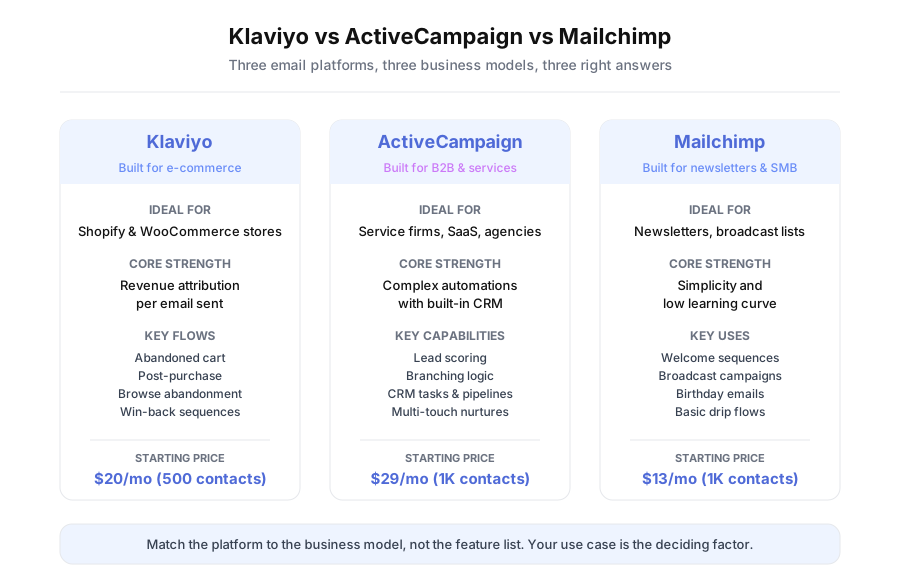
Which Email Platform Is Best for E-commerce?
Klaviyo is the clear winner for Shopify and WooCommerce stores. Its native integration pulls product data, order history, and browsing behavior into flows that other platforms can only approximate. Klaviyo’s 2025 benchmark data shows merchants using its flows attribute 20-30% of total store revenue to email.
The difference comes from data depth. When a customer browses a product on your Shopify store, Klaviyo knows the product ID, price, image, collection, and inventory status in real time. That data fuels emails with dynamic product blocks, personalized recommendations, and one-click return-to-cart links — all auto-generated.
ActiveCampaign can handle e-commerce through Zapier or Make, but the gap between “native integration” and “webhook-triggered workaround” shows up in every abandoned cart email. Mailchimp restored its Shopify integration in 2023, but it’s still roughly half the depth of Klaviyo’s.
If you sell physical products online, the decision is almost always Klaviyo.
Which Platform Is Best for B2B and Service Businesses?
ActiveCampaign wins for B2B, SaaS, agencies, and professional services. Its automation builder supports branching logic, lead scoring, CRM pipeline actions, and goal-based flow termination — capabilities that B2B nurture sequences depend on. According to ActiveCampaign’s 2025 customer data, service businesses average 12-18 automations per account versus 4-6 on Klaviyo.
B2B customer journeys span weeks to months across multiple touchpoints. You need to score engagement over time, move contacts between pipeline stages, assign tasks to sales reps, and branch flows based on behavior that hasn’t happened yet. ActiveCampaign treats all of this as table stakes.
Klaviyo’s e-commerce flows don’t translate well. Abandoned cart isn’t a concept for a consultancy selling $50,000 engagements. Lead scoring, tagging by behavior, and CRM integration are where the real B2B value lives.
For alternatives worth comparing, see GoHighLevel vs ActiveCampaign if you’re evaluating all-in-one CRM platforms.
How Do the Three Platforms Compare on Pricing?
Pricing diverges significantly as lists grow. Mailchimp is cheapest below 1,000 contacts, ActiveCampaign is most competitive at scale, and Klaviyo sits in the middle — but its revenue attribution typically justifies the premium for e-commerce. All three price based on contact count, not email volume.
Here’s what you’ll actually pay at common list sizes in 2026, based on published pricing pages as of March 2026:
| Platform | 1,000 contacts | 5,000 contacts | 10,000 contacts | 25,000 contacts |
|---|---|---|---|---|
| Mailchimp Essentials | $13/mo | $50/mo | $110/mo | $270/mo |
| ActiveCampaign Plus | $49/mo | $99/mo | $149/mo | $299/mo |
| Klaviyo | $45/mo | $100/mo | $150/mo | $400/mo |
The real cost isn’t the subscription — it’s the revenue you don’t capture. A Klaviyo user running abandoned cart recovery on a store doing $50K/month typically recovers 5-10% of abandonment revenue, or $2,500-$5,000/month. At that scale, the $100/month fee is irrelevant.
Mailchimp’s price advantage evaporates past 10,000 contacts. Its automation ceiling also shows up faster than most businesses expect.
How Does Automation Depth Differ Across the Three Platforms?
ActiveCampaign has the deepest automation builder. Klaviyo has the most polished e-commerce flows. Mailchimp’s Customer Journey builder handles simple welcome sequences and birthday emails but lacks branching logic, lead scoring, and deep behavioral triggers that complex nurture flows require.
What Can You Build in Mailchimp’s Customer Journey Builder?
Mailchimp’s automation handles the essentials: welcome sequences, birthday emails, post-purchase follow-ups via its Shopify integration, and date-based triggers. You can build multi-step flows with basic conditional logic, but you’ll hit a ceiling fast.
What’s missing: advanced branching based on multiple conditions, lead scoring tied to engagement history, goal-based flow termination, and behavioral triggers like “viewed this page three times.” If your automation strategy is “welcome new subscribers and send birthday discounts,” Mailchimp is fine. If it’s anything more ambitious, you’ll want Klaviyo or ActiveCampaign.
What Makes ActiveCampaign’s Automations So Powerful?
ActiveCampaign’s automation builder supports branching logic on any field, lead scoring that adjusts based on opens/clicks/site visits, goals that end automations when contacts convert, CRM task creation for sales follow-up, and conditional content within emails. According to G2’s 2025 user survey, ActiveCampaign scored 9.1/10 on automation capability — the highest in its category.
A typical B2B nurture might look like: new lead fills out a form, automation tags them by industry, sends three educational emails over 10 days, checks their lead score, and either routes to sales (high score) or enters a long-term nurture (low score). That entire flow is one automation in ActiveCampaign.
What Are Klaviyo’s Flows Best At?
Klaviyo’s Flows are purpose-built for e-commerce revenue recovery:
- Abandoned cart: triggers when a user adds to cart but doesn’t purchase, with the exact product auto-populated
- Browse abandonment: triggers when a user views a product three or more times without adding to cart
- Post-purchase: sequences timed to delivery date with product-specific upsells and review requests
- Win-back: triggers after 60-90 days of no purchase activity
- Price drop: triggers when a previously viewed product drops in price
Each flow is a pre-built template. You customize the content, adjust timing, and go live in under an hour. Revenue attribution is native — Klaviyo shows exactly how much each flow earned, not estimates. This is the feature Shopify merchants cite most often as their reason for choosing Klaviyo over cheaper options.
Which Platform Has the Best Deliverability?
All three platforms hit 95-98% inbox placement in 2025 according to Return Path’s deliverability benchmark. The differences between platforms are smaller than any of them claim. Your list hygiene, sender reputation, and authentication setup matter far more than which tool you pick.
Klaviyo automatically suppresses unengaged contacts to protect sender scores. ActiveCampaign runs built-in spam tests on every campaign before sending. Mailchimp has the strongest automatic list hygiene but has had reputation issues with certain send patterns historically.
Here’s what actually drives deliverability regardless of platform:
- Domain authentication: SPF, DKIM, and DMARC records configured correctly
- List quality: remove non-openers after 60-90 days
- Send consistency: avoid month-long gaps followed by mass sends
- Engagement focus: send to your most engaged segments first on major campaigns
For small businesses, deliverability is rarely the deciding factor between these three. Pick the platform that matches your business model and invest the time you’d spend on deliverability comparisons into list hygiene instead.
How Do CRM and Tool Integrations Compare?
Klaviyo leads on e-commerce integrations, ActiveCampaign leads on CRM and sales tool integrations, and Mailchimp is middle-of-the-road on both. The integration you actually need should drive the decision — native connections save hours of Zapier configuration and fewer data sync failures.
| Integration | Klaviyo | ActiveCampaign | Mailchimp |
|---|---|---|---|
| Shopify | Native (deep) | Via Zapier/Make | Native (basic) |
| WooCommerce | Native | Via Zapier/Make | Native (basic) |
| HubSpot CRM | Via Zapier/Make | Native | Via Zapier/Make |
| Salesforce | Via Zapier/Make | Native | Native (basic) |
| Pipedrive | Via Zapier/Make | Native | Via Zapier/Make |
| SMS (built-in) | Yes | Yes (add-on) | No |
| Facebook Ads audiences | Native | Native | Native |
Klaviyo’s Shopify integration pulls 100+ data points per customer — every product viewed, every cart, every order, every discount used. ActiveCampaign’s Salesforce and HubSpot integrations sync contacts, deals, and activity bidirectionally with under 5-minute delays. Mailchimp’s integrations generally work but lack the depth that drives power-user automations.
When Should You Switch Platforms?
Switch when your automation ceiling is costing you revenue, when you outgrow your current platform’s e-commerce or CRM integrations, or when a 30-60 day migration will pay for itself within 90 days through better-performing flows. Most Mailchimp users migrate out within 18-24 months as their automation needs evolve.
A few clear signals it’s time to move:
- Revenue ceiling: you can’t tell which emails generated what revenue
- Automation friction: building your desired flow takes a dozen workarounds
- Integration gaps: you’re running Zapier to patch missing native connections
- Cost per performance: cheaper platform is costing more in lost automation revenue
Migration effort scales with list size and automation complexity. A 2,000-contact list with three welcome sequences migrates in a day. A 50,000-contact list with lead scoring, tagged segments, and 15 automations is a 3-5 day project even with vendor support.
For related reading, see AI for Small Business Marketing: What’s Actually Saving Time in 2026 and How to Set Up Automated Follow-Up Sequences That Actually Convert.
Which Email Platform Should You Actually Choose?
Choose Klaviyo if you run an e-commerce store on Shopify or WooCommerce. Choose ActiveCampaign if you run a B2B service business, agency, or SaaS with complex customer journeys. Choose Mailchimp if you primarily send newsletters and broadcasts without behavioral automation needs. The decision is almost entirely about business model, not features.
Here’s the short version of when each makes sense:
Pick Klaviyo when:
- You sell physical products through Shopify or WooCommerce
- Abandoned cart, post-purchase, and win-back flows are your primary automation needs
- You need per-email revenue attribution tied to actual orders
- Dynamic product content in emails matters
Pick ActiveCampaign when:
- You run a B2B service business, agency, consultancy, or SaaS
- Your sequences require branching logic, lead scoring, and CRM actions
- Customer journeys span weeks to months with multiple touchpoints
- You want email and basic CRM in one platform
Pick Mailchimp when:
- You send newsletters and broadcasts more than behavioral sequences
- Simplicity and familiarity outweigh automation depth
- You’re starting email marketing and want the lowest learning curve
- Your automation needs won’t grow significantly in the next 12 months
If you’re on Mailchimp and your list is under 5,000 contacts, migrate now rather than in six months. Migration effort scales with list size, and every month you delay makes the switch harder.
Book a free automation audit and we’ll assess your current email setup, identify automation opportunities you’re leaving on the table, and recommend the right platform for your business model and growth stage.