Customer service software is one of the higher-stakes tool decisions a small business will make in 2026. The platform you pick shapes how customers reach you, how your team handles tickets, how much gets automated, and what percentage of support volume never needs a human. Get it wrong and you’re paying $300/month for features you don’t use — or hitting a $0.99-per-AI-resolution meter you didn’t see coming. According to G2’s 2025 Customer Service Software category, Intercom, Zendesk, and Tidio dominate the SMB evaluation list, but they’re built for wildly different scales and philosophies.
This comparison cuts through the marketing to show what each platform actually delivers at the small business price points — and where the real trade-offs live.
Which Customer Service Platform Fits a Small Business Best?
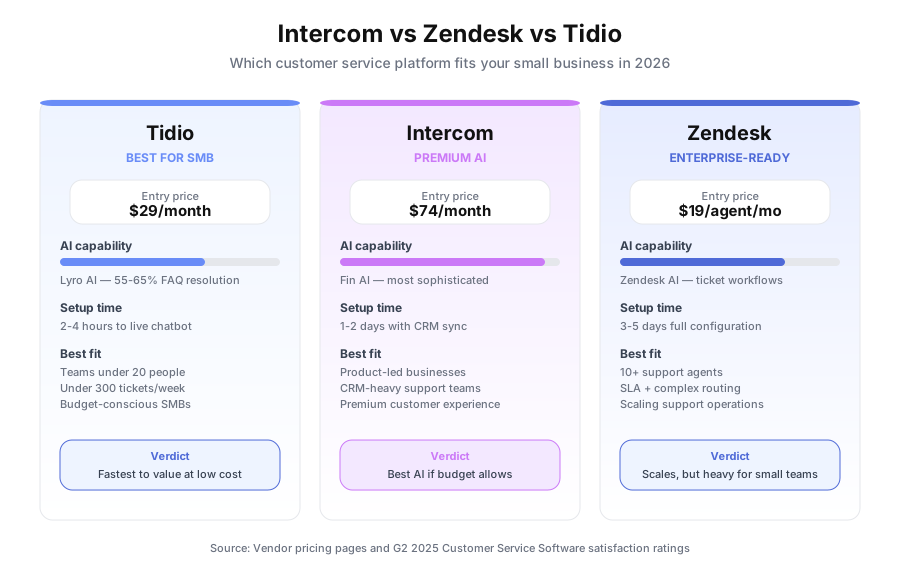
Tidio fits most businesses under 20 people with its $29-79/month pricing and 2-4 hour setup. Intercom fits product-led teams willing to pay $169+/month for Fin AI’s superior conversational quality. Zendesk fits teams with 10+ agents who need SLA tracking, complex routing, and don’t mind a 3-5 day configuration project.
The mistake small businesses make is picking the platform their bigger competitors use. Zendesk is excellent software, but a 3-person team running it is like renting a warehouse to store a bike. Tidio’s G2 ratings show it leading the SMB segment in ease of setup and time-to-value — two metrics that matter more than feature depth when you don’t have a dedicated admin.
Pick the platform that matches your current scale, not the one that looks impressive in a stack diagram.
What Is Each Platform Actually Built For?
Intercom is a customer communications platform combining support, sales, and in-app messaging. Zendesk is a structured ticketing help desk built for scale and SLA compliance. Tidio is an SMB-first live chat and chatbot tool with AI. Each one solves a different problem, so the “best” answer depends on which problem you actually have.
Intercom: the premium conversational platform
Intercom started as a product messaging tool and grew into a full customer service suite. It’s the platform that small-but-growing SaaS companies tend to pick when they want a polished customer-facing experience. Fin AI (Intercom’s flagship AI agent) learns from your knowledge base, past conversations, and CRM data.
Zendesk: the structured help desk
Zendesk’s DNA is ticket management. It excels at organizing high-volume queues, routing work by rules, and producing reporting that operations managers actually use. According to Zendesk’s 2024 CX Trends Report, companies using its workflow automation resolve tickets 31% faster than those without.
Tidio: the SMB chatbot-first platform
Tidio is purpose-built for small businesses. The chatbot visual builder is intuitive, the chat widget installs with one code snippet, and Lyro AI handles FAQ deflection without requiring a training data science project.
How Do Intercom, Zendesk, and Tidio Compare on Price?
Tidio is the cheapest at $29-79/month flat. Intercom starts at $74/month but climbs to $169+ for most SMBs and adds $0.99 per AI resolution. Zendesk charges $55-115 per agent per month, which sounds manageable until you add the $50/agent AI module and multiply by team size.
| Plan | Tidio | Intercom | Zendesk |
|---|---|---|---|
| Entry | $29/mo (Starter) | $74/mo (Essential, 2 seats) | $55/agent/mo (Suite Team) |
| Mid | $59/mo (Communicator) | $169/mo (Advanced) | $89/agent/mo (Suite Growth) |
| Full-featured | $79/mo (Tidio+) | Custom (Expert) | $115/agent/mo (Suite Professional) |
| AI features | Included in Tidio+ | $0.99 per Fin resolution | $50+/agent/mo add-on |
Run the math on a realistic 5-agent team wanting full AI: Tidio costs about $79/month total. Zendesk lands near $345/month on Suite Team ($55/agent plus ~$14 AI add-on, times 5). Intercom falls between $250 and $400/month depending on AI volume.
That’s a 4-5x price gap. The question isn’t whether Intercom or Zendesk is worth more money — it’s whether your specific business will use the extra capability enough to justify it.
Which Platform Has the Best AI in 2026?
Intercom’s Fin AI leads on conversational quality and complex query handling. Tidio’s Lyro wins on value — it resolves 55-65% of FAQ queries at a fraction of Fin’s cost. Zendesk’s AI is weaker on conversational resolution but strong on ticket classification and routing. Your answer depends on whether you prioritize quality, cost, or workflow automation.
Tidio Lyro AI: FAQ deflection done right
Lyro is trained on a knowledge base you upload — FAQ docs, product pages, return policies. It shines on predictable queries: “Where’s my order?” “What’s your return window?” “Do you ship to Canada?” Tidio’s own case studies show Lyro resolving 55-65% of queries for businesses with well-built knowledge bases.
Where Lyro struggles: multi-turn conversations, ambiguous requests, and anything requiring customer context from a separate system. It’s solid for standard use cases, less so for complex B2B support.
Intercom Fin AI: the most capable assistant
Fin is the most sophisticated AI of the three. It handles ambiguous questions, multi-step conversations, and personalizes responses using CRM data like customer plan, purchase history, or lifecycle stage. Intercom publishes resolution rates up to 50% across its customer base, though quality-adjusted rates run higher than raw deflection.
The catch is pricing. At $0.99 per resolution on the Advanced tier, a business handling 500 AI conversations monthly pays $495 in AI fees alone — on top of the $169 base. For a detailed breakdown of Fin’s capabilities, see our Intercom Fin AI review.
Zendesk AI: structured ticket intelligence
Zendesk’s AI (powered partly by OpenAI) focuses on ticket classification, intent detection, response suggestions, and routing. It’s less about end-to-end conversational resolution and more about making human agents faster.
| AI feature | Tidio Lyro | Intercom Fin | Zendesk AI |
|---|---|---|---|
| FAQ resolution rate | 55-65% | 40-60% | Variable (routing focus) |
| Multi-turn conversation quality | Fair | Strong | Fair |
| CRM data integration | Limited | Deep | Moderate |
| Monthly cost (5 agents) | $79 flat | $250-495 | $345+ |
How Fast Can You Set Up Each Platform?
Tidio gets a working chatbot live in 2-4 hours. Intercom takes 1-2 days to configure CRM sync, AI training, and routing. Zendesk’s full configuration (workflows, SLAs, views, macros) runs 3-5 days and frequently stalls during onboarding. For small teams without a dedicated admin, setup time is often the real hidden cost.
| Dimension | Tidio | Intercom | Zendesk |
|---|---|---|---|
| Time to first chatbot | 2-4 hours | 1-2 days | 3-5 days |
| Technical requirement | Low | Low-moderate | Moderate |
| Onboarding support | Self-serve | Guided (paid plans) | Docs + community |
| Admin complexity | Low | Moderate | High |
Tidio’s self-serve flow is genuinely fast. Upload your FAQs, paste a snippet into your site, configure Lyro’s tone, and you’re live. Most small businesses finish in one sitting.
Intercom expects you to connect your CRM, import contacts, configure Fin’s training sources, and build message flows. It’s not hard, but it’s a real project — plan a day or two.
Zendesk rewards careful configuration. The admin work pays off once you’re at scale, but small teams often underestimate the setup and end up with a half-configured instance that underperforms both competitors.
Which Platform Wins on Channel Coverage?
All three cover website chat, email, Instagram, and Facebook Messenger. Intercom and Zendesk add SMS and broader integrations by default. Tidio adds WhatsApp on the Tidio+ tier. Only Zendesk offers phone/voice as a paid add-on. For digital-native SMBs, Tidio covers the essentials; for multichannel operations, Intercom or Zendesk reach further.
| Channel | Tidio | Intercom | Zendesk |
|---|---|---|---|
| Website live chat | Yes | Yes | Yes |
| Yes | Yes | Yes | |
| Instagram DMs | Yes | Yes | Yes |
| Facebook Messenger | Yes | Yes | Yes |
| Tidio+ only | Yes | Yes | |
| SMS | No | Yes | Yes |
| Phone/voice | No | No | Yes (add-on) |
For most small businesses, digital channels cover 90% of actual support volume. If you’re already fielding customer calls, Zendesk’s Talk add-on is the only integrated option of the three.
When Should You Choose Tidio Over Intercom?
Choose Tidio when budget matters, your team is under 20 people, weekly support volume is under 300 interactions, and FAQ deflection is your main AI use case. Tidio’s $79/month Tidio+ plan covers most small-business needs at a 3-5x lower cost than Intercom. If your customers don’t expect white-glove AI conversations, Tidio delivers the core value.
The honest test: do you need Fin’s conversational sophistication, or are you paying for features that won’t move the needle on resolution rate? For a bootstrapped ecommerce store answering shipping questions, Tidio wins every time.
When Is Intercom Worth the Premium?
Intercom is worth the higher cost when you’re a product-led business, need deep CRM integration, serve customers with complex questions, and want the most polished in-app experience. Fin AI’s quality advantage shows up most in nuanced multi-turn conversations — the kind that come up in SaaS, fintech, or any subscription business where customer context drives response quality.
If your support volume justifies $200-400/month in software and your customers expect fast, context-aware answers, Intercom’s premium is defensible. Otherwise, you’re paying for capability you’ll never use.
When Does Zendesk Actually Fit a Small Business?
Zendesk fits once you have 10+ support agents, complex routing requirements, detailed SLA tracking, and the admin capacity to configure it properly. Below that threshold, Zendesk’s full feature set is underused and the setup overhead outweighs the benefits. Growing teams that expect to scale to 20+ agents within a year are the exception — they benefit from starting on Zendesk early.
The signal you’ve grown into Zendesk is when your current tool can’t handle ticket assignment rules, SLA enforcement, or multi-queue workflows. Until then, simpler tools deliver better outcomes with less friction. For a detailed look at how routing logic works across platforms, see our support ticket routing automation guide.
Should You Skip These Platforms and Build a Custom Chatbot?
A custom GPT-powered chatbot (built with Make, Zapier, or a similar automation platform) makes sense if your workflow is unique, you want full control over AI behavior, and you have technical support to build it. The trade-off: more upfront work, no pre-built integrations, but zero platform lock-in and unlimited customization. Most small businesses are better served by Tidio or Intercom.
Custom builds work best when you need to integrate proprietary data, enforce specific compliance behavior, or route conversations through unusual logic. They’re not the default — they’re the exception.
For related reading, see our case study on how an IT support firm resolved 60% of helpdesk tickets without engineers, our article on AI in customer service trends for 2026, and our guide to the best AI chatbot builders for small business if you’re evaluating chatbot-first solutions beyond full customer service platforms. If you have ruled out Zendesk for cost or complexity reasons, see our Zendesk alternatives for small business. If Intercom Fin’s per-resolution pricing does not fit your volume, see our Intercom Fin AI alternatives comparison.
Ready to Pick the Right Platform?
The right platform depends on your team size, weekly ticket volume, channel mix, and AI expectations — not on what’s trending in your industry. A 15-minute conversation usually surfaces the real answer faster than a 3-week trial.
Book a free automation audit and we’ll map your support volume, channel mix, and AI requirements, then recommend the platform configuration that delivers the highest deflection rate at the right price point for your team.