A support manager I worked with last year described her inbox this way: “It’s 80% the same 10 questions and 20% the things I actually need to be solving.” That’s the ticket deflection problem in one sentence. Most small business support teams spend most of their time answering questions that don’t need a human — and they’re burning out the team that should be handling the work that does.
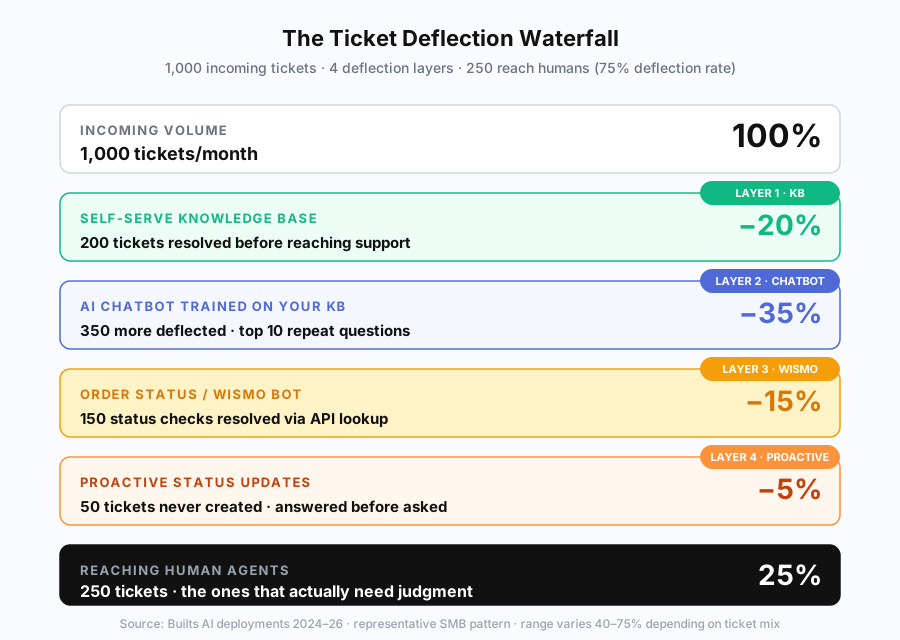
Ticket deflection is the fix, and it’s measurable. According to a 2024 Salesforce State of Service report, high-performing support organizations deflect 47% of inquiries through self-service and AI before they reach a human agent. The best-performing SMBs we work with at Builts AI hit 70-75% — and they didn’t get there by buying a chatbot. They got there by stacking four deflection layers, each one absorbing a different slice of ticket volume.
This guide breaks down what ticket deflection actually is, what good rates look like in 2026, the 7 patterns that produce them, and how to calculate cost savings honestly. (For the wider view of which customer service automation plays are worth deploying at all, start there.) The math at the end will tell you whether deflection is worth the effort for your specific volume — for most small businesses, the answer is yes within the first 60 days.
What is ticket deflection in customer support?
Ticket deflection is the percentage of customer support inquiries resolved without a human agent — through self-service knowledge bases, AI chatbots, automated lookups, or proactive notifications that prevent the ticket from being created in the first place. It’s measured as a percentage of total ticket attempts. Good deflection lifts CSAT (faster, 24/7, consistent answers). Bad deflection just defers the work and damages trust.
The four mechanisms that produce real deflection:
- Self-service knowledge base. Customers find answers in your help docs before contacting support.
- AI chatbots trained on your KB. Customers get instant answers from a bot that knows your actual product and policies.
- Automated data lookups. Order status, account info, appointment confirmations — answered by API without involving a human.
- Proactive notifications. The ticket never exists because you already told the customer what they were going to ask.
The fourth mechanism is the one most teams skip. The most efficient ticket is the one that never gets created — and that’s almost always a notification problem, not a chatbot problem.
What is a good ticket deflection rate in 2026?
Good ticket deflection rates run 40-75% for small businesses in 2026. The range depends heavily on ticket mix and how well the deflection layers are stacked. E-commerce with high WISMO volume can hit 70%+. B2B SaaS with complex technical tickets lands at 40-55%. Service businesses reach 50-65%. Anything below 30% means your tools aren’t trained on real customer questions — not that deflection doesn’t work.
Benchmarks we measure across SMB deployments at Builts AI:
| Industry | Typical deflection rate | What drives it |
|---|---|---|
| E-commerce (DTC) | 60-75% | WISMO bots + FAQ chatbot |
| Service businesses (HVAC, dental, salon) | 50-65% | Appointment automation + after-hours capture |
| B2B SaaS | 40-55% | KB chatbot + in-product help |
| Professional services (legal, accounting) | 35-50% | Document collection + FAQ |
| Property management | 55-70% | Tenant FAQ + maintenance request automation |
What sets the ceiling for your business is the percentage of tickets that are genuinely repetitive vs genuinely unique. If 80% of your inbox is the same 10 questions, you can hit 70%+ deflection. If most tickets are custom inquiries that require judgment, your ceiling is closer to 35-45%. Both are wins. The mistake is comparing your number to someone else’s benchmark without accounting for ticket mix.
How do I calculate ticket deflection rate?
The deflection rate formula is straightforward: (tickets resolved without human intervention) ÷ (total ticket attempts) × 100. Total attempts includes both chatbot conversations and human-handled tickets. Critical caveat — only count deflections where CSAT stays flat or improves. A bot that “resolves” tickets by giving wrong answers isn’t deflecting; it’s hiding escalations and damaging trust until customers churn.
A worked example for a 12-person business doing 1,500 monthly support attempts:
Chatbot conversations resolved without escalation: 800
Self-service KB searches that didn't become tickets: 200
WISMO bot lookups completed: 150
Tickets handed to humans: 350
Total attempts: 1,500

Deflection rate = (800 + 200 + 150) ÷ 1,500 × 100
               = 1,150 ÷ 1,500 × 100
               = 76.7%
The number above is the gross deflection rate. The CSAT-adjusted rate is what actually matters — it discounts deflections where the customer was unhappy. If 10% of the chatbot-resolved tickets had CSAT below 4/5, your real deflection rate is (1,150 − 80) ÷ 1,500 = 71.3%. That’s the metric to track week-over-week.
What are the 7 patterns that actually deflect tickets?
The 7 patterns below cover the full deflection stack. The first three handle the bulk of repetitive volume (60-70% combined). The middle two address ticket creation itself (preventing the inquiry in the first place). The last two compound deflection by making humans faster on what’s left. Most SMBs implement 3-4 of these and hit their deflection ceiling — going wider beats going deeper on any single pattern.
Pattern 1: A real knowledge base (not a buried FAQ)
A well-structured knowledge base alone deflects 15-30% of potential tickets. The pattern: searchable help center, prominent placement on every customer-facing page, articles written from actual support tickets (not marketing). A 2024 Aberdeen study found companies with effective knowledge bases had 41% lower support costs. Most SMBs already have one — it’s just buried in the footer.
Quick wins: Put a search bar in the website header. Add inline help links in transactional emails. Track which articles get viewed most — those are the highest-impact update targets.
Pattern 2: AI chatbot trained on your real knowledge base
This is the highest-impact deflection pattern in 2026. A chatbot trained on your actual help docs, policies, and resolved ticket history deflects 30-50% of website inquiries. The training data matters more than the platform — Chatbase trained well beats a custom build trained poorly. We covered the technical setup in our RAG setup guide; the tool comparison is in our Chatbase review and Intercom Fin review.
Pattern 3: WISMO bot for order-status queries
For any business that ships physical products, “where is my order” tickets are 20-40% of total volume. A simple bot that pulls tracking info from Shopify/WooCommerce/your-fulfillment-platform via API and returns a status update kills nearly all of them. Setup: 1-2 weeks. Deflection impact: 15-25% of total tickets, often the cheapest tickets to deflect.
Pattern 4: Proactive notifications that prevent tickets
The most efficient deflection: the ticket that never gets created. Send proactive updates at every key milestone — order shipped, appointment confirmed, payment received, delay detected, document needed. Customers don’t email asking “what’s happening” if they already know. We measured a 60-80% drop in inbound “status check” volume across deployments that implemented proactive notifications. Tools: webhook automation from your operational system, triggered SMS/email via Twilio, Klaviyo, or your CRM’s workflow engine.
Pattern 5: In-product help and onboarding
For SaaS and product-led businesses, deflection starts in the product itself. Contextual help tooltips, onboarding sequences that explain features before customers ask, in-app status indicators. Per a 2024 Userpilot study, in-product help deflects 18-32% of would-be support tickets. Tools: Intercom Product Tours, Pendo, Userpilot, or custom modals tied to user activity.
Pattern 6: Smart routing and macros for tickets that do reach humans
Even tickets that need a human don’t all need your best agent. Smart routing tags incoming tickets by topic, urgency, and customer tier, then sends them to the right person with the right macro pre-loaded. Average handle time drops 20-35%. This isn’t strictly deflection — it’s making your human capacity go further so the deflection layers can take more load. Our ticket routing setup guide walks through the implementation. See also the support ticket routing automation overview for a full breakdown of channels, tools, and routing logic patterns.
Pattern 7: Community/forum self-resolution
For high-volume B2B and SaaS, a community forum where customers help each other deflects 5-15% of tickets at near-zero ongoing cost. Discourse, Circle, or even a Slack community works. The trick is seeding it with team-answered posts before opening to customers, then incentivizing power users to answer questions for new ones.
How does ticket deflection actually save money?
Each deflected ticket saves $1.50-$3.00 in loaded agent time for typical SMB support operations. The math: a $4,500/month loaded rep handles roughly 150 tickets/month, which is $30/ticket. A deflected ticket saves 70-90% of that handle cost (some still requires partial review). At 1,000 deflected tickets monthly, that’s $1,500-$3,000/month in direct savings — plus avoided hires once deflection scales past 2,000+ monthly tickets.
The full cost-savings formula for ticket deflection:
Monthly savings = (Tickets deflected × Cost per ticket × Deflection efficiency)
                + (Hires avoided × Loaded cost per hire ÷ 12)
                + (After-hours revenue captured)
                − (AI tool subscription)
                − (Setup time amortized)
Worked example for the deflection waterfall in the diagram above (1,150 monthly deflections at the 76.7% rate):
- Direct savings: 1,150 deflections × $2.50/ticket = $2,875/month
- Hire avoided (would’ve needed a 4th rep): $4,500/month ÷ 12 months amortized = $4,500/month avoided
- After-hours leads captured: 40% of inquiry volume × $50 average value = $1,500/month recovered
- Less AI tooling cost (chatbot subscription): −$200/month
- Net monthly savings: ~$8,675
That’s roughly $104,000 annualized. Most SMBs we work with hit similar numbers within 6 months of implementing 3-4 deflection patterns. We covered the broader cost-reduction angle in our reduce customer service costs guide — deflection is the single biggest line item there.
What kills ticket deflection rates?
Five mistakes consistently tank deflection rates: training AI on generic content instead of real customer questions, hiding the chatbot, forcing customers through too many steps before reaching a human, not measuring CSAT on deflected tickets, and treating deflection as a launch event instead of an ongoing tuning process. Fix these and deflection rates typically lift 15-30 points within 90 days.
The five killers in order of frequency:
- Generic training data. AI trained on a 12-page FAQ misses the 60% of tickets that require specific product or policy knowledge. The fix is feeding it real resolved tickets, not just marketing-facing docs.
- Invisible deflection tools. A chatbot buried in the footer or a KB hidden behind three menu levels gets zero use. Self-service has to be the most obvious option on the page.
- Friction before human handoff. Customers willing to wait 30 seconds for AI won’t tolerate 5 minutes of menus before reaching a person. One-click escape, always.
- No CSAT measurement on deflected tickets. Without this, you don’t know whether deflection is working or hiding escalations. Sample 20-50 deflected tickets weekly.
- Set-and-forget deployment. Customer questions evolve as your product changes. AI trained 6 months ago is already losing accuracy. Retrain monthly on the latest resolved tickets.
Our AI hallucination prevention guide covers the technical patterns that close the accuracy gap specifically — combined with the strategy fixes above, the deflection rate usually doubles within 90 days.
How do I track ticket deflection over time?
Track ticket deflection with three weekly metrics: gross deflection rate (resolved without human ÷ total attempts), CSAT-adjusted deflection rate (gross minus deflections with low CSAT), and escalation rate from each deflection layer. Pair these with a monthly accuracy audit on 50 random AI-handled tickets. Skipping the audit is how good deployments quietly become bad ones.
The four-metric dashboard we recommend:
| Metric | Frequency | What it tells you |
|---|---|---|
| Gross deflection rate | Weekly | Is the volume going somewhere besides humans? |
| CSAT on deflected tickets | Weekly | Are customers actually happy with the deflection? |
| Escalation rate per layer | Weekly | Which layer is dropping the most customers to human? |
| AI accuracy audit (50 tickets) | Monthly | Is AI accuracy holding or drifting? |
Most SMB helpdesks (Zendesk, Intercom, Help Scout, Front) can produce the first three metrics natively or via simple dashboards. The accuracy audit is manual — pull 50 random AI-handled tickets, read them, score them 1-5 on accuracy and tone. Anything averaging below 4.0 is a tuning trigger. If Zendesk’s per-agent pricing or admin overhead is a concern at your team size, see our Zendesk alternatives for small business comparison for lighter-weight options.
When ticket deflection isn’t the right play
Ticket deflection isn’t worth the effort for businesses under 200 monthly tickets, businesses where every ticket is genuinely unique (hyper-customized B2B work), or businesses with no documented knowledge base to train AI on. Below 200 tickets, setup time exceeds savings. With unique tickets, there’s nothing repetitive to deflect. Without docs, there’s nothing to train AI on — and the first project is documenting, not automating.
For very small operations, the right move is usually pattern 4 (proactive notifications) and pattern 6 (smart routing) without investing in chatbots. Those two patterns alone produce 25-40% of the deflection impact at a fraction of the setup cost. The decision math is in our broader how to automate customer support guide.
What’s the right next step?
Implement the deflection waterfall in tiers. Week 1: audit your current ticket mix and pick the top 2 deflection targets. Week 2-3: ship a proactive notification flow for your most common “status check” pattern. Week 4-6: deploy an AI chatbot trained on your real knowledge base. Week 7-8: layer in WISMO or order-status automation if applicable. Most SMBs see 30-40% deflection inside 60 days from this sequence — and that’s before any custom integration work.
At Builts AI, we build custom AI customer support systems with full ticket deflection deployment for small and mid-sized businesses across Canada and the US. Pricing is transparent: $8,000-$30,000 CAD for the one-time Build Phase, $500-$2,500 CAD/month optional Maintenance. The free audit produces a written deflection-rate projection in 48 hours, including which patterns fit your specific ticket mix and what your CSAT-protected ceiling is.
The math we keep coming back to: every 1,000 tickets you deflect saves $2,000-$3,000/month and reclaims 50+ hours of staff time. Most SMBs leave that money on the table because deflection sounds technical. It isn’t. It’s just refusing to answer the same 10 questions for the 11th time.