You want to automate something in your business. Your first question is obvious: what’s this going to cost?
Most agencies dodge it. They say “it depends” and push you toward a sales call. You deserve real numbers before talking to anyone, so here they are. Small business automation projects cost $3,000 to $15,000 to build, plus $200 to $600 per month in tools, with typical payback in 2 to 4 months. Forrester’s 2024 Total Economic Impact studies show 200% average first-year ROI. Those numbers come from actual client projects we’ve delivered since 2023.
How much does business automation actually cost?
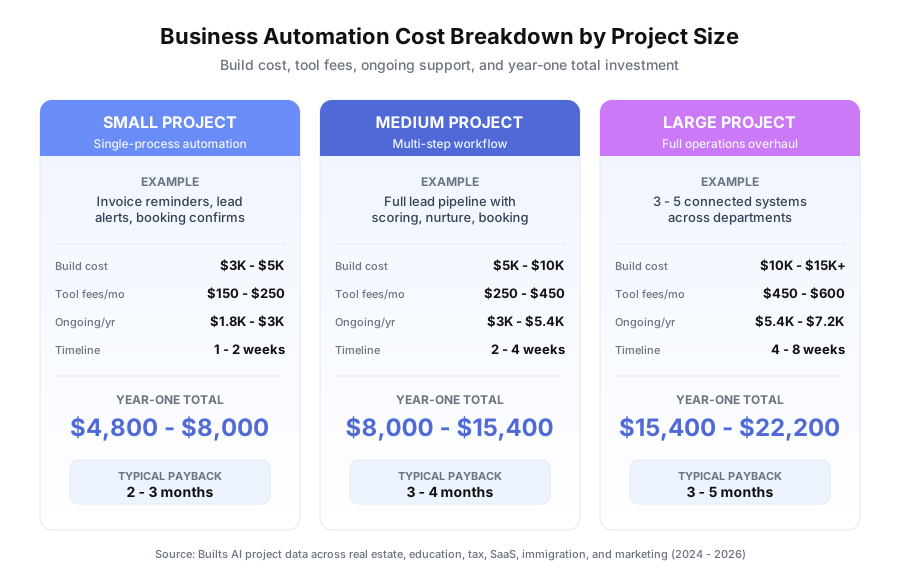
Small business automation costs $3,000 to $15,000 for the build and $200 to $600 per month for tools. Simple single-process automations start at $3,000. Multi-step workflows run $5,000 to $10,000. Full operations overhauls with 3 to 5 connected systems reach $15,000 or more. Builds take 1 to 8 weeks — see our how long does automation take breakdown for a phase-by-phase look at where the weeks actually go (discovery, build, testing, handoff).
Here’s how the three tiers break down:
| Project Type | Build Cost | Timeline | Example |
|---|---|---|---|
| Single-process automation | $3,000 - $5,000 | 1-2 weeks | Invoice reminders, lead alerts, appointment confirmations |
| Multi-step workflow | $5,000 - $10,000 | 2-4 weeks | Full lead pipeline: inquiry, scoring, nurture, CRM updates |
| Full operations overhaul | $10,000 - $15,000+ | 4-8 weeks | 3-5 connected systems across departments |
Deloitte’s 2023 Global Intelligent Automation Survey found 73% of organizations using automation report positive ROI within 12 months. For small teams, payback is often faster because every hour saved has a bigger proportional impact on the business.
We built AcquireX Properties Capital three custom systems (deal analysis, tenant management, investor reporting) that tripled their portfolio capacity. Three people, same team, a fraction of what an operations hire would have cost.
What drives automation pricing up or down?
Five factors determine where your project lands on the $3K to $15K range: number of tools connected, logic complexity, data quality, whether integrations are standard or custom, and event volume. Each factor can shift your build cost by $1,000 to $5,000. Clean data and off-the-shelf connectors keep costs low.
Number of tools. Connecting HubSpot to Gmail is simpler than connecting HubSpot, Google Calendar, QuickBooks, Slack, and a custom database. Each integration adds design and testing time. MuleSoft’s 2023 Connectivity Benchmark Report found the average enterprise uses 1,061 applications. Small businesses typically use 15 to 30, but connecting even 5 of them needs careful planning.
Logic complexity. “When X happens, do Y” is straightforward. A workflow with 15 conditional branches, retry logic for API failures, and data transformation across 4 systems takes real engineering.
Data quality. Clean, structured data migrates smoothly. Spreadsheets with inconsistent formats, missing fields, and 3,000 duplicate contacts need cleanup first. Gartner’s 2023 Data Quality Market Survey estimates poor data quality costs organizations $12.9 million per year on average.
Custom vs. standard integrations. HubSpot, Google Sheets, Slack, and QuickBooks all have mature APIs with pre-built connectors. Niche industry software (immigration case management, dental practice systems) may need custom API work, adding $2,000 to $5,000.
Volume. A system handling 50 events per day is simpler to monitor than one processing 5,000. Higher volume needs stronger error handling and infrastructure.
How does automation cost compare to hiring?
This is the comparison that makes the math obvious. A full-time employee in Canada costs $45,000 to $65,000 per year in salary and benefits, according to Statistics Canada’s 2024 Survey of Employment, Payrolls and Hours. A comparable automation costs $8,000 to $22,000 in year one and drops to $3,000 to $7,000 in year two when the build cost is gone.
| Hiring one employee | Automating the same work | |
|---|---|---|
| Year 1 cost | $45,000 - $65,000 | $8,000 - $22,000 |
| Year 2 cost | $45,000 - $65,000 (recurring) | $3,000 - $7,000 (tools only) |
| Availability | 40 hrs/week, business hours | 24/7/365 |
| Time to productive | 2-3 months (recruit + onboard) | 2-6 weeks |
| Handles volume spikes | No. Same capacity. | Yes. Scales automatically. |
| Error rate on repetitive tasks | 1-3% (human fatigue) | Near zero |
SHRM’s 2024 Talent Acquisition Benchmarking Report puts average cost-per-hire at $4,129 before you even count salary. That’s money the automation never charges.
Taxvisory’s founder manages 300 tax clients solo. Before automation, she was working 14-hour days during tax season. The system handles document chasing, scheduling, and status updates. She didn’t hire an assistant. She automated the work that would have needed one. A part-time assistant would run $25,000 per year. The automation cost a fraction of that and runs year-round.
Thompson Career College was losing prospective students because their inquiry response took 1 to 2 business days. They considered hiring another admissions coordinator. Instead, they automated the response pipeline. Response time dropped to under 60 seconds. Admissions calls tripled. No new headcount.
How do you calculate automation ROI?
Use this formula: annual ROI = (hours saved per week x hourly cost x 52) + recovered revenue - total automation cost. Forrester’s 2024 Total Economic Impact methodology, used across more than 150 commissioned studies, consistently shows average first-year ROI on business process automation at 200%. Small teams can usually estimate their return in under 10 minutes.
For a deeper walkthrough of the formula and all five value components, see our guide on how to calculate automation ROI. Here’s the math with real numbers.
Example: Lead follow-up automation
A 5-person team spends 12 hours per week on manual lead response. At $25 per hour loaded cost, that’s $15,600 per year. They’re also losing an estimated 30% of leads to slow response. A Harvard Business Review study by James Oldroyd (2011, updated by Drift in 2023) found responding within 5 minutes makes you 100x more likely to connect than waiting 30 minutes.
- Automation build: $6,000
- Annual tools: $3,600 ($300/month)
- First-year total cost: $9,600
- Labor saved: $15,600/year
- Revenue recovered (conservative): $20,000/year from faster response
- First-year net ROI: $26,000 positive
- Payback period: 3.2 months
Year two? The build cost is gone. Annual cost drops to $3,600 in tools. ROI jumps to $32,000. This matches what we saw at Thompson Career College, where revenue impact from faster lead response far exceeded the labor savings.
What are the ongoing monthly tool costs?
Monthly tool costs run $200 to $600 for most small businesses. That covers your automation platform, CRM, communication APIs, hosting, and monitoring. Per-execution platforms like Zapier are cheap at low volume but scale expensively. Flat-rate platforms like self-hosted n8n stay predictable as volume grows.
| Tool Category | Monthly Cost | Examples |
|---|---|---|
| Automation platform | $0 - $100 | n8n (self-hosted, free), Make ($10 - $99), Zapier ($20 - $100) |
| CRM | $50 - $150 | HubSpot (free - $150), Pipedrive ($14 - $99), GoHighLevel ($97 - $297) |
| Communication APIs | $20 - $100 | Twilio (pay-per-use), SendGrid ($20 - $90) |
| Hosting / infrastructure | $20 - $50 | Railway, Render, DigitalOcean |
| Monitoring / error tracking | $0 - $50 | Built into most platforms |
Total: $200 to $600 per month for a typical small business stack.
The key question to ask any automation partner: what happens when your volume doubles? Zapier charges per task. Make charges per operation. At low volume it’s cheap. At scale it adds up fast. n8n and self-hosted platforms use flat-rate or free pricing, which works better for high-volume workflows.
What hidden costs should you watch out for?
Four cost traps appear most often in small business automation projects: per-execution pricing that spikes at scale, vague retainers with no defined deliverables, proprietary platform lock-in, and scope creep between projects. Each can add thousands to your real total. Ask about all four before signing anything.
Per-execution pricing at scale. A Zapier plan that costs $49 per month at 2,000 tasks can jump to $299+ when your workflow processes 10,000 tasks. Ask about volume pricing before committing.
Vague retainers. Monthly support is reasonable ($500 to $1,500 per month for monitoring, updates, and optimization). A retainer with no defined deliverables is not. Get scope in writing. Our guide on how to choose an AI automation agency covers what to look for in contracts.
Tool lock-in. Some agencies build on proprietary platforms. If you leave, you lose everything. A 2023 Gartner survey found vendor lock-in is the number one concern for 56% of organizations evaluating automation platforms. At Builts AI, you own your workflows, your data, and your systems. No lock-in.
Scope creep. “While you’re in there, can you also…” is the number one cause of budget overruns. Finish one project, measure results, then scope the next one separately.
What does it cost to do nothing?
Here’s the number most businesses forget. If your team spends 15 hours per week on a process that could be automated, that’s $31,200 per year at $40 per hour. Every year you wait is another $31,200 spent on work a system could handle. IDC’s 2023 State of Data Management report found employees spend 30% of their time on manual data tasks that could be automated.
For a 5-person team averaging $50,000 in salary, that 30% figure works out to $75,000 per year in manual data work alone. And that’s before you count slow lead response, missed follow-ups, or the cost of errors that automation would have caught. Labor is only Layer 1; the true cost of manual processes breaks down all five layers — error correction, opportunity cost, morale, and customer impact — which together typically run 3-5x the direct labor figure.
Pixorr, a 5-person SEO agency, had one team member spending a full work week every month on client reporting. After automating the report pipeline, that person does SEO strategy instead. The automation didn’t just save time. It redirected a skilled employee from spreadsheet work to revenue-generating strategy.
How do you get started with business automation?
Every project we’ve built started with the same step: a 30-minute conversation about how the business actually works. No sales pitch, no pressure. Just a clear map of where your time is leaking and which 2 to 3 processes would return the most value if automated first. You leave with written numbers, not a vague estimate.
Book a free audit. We’ll map your workflows, identify the 2 to 3 processes costing you the most time and money, and send you a written Automation Opportunity Report within 48 hours. It includes estimated savings for each bottleneck and a recommended starting point.
The audit is free. The report is yours to keep. And the numbers in it will make the automation decision simple math, not a guess.
If you want to sanity-check budgets first, see how we price automation projects — custom quotes by scope, no per-seat fees. We’re based in Toronto and work with businesses across Ontario as well as remote teams across North America.