“How long until it’s live?” It’s the first question every business owner asks, and the honest answer frustrates most people: it depends. But it depends on five specific, measurable things, not hand-waving.
Celonis’s 2024 Process Intelligence report puts the median time-to-value for business process automation at 6 weeks. That’s the benchmark. Some projects come in under two weeks. Some take eight. The difference isn’t the technology. It’s how well you’ve prepared before anyone touches a workflow builder.
Here’s the honest breakdown, with real client timelines and the five factors that’ll make or break your schedule.
What are the three tiers of automation complexity?
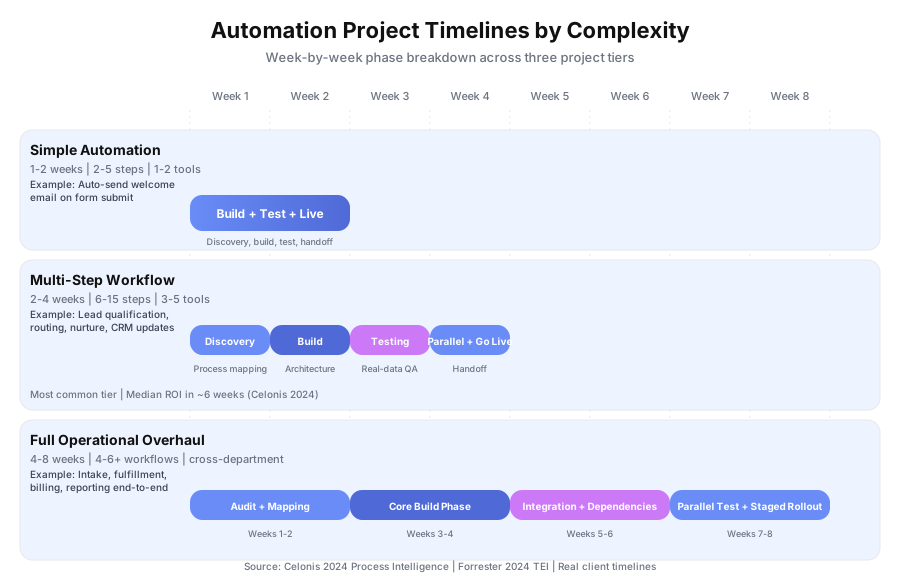
Every automation project fits one of three tiers. The tier sets your timeline, your budget, and your testing requirements. Estimating a timeline without picking a tier first is guessing.
| Tier | Description | Timeline | Example |
|---|---|---|---|
| Simple | Single trigger, 2-5 steps, 1-2 tools | 1-2 weeks | Auto-send welcome email when form is submitted |
| Multi-step | Multiple triggers, 6-15 steps, 3-5 tools, conditional logic | 2-4 weeks | Lead qualification, routing, nurture sequence, CRM updates |
| Full overhaul | 4-6+ connected workflows, cross-department, multiple systems | 4-8 weeks | End-to-end operations (intake, fulfillment, billing, reporting) |
Forrester’s 2024 Total Economic Impact studies show average ROI of 200% within the first year across all three tiers. But the time to first value varies sharply. Most small businesses start with Tier 1 or Tier 2. That’s where the fastest wins live, and where you prove value before committing to a bigger overhaul.
What does a week-by-week project flow look like?
A typical Tier 2 project (multi-step workflow) runs four weeks. Week 1 is discovery and process mapping. Week 2 is architecture and build. Week 3 is testing with real data. Week 4 is a parallel run against the manual process, then handoff. Each week has a specific deliverable, not a vague “we’re working on it.”
Here’s what actually happens each week, based on real projects with clients including Thompson Career College, AcquireX Properties, and Skylarks International.
Week 1: Discovery and process mapping. We document your current process step by step. Every trigger, every action, every decision point, every exception. Process Street’s 2024 Automation Benchmark found companies that document processes before automating hit ROI 2.3x faster. This week is the investment that speeds up everything after.
Week 2: Architecture and build. Design the flow. Select and configure tools (n8n, Make, Zapier, custom APIs). Build the core workflow. Connect systems. This is the heads-down technical week. Visual workflow builders like n8n and Make let you see the logic as it takes shape.
Week 3: Testing and refinement. Test with real data, not sample data. Real client records, real email addresses (test accounts), real file formats. IDC’s 2023 Future of Work study found employees spend 30% of their time on manual data tasks, and those tasks produce messy, inconsistent data. Your automation has to handle that mess.
Week 4: Parallel run and handoff. Run the automation alongside the manual process for 5-7 days. Compare outputs. Train your team on monitoring. Go live. Tier 1 compresses this flow into 1-2 weeks by combining steps. Tier 3 extends it to 4-8 weeks by adding workflows in phases.
What factors speed up or slow down the timeline?
Five variables determine whether your project hits the timeline or drags past it: process clarity, tool ecosystem, data quality, approval speed, and testing thoroughness. Deloitte’s 2023 Global Intelligent Automation Survey found 73% of organizations report positive ROI within 12 months, and the speed to that ROI depends almost entirely on these factors.
1. Process clarity
If your team can describe the process step-by-step on day one, you skip 3-5 days of discovery. If no one agrees on how the process actually works (common with undocumented tribal knowledge), add 1-2 weeks.
Speed tip: Before kickoff, have the person who performs the task write down every step. Record a screen share of them doing it. That raw documentation cuts discovery time in half.
2. Tool ecosystem
Modern cloud tools (HubSpot, Google Workspace, Slack, QuickBooks Online, Airtable) have APIs and pre-built integrations. They connect in hours. MuleSoft’s 2023 Connectivity Benchmark found the average enterprise uses 1,061 apps. Small businesses typically use 10-30, but even one legacy tool without an API can add a week.
Speed tip: List every tool the process touches before kickoff. Flag any that are self-hosted, desktop-only, or older than 5 years.
3. Data quality
If your CRM has duplicate contacts, inconsistent naming, missing fields, or outdated records, the automation inherits those problems. Gartner’s 2023 Data Quality report puts the cost of poor data quality at $12.9 million per year for the average organization. For small businesses, the cost shows up as broken automations, wrong emails, and missed follow-ups.
Speed tip: Run a data cleanup before the build starts. Deduplicate contacts, standardize field formats, fill required fields. One day of cleanup prevents a week of debugging.
4. Approval speed
Every project hits decision points that need sign-off: which email template to use, what the escalation rules should be, who gets notified when. If those decisions take 3 days each because the decision-maker is in back-to-back meetings, a 3-week build becomes a 5-week build.
Speed tip: Designate one person with authority to approve decisions within 24 hours. Statistics Canada’s 2024 SEPH data puts the cost of a Canadian full-time employee at $45,000-$65,000 per year. Every week of delay costs real money in continued manual work.
5. Testing thoroughness
Cutting testing short is the most expensive shortcut. A process that works perfectly in testing but breaks on the first edge case in production creates more work than the manual process it replaced.
Speed tip: Dedicate at least 25% of the project timeline to testing. For a 4-week project, that’s a full week.
How did Thompson Career College’s timeline play out?
Thompson Career College (TCC) in London, Ontario needed to automate their entire prospective student inquiry pipeline. They were handling 300+ monthly inquiries, but responses took 1-2 business days because admissions staff were manually triaging, emailing, and scheduling calls.
A Harvard Business Review study (Oldroyd, 2011; updated by Drift in 2023) found responding within 5 minutes makes you 100x more likely to connect than waiting 30 minutes. TCC was waiting 24-48 hours. In a competitive market with institutions like Fanshawe College and Western University nearby, that delay was directly costing enrollment.
Their timeline (Tier 2, multi-step):
- Week 1: Mapped the full inquiry-to-enrollment pipeline. Identified two distinct automation needs: speed-to-lead for new inquiries and student support for enrolled students.
- Week 2: Built the speed-to-lead system. Automated instant responses, qualification workflows, and admissions call booking through their CRM and scheduling tools.
- Week 3: Built the student support automation. Integrated with their student information system to handle common queries (schedules, deadlines, document requests).
- Week 4: Parallel testing with real inquiries. Refined response templates. Trained admissions staff.
Total time: 4 weeks. Result: response time dropped from 1-2 days to under 60 seconds. Admissions calls tripled. 80% of student queries auto-resolved without staff involvement.
How did AcquireX Properties handle a full overhaul?
AcquireX Properties is a 3-person real estate investment team managing 15 active deals manually using spreadsheets, email, and phone calls. Deal analysis alone took hours per property because they were pulling data from multiple sources and running calculations by hand.
Their timeline (Tier 3, full overhaul):
- Weeks 1-2: Full process audit. Mapped deal sourcing, analysis, due diligence, and portfolio tracking. Identified 6 connected processes that needed automation.
- Weeks 3-4: Built deal sourcing and analysis workflows. Connected property databases, financial modeling tools, and their CRM. McKinsey’s 2024 Global Survey on AI and Automation found 60% of occupations have 30%+ automatable tasks. For AcquireX, the number was closer to 70% of their deal pipeline.
- Weeks 5-6: Built due diligence and portfolio tracking. Integrated document management, reporting dashboards, and alert systems.
Total time: 6 weeks. Result: portfolio capacity tripled (from 15 to 45+ deals), deal analysis ran 80% faster, and the 3-person team operated with the capacity of a firm three times its size.
How can I speed up my automation project?
Five tactics consistently compress timelines. None of them require more budget. All of them require preparation before the build starts.
- Document before you call anyone. Screen-record the process. Write the steps. Process Street’s 2024 data shows this alone cuts project time by 30-40%.
- Clean your data first. Spend one day deduplicating and standardizing. It prevents a week of debugging later.
- Assign a decision-maker. One person with authority to approve templates, logic changes, and go-live within 24 hours.
- Start with one process, not five. UiPath’s 2024 Automation Index found organizations that start at Level 1 (single process) achieve 4x higher adoption than those that try to automate everything at once.
- Protect parallel testing time. Running the automation alongside the manual process for one week catches issues that save you three weeks of fixing later.
What’s the fastest way to get an accurate timeline for my project?
Every project is different, but the variables are predictable. Your timeline depends on your tier, your process clarity, your tool stack, your data quality, and your approval speed. Not sure if your business is ready? Our checklist of 7 signs your business is ready to automate helps you assess before committing to a timeline.
We offer a free automation audit that scores all five factors and gives you a realistic, week-by-week project plan. No guessing. No “it depends” without specifics. If you’re evaluating agencies, our guide on how to choose an AI automation agency covers exactly what to ask about timelines and deliverables. Celonis’s 2024 data puts the median project at 6 weeks. We’ll tell you whether yours will be faster or slower, and exactly why.
Book your free automation audit and get an honest timeline for your project.