Most owners can tell you what they spend on rent, software, and payroll. Almost none can tell you what they spend on manual processes, because manual work doesn’t show up as a line item. It hides inside salaries, spreads across every department, and compounds silently until a team is busy all day but output hasn’t grown in a year. According to IDC’s 2023 Future of Work study, employees spend 30% of their working hours on manual data entry and transfer alone. For a 5-person team averaging $55,000 each, that’s $82,500 in annual labor spent on work a machine could do, and that’s only the first of five cost layers.
The real number is much higher.
What Is the True Cost of a Manual Process?
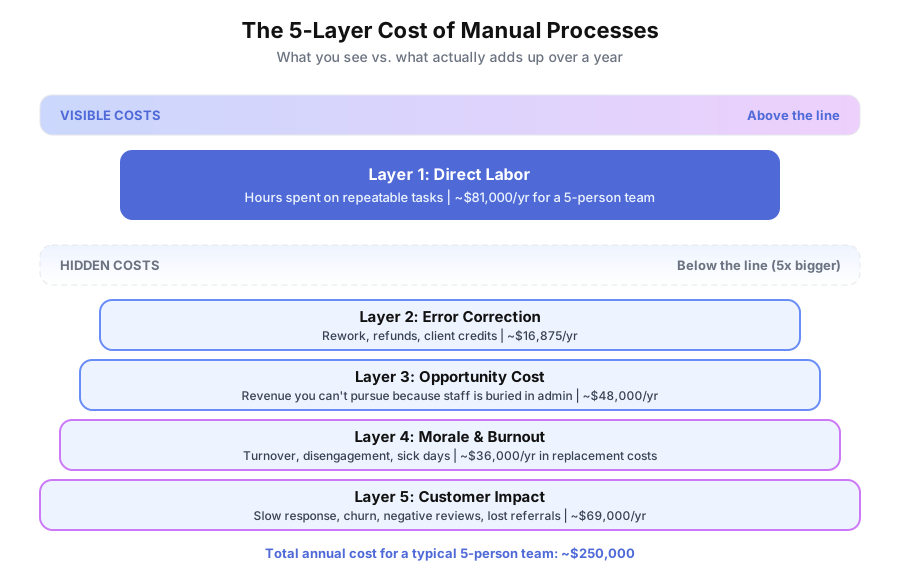
The true cost of a manual process is the sum of five layers: direct labor, error correction, opportunity cost, morale and burnout, and customer impact. Most owners only see the first layer (payroll hours). The other four are invisible until you measure them, and together they’re usually 3-5 times larger than Layer 1.
Gartner’s 2023 Data Quality report found poor data quality alone costs organizations an average of $12.9 million per year. For small businesses the dollar number is smaller, but as a percentage of revenue it’s often bigger. A $50,000 data error that a Fortune 500 firm absorbs without noticing can end a small firm’s quarter.
| Layer | What It Measures | Typical Annual Impact |
|---|---|---|
| 1. Direct labor | Hours on repeatable manual tasks | 25-35% of payroll |
| 2. Error correction | Rework, refunds, client credits | 5-15% of labor costs |
| 3. Opportunity cost | Revenue you can’t pursue | Often the largest layer |
| 4. Morale and burnout | Turnover, sick days, disengagement | $15,000-$50,000 per lost hire |
| 5. Customer impact | Slow response, churn, lost referrals | Varies by industry |
How Much Does Direct Manual Labor Really Cost? (Layer 1)
Direct labor is the easy math: count hours spent on repeatable tasks that follow the same steps every time, then multiply by the loaded hourly rate. For a 5-person Canadian team at $27/hour fully loaded, 30% of hours spent on manual data work equals about $81,000 per year, before any hidden costs.
Statistics Canada’s 2024 SEPH data shows a full-time employee costs $45,000-$65,000 per year once you include benefits, employer contributions, workspace, and tools. That’s roughly $22-$32 per hour loaded.
Worked example for a 5-person team:
- Each person works 2,000 hours per year
- IDC’s 30% figure means 600 hours per person on manual tasks
- 5 people x 600 hours x $27/hour = $81,000/year
At Taxvisory, a solo tax practitioner managing 300 clients, manual document collection consumed 15-20 hours per week during tax season. At a CPA’s billing rate, that’s revenue-generating time redirected to admin. After automating, the firm cut document chasing by 80% and recovered weekends through the busiest months of the year.
What Do Errors and Rework Actually Cost? (Layer 2)
Layer 2 is error correction. Manual data entry runs a 1-4% error rate in most studies, and the cost isn’t just the error. It’s the detection time, the correction time, the apology email, the client credit, and the trust damage. For a 5-person team, that adds roughly $16,875 per year on top of Layer 1.
Gartner’s 2023 Data Quality report shows organizations spend 15-25% of revenue dealing with data quality issues. In small businesses, the symptoms are wrong invoices, missed follow-ups, duplicate outreach, and incorrect reports.
Worked example for a 5-person team:
- 10 manual tasks per person per day x 2% error rate = 1 error/person/day
- 30 minutes to detect, correct, and communicate each = 2.5 hours/day team-wide
- 2.5 hours x 250 working days x $27/hour = $16,875/year
At Pixorr, a 5-person SEO agency, manual report formatting produced 2-3 errors per month. Every error triggered a client email exchange, sometimes a call, and always a redo. After automating reports, formatting errors dropped to zero. Not fewer. Zero.
What’s the Opportunity Cost of a Busy, Slow Team? (Layer 3)
Layer 3 is the revenue your team can’t pursue because they’re buried in admin work, plus the deals you lose by responding too slowly. This is usually the biggest hidden layer because it’s the revenue you never earned. A 5-person team typically loses $40,000-$60,000 per year here.
A Harvard Business Review study (Oldroyd, updated by Drift in 2023) found that responding to a lead within 5 minutes makes you 100x more likely to connect than waiting 30 minutes. Not 10% more. One hundred times.
Thompson Career College was living this penalty. They received 300+ monthly inquiries for career programs. Manual triage meant responses took 1-2 business days. In a market competing with Fanshawe College and Western University, that delay was directly costing enrollment. After automating their speed-to-lead system, response time dropped from 1-2 days to under 60 seconds, and admissions calls tripled.
Salesforce’s 2024 Small Business Trends Report found 43% of small business owners rank automation as their top priority specifically because manual work caps growth capacity. Worked example:
- 50 inbound leads/month x 10% manual conversion = 5 clients
- Speed penalty reduces effective conversion to 6% = 3 clients
- 2 lost clients/month x $2,000 avg value = $48,000/year
What Does Manual Work Do to Team Morale? (Layer 4)
Layer 4 is the damage manual work does to your people: burnout, disengagement, sick days, and turnover. Zapier’s 2024 State of Business Automation Report found 29% of professionals automate specifically to avoid burnout, which means more than 1 in 4 workers is already at their limit. For a 5-person team, one burnout-driven exit costs about $36,000 in replacement.
SHRM’s 2024 Human Capital Benchmarking report puts the average cost-per-hire at $4,129, before salary, benefits, or the 3-6 months to full productivity. Gallup’s 2024 State of the Global Workplace report found disengaged employees cost the world economy $8.9 trillion annually (9% of global GDP), and disengagement tracks closely with repetitive, low-value work.
KwikUI, a SaaS platform with 3,000+ users, watched support reps burn out on repetitive tickets. After automating and adding AI to the support pipeline, tickets dropped 65%, team capacity returned to strategic work, trial-to-paid conversion doubled from 4% to 8%, and churn decreased 40%.
Worked example for a 5-person team:
- 1 burnout-driven exit per 18 months
- Cost per exit: $4,129 hiring + 3 months reduced productivity ($13,750) + onboarding time ($18,000) = roughly $36,000 annualized
How Does Manual Work Hurt Customers? (Layer 5)
Layer 5 is customer impact: slow response times, inconsistent service, angry reviews, lost referrals, and churn. For a 5-person team, Layer 5 typically costs $60,000-$80,000 per year, and it’s the layer most likely to kill the business if left unfixed. Zendesk’s 2024 CX Trends report found 73% of customers will switch to a competitor after multiple bad experiences.
AcquireX Properties, a 3-person real estate investment team, hit a ceiling managing 15 active deals manually. Instead of hiring a fourth person, they automated deal analysis and portfolio management. Portfolio capacity tripled from 15 to 45+ active deals with no new hires, and response times to sellers dropped from hours to minutes, protecting their reputation.
Forrester’s 2024 Customer Experience Index shows a 1-point CX score improvement is worth $175 million in revenue for a large B2B firm. For a small business, the ratio is similar: better service compounds into referrals, reviews, and renewals.
Worked example for a 5-person team:
- 20 clients at $6,000 average annual value = $120,000 recurring
- Poor service costs 15% churn instead of 5%, losing 2 extra clients/year
- Hiring cost to replace growth = $4,129 + additional salary burden
- Layer 5 cost: ~$69,000/year (lost clients + replacement hiring)
What’s the Total Cost? A Full Worked Example
Add the five layers together for a 5-person team doing $600,000 in annual revenue and the total is about $250,875 per year, or roughly 42% of gross revenue. That number shocks most owners because they’ve only ever seen Layer 1 on their P&L.
| Cost Layer | Annual Cost | Calculation |
|---|---|---|
| Layer 1: Direct labor | $81,000 | 5 people x 600 hrs x $27/hr |
| Layer 2: Error correction | $16,875 | 2.5 hrs/day x 250 days x $27/hr |
| Layer 3: Opportunity cost | $48,000 | 2 lost clients/month x $2,000 |
| Layer 4: Morale and burnout | $36,000 | 1 turnover event / 18 months |
| Layer 5: Customer impact | $69,000 | Churn + replacement hiring |
| Total | $250,875 |
Forrester’s 2024 Total Economic Impact studies put the average ROI on business process automation at 200% within the first year. Spend $15,000 automating the top three processes and recapture even 30% of the $250,875, and that’s $75,000 back in year one. Our step-by-step guide on how to calculate automation ROI walks you through the same numbers for your own operation.
Deloitte’s 2023 Global Intelligent Automation Survey found 73% of organizations hit positive ROI within 12 months. The 27% who don’t? They usually tried to automate without measuring the baseline first.
How Do I Measure My Own Manual Process Costs in 4 Weeks?
Run a four-week audit: week one tracks time on repeatable tasks, week two logs every error and rework, week three measures lead and client response speed, and week four counts opportunities declined for lack of capacity. At the end you’ll have a dollar figure for each of the five layers, grounded in your own data.
Week 1: Time tracking. Have every team member log tasks for one full week. Categorize each as “unique/creative” or “repeatable/process.” Multiply repeatable hours by loaded hourly rate.
Week 2: Error logging. Track every error, correction, redo, or client complaint. Note fix time and downstream impact (credits, delays, rework).
Week 3: Speed measurement. Measure response times to leads, clients, and internal requests. Compare against the HBR 5-minute benchmark.
Week 4: Opportunity audit. Count potential clients, projects, or growth initiatives you declined, delayed, or deprioritized. Assign conservative revenue estimates.
McKinsey’s 2024 Global Survey on AI and Automation found 60% of occupations have at least 30% of tasks that could be automated. Your audit will show you which tasks, what they cost, and where to start. Once you have that data, our list of 25 business processes you can automate today matches your highest-cost tasks to proven automation patterns, and our automation cost breakdown shows what each fix typically costs to build.
What’s the Fastest Way to Get a Clear Cost Picture?
Four weeks of self-tracking produces a solid estimate. An expert audit takes 3-5 business days and gives you industry benchmarks, a five-layer cost calculation, and a ranked list of automation targets, plus ROI estimates for each. We’ve run this audit for SEO agencies like Pixorr, SaaS companies like KwikUI, real estate teams like AcquireX, and solo practitioners like Taxvisory.
The pattern is always the same: the real cost is 3-5 times what the owner expected. Sometimes it’s not even the dollars that hurt most, it’s the weekends, the burnout, and the customers who quietly walked away.
One more thing worth knowing before you start. Asana’s 2024 Anatomy of Work Index surveyed 9,615 knowledge workers across seven countries and found they spend 58% of the workday on “work about work” (status updates, follow-ups, chasing approvals) instead of the job they were hired to do. That’s not a motivation problem or a skill problem. It’s a process problem, and it’s fixable.
Every week you wait, the five layers keep compounding. Every error, every slow reply, every burned-out rep, every lost referral. The audit below is free, fast, and concrete.
Book your free automation audit and find out what manual work is really costing your business.