The AI automation agency market tripled in 2025, and according to LinkedIn Talent Insights, the number of profiles listing “AI automation expert” grew 412% between January 2024 and November 2025. Quality did not keep pace. A Gartner 2025 Digital Transformation Survey found that 58% of businesses who reported a failed automation implementation blamed the agency, not the technology. The tools are generally reliable. What breaks projects is a shallow discovery phase, missing ROI models, and agencies that disappear after handover. This guide gives you the seven questions to ask before signing, the answers that signal a real partner, and the red flags that predict a disaster.
Why does choosing the right automation agency matter so much?
A poorly built automation creates more problems than it solves. Broken workflows, wrong data routing, and unpredictable outputs can damage customer relationships and eat more staff time than the manual process ever did. The agency you pick — not the platform — decides whether the project succeeds.
Gartner’s 2025 Digital Transformation Survey is the clearest data point on this. Out of 2,100 mid-market and SMB respondents, 58% of failed projects cited “agency overpromised and underdelivered” as the primary cause. Only 14% blamed the underlying technology. Another 17% blamed internal adoption. The rest was data quality and scope creep.
The market also grew fast. According to LinkedIn Talent Insights (November 2025), profiles listing “AI automation” as a specialty grew 412% year-over-year. That’s a flood of new entrants, most of whom took a weekend course and started selling.
You can’t vet an agency on a website. You vet them on the questions below.
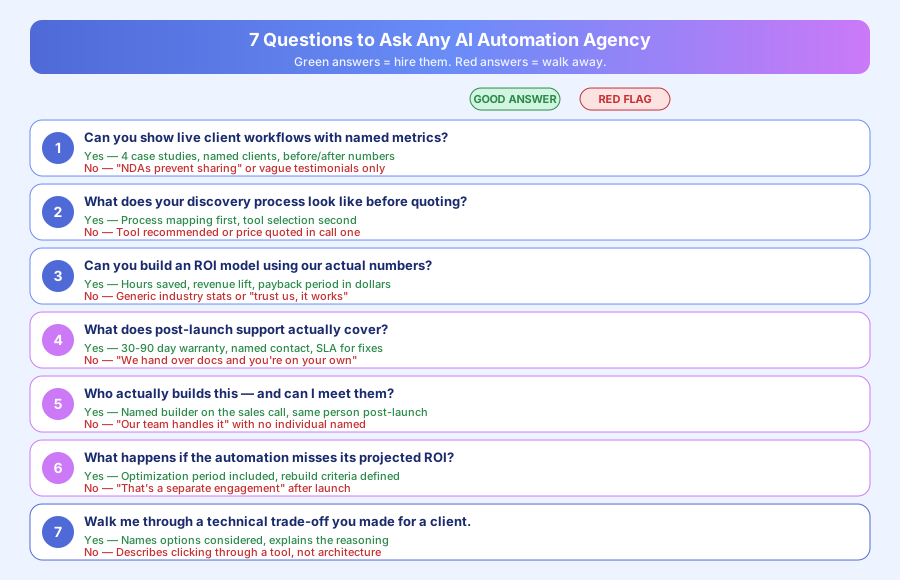
7 questions to ask before signing with an automation agency
Question 1: “Can you show me case studies with specific metrics from businesses similar to mine?”
Answer capsule: A legitimate agency shares named clients, documented industries, and before/after numbers — response time dropped from X to Y, staff hours fell from A to B, conversion lifted by Z%. Vague praise like “works great, highly recommend” means nothing. Real results come with real digits and willing references.
A strong case study includes the problem, the build, the outcome, and permission to reference the client directly. If every case study is anonymized, ask why. Some industries genuinely need confidentiality, but legitimate agencies always have a few clients willing to hop on a reference call.
Red flag: “We have lots of happy clients but can’t share details due to confidentiality.” If zero clients will vouch for them, you’re probably the test case.
What to test: Ask for one reference call. A real agency will set one up within 48 hours.
Question 2: “What does your discovery process look like before you recommend anything?”
Answer capsule: Quality agencies start with your process, not their toolbox. Before any platform gets mentioned, they should map your workflow step by step, quantify the manual work, document current systems, and pin down what success looks like. If they’re naming tools in call one, they’re selling you something generic.
Before recommending Make vs. Zapier, GPT vs. rules-based systems, or any specific architecture, a real agency documents:
- Your current workflow, step by step, with timing data
- Where manual work lives and how many hours it consumes weekly
- What data sits in which systems and how (or whether) they connect
- What success looks like in metrics you already track
Red flag: An agency that quotes a price or recommends specific tools in the first conversation without a discovery phase. They’re selling a generic solution before they understand your specific problem.
Question 3: “Can you provide an ROI model before we start?”
Answer capsule: Credible agencies model expected returns before asking for commitment. That means your actual support ticket volume, your current response times, your real conversion rates — not generic industry averages. The model should show time saved, revenue impact, and payback period in dollars you can verify.
McKinsey’s 2025 Small Business Automation Survey reported a median payback period of 5.2 months across 1,200 SMB projects with documented ROI. That’s the realistic benchmark. Anyone projecting a two-month payback is guessing, and anyone refusing to project at all hasn’t modeled the work.
The ROI model should also state assumptions clearly: “Assumes current ticket volume of 340 per week, average handle time 6 minutes, deflection rate of 35%.” Transparent assumptions mean you can test them yourself.
Red flag: An agency that can’t or won’t provide a specific ROI model. If they can’t predict the outcome, they can’t commit to delivering it.
Question 4: “What does post-implementation support look like?”
Answer capsule: Automations break. APIs change, workflows drift, edge cases surface. A real agency commits to a 30-90 day warranty period, a response time SLA, and either an ongoing retainer or documentation strong enough for your team to maintain independently. Handover-and-disappear agencies leave you with a system you can’t fix.
Forrester’s 2025 automation report found that projects without a defined post-launch support phase had a 47% higher abandonment rate within six months compared to projects with at least 30 days of included support. The maintenance window isn’t a nice-to-have — it’s the difference between a working system and shelfware.
Red flag: “We hand over the documentation and you’re on your own.” A one-time build with no support sets you up to lose the investment the first time an integration breaks.
Question 5: “Who actually builds this — and will they be available after launch?”
Answer capsule: In larger agencies, the senior who sells the engagement rarely builds it. Find out who your actual implementation lead is, meet them during the sales process, and confirm they’re the named contact for post-launch support. Anonymous “teams” create accountability gaps that surface exactly when you need help.
A strong answer sounds like: “Priya will be your lead architect. She’ll own the discovery call, the build, and any support tickets for the first 60 days.” A weak answer is: “Our team handles implementation, and we route support through a shared inbox.”
Red flag: “Our team handles it” with no individual named. Accountability requires a person.
Question 6: “What happens if the automation misses its projected results?”
Answer capsule: Quality agencies stand behind their projections. The right answer includes a defined optimization period after launch, a commitment to adjust the build if metrics miss the model, and clear criteria separating a refinement from a rebuild. If they’re only accountable for deliverables, they’re not accountable for outcomes.
This question separates agencies from contractors. Contractors build to specification and exit. Agencies tie their reputation to the result, because they want the case study and the referral.
Red flag: “We build what was specified. If results don’t match expectations, that’s a separate engagement.” Deliverables that don’t perform aren’t worth what you paid.
Question 7: “Can you walk me through a technical decision you made for a client and why?”
Answer capsule: This question separates tool operators from automation architects. A strong answer describes a specific situation, the options considered, the trade-offs weighed, and the outcome. A weak answer describes clicking through a platform interface. Architects think in systems. Operators think in buttons.
A real answer might go: “One client had 40,000 monthly operations, which pushed them past Zapier’s team plan pricing. We evaluated n8n self-hosted versus Make’s Teams plan, chose Make because the client had no DevOps capacity, and saved them $18,000 a year compared to the Zapier quote.”
Red flag: An answer that describes a tool’s features without explaining why that tool beat alternatives for that client. Tool familiarity is not expertise.
The 7-point evaluation scorecard
| Criterion | Strong Answer | Weak Answer |
|---|---|---|
| Case studies | Named clients, specific before/after metrics, references available | Vague testimonials, anonymized everything |
| Discovery process | Process-first, tool-second, quantifies current workflow | Tool recommendation in call one |
| ROI modeling | Your numbers, transparent assumptions, payback in months | Generic industry benchmarks or refusal |
| Post-launch support | 30-90 day warranty, SLA, named contact | Handover only, no warranty period |
| Implementation accountability | Named builder, met during sales, stays post-launch | Anonymous “team,” different person post-launch |
| Outcome accountability | Optimization period, rebuild criteria defined | Deliverable-only, extra scope for fixes |
| Technical reasoning | Explains trade-offs, names alternatives considered | Describes tool features, no alternatives |
An agency that scores strong across all seven is worth paying a premium for. An agency that scores weak on ROI modeling and outcome accountability will almost certainly underdeliver, regardless of how impressive their toolchain looks.
What does a real automation project cost in 2026?
Price is a proxy for scope, not quality. The cheapest agency isn’t the worst, and the most expensive isn’t the best. What price should reflect is work volume, integration complexity, support depth, and the seniority of the people doing the build.
Based on 2026 SMB pricing data from Clutch.co’s automation services directory:
- Single workflow build (one trigger, 3-5 actions, one system): $2,500-$5,000
- Multi-workflow implementation (3-5 workflows, 2-4 systems): $8,000-$15,000
- Enterprise-grade stack (10+ workflows, custom integrations): $25,000-$75,000
- Ongoing maintenance retainer: $500-$2,000 per month
A $2,500 quote for a single well-scoped automation is excellent value. A $2,500 “AI automation package” promising to automate your entire business without discovery is a red flag at any price.
Get detailed scope statements from at least two agencies before comparing prices. Comparing quotes without comparable scopes is comparing apples to trucks.
How long should an AI automation project take?
Answer capsule: A single-workflow build runs 2-3 weeks from discovery to go-live. Multi-system implementations covering 3-5 workflows run 6-10 weeks. Discovery is roughly 20% of the timeline, building is 40%, and testing plus handover is the final 40%. Anyone promising a full automation stack in under two weeks is skipping QA.
A realistic 8-week project looks like this:
- Week 1-2: Discovery, process mapping, ROI model, scope lock
- Week 3-4: Core build on staging, first integration tests
- Week 5-6: Full system build, edge case handling, internal QA
- Week 7: User acceptance testing with your team
- Week 8: Go-live, monitoring, first week of warranty support
If an agency compresses this into three weeks, ask what they’re cutting. It’s almost always testing — and testing is where 80% of production bugs get caught.
Freelancer vs. agency: which is right for you?
Freelancers are right for narrow, well-defined automation tasks where you have internal technical capacity to maintain the system after delivery. Agencies are right for multi-system implementations, ongoing support needs, and teams without in-house automation skills.
The difference isn’t quality. Individual freelancers can be outstanding. The difference is bench depth. Agencies cover sick days, add capacity when scope grows, and maintain continuity without depending on a single person. If your automation is business-critical, bench depth matters more than hourly rate.
For related reading, see The Real ROI of AI Automation: Numbers From 50+ Small Business Implementations and How to Build an AI Strategy for Your Small Business.
Book a free automation audit — this is exactly the discovery conversation the right agency should start with. We’ll map your current processes, identify your highest-ROI automation opportunities, and give you a specific ROI model before recommending any implementation.