According to McKinsey’s 2024 Global Survey on AI and Automation, 60% of all occupations have at least 30% of their activities that could be automated with technology that already exists. For small businesses that number is usually higher, because lean teams handle more repetitive operational work per person than large enterprises. The opportunity is huge, but “automation” gets used so loosely that most owners aren’t sure what it means for their specific operation. This guide gives you the practical version — what business process automation actually is, when to use it, what it costs, and how to start without wasting money.
What Is Business Process Automation?
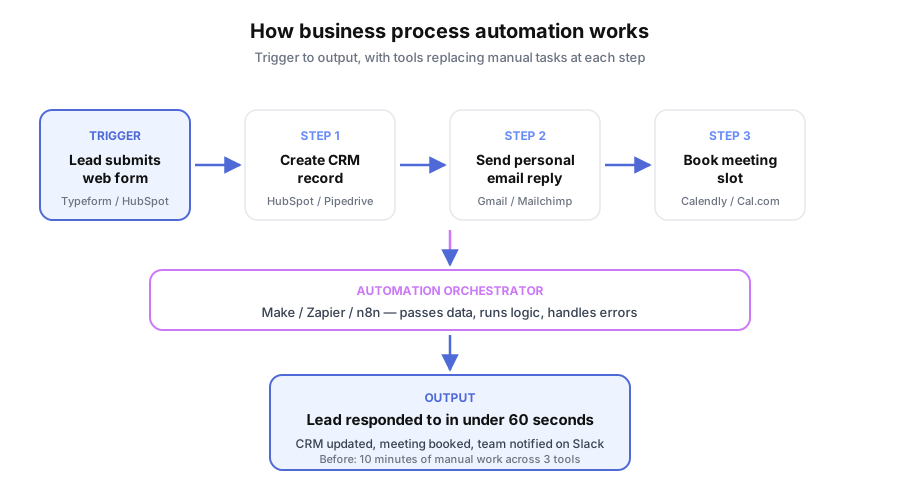
Business process automation (BPA) is the use of software to run a repeatable, multi-step workflow without manual clicks. A specific event triggers the workflow, and the system executes every step: moving data between tools, sending messages, updating records, and routing decisions. It’s different from automating a single task.
The key word is “process.” You’re not automating one action. You’re automating a sequence of connected steps that happen in the same order, triggered by the same event, every single time.
Here’s a concrete example. A lead fills out a form on your site. Today, someone sees the notification, opens the CRM, checks for duplicates, creates a record, drafts a personal email, sends it, schedules a follow-up reminder, and logs the interaction. That’s 7 steps, 3 tools, 10 minutes. Multiply by 25 leads a day and you lose 4 hours of team time before lunch.
With BPA, the form submission fires all 7 steps instantly. The lead gets a reply in under 60 seconds. Your team only gets pulled in when a human decision actually matters. A Harvard Business Review study (Oldroyd, 2011; refreshed by Drift, 2023) found that responding within 5 minutes makes you 100x more likely to connect than waiting 30 minutes. Thompson Career College automated exactly this workflow — response times dropped from 1-2 business days to under 60 seconds, and admissions calls tripled.
How Is BPA Different from Task Automation, AI, and RPA?
These four terms get used interchangeably, but they solve different problems. Picking the wrong one wastes money. Here’s the short version so you can tell them apart in one table.
| Type | What it does | Example | Best for |
|---|---|---|---|
| Task automation | Runs a single action | Auto-save a document every 5 minutes | Individual productivity |
| Business process automation | Runs a multi-step workflow | Lead form triggers CRM entry, email reply, and call booking | Operational efficiency |
| AI (Artificial Intelligence) | Makes decisions from patterns | Understanding customer intent in support messages | Unstructured inputs |
| RPA (Robotic Process Automation) | Mimics human clicks in software | Bot enters data into a legacy system with no API | Enterprise legacy systems |
Most small businesses need BPA first. It handles about 80% of efficiency gains. AI adds value in specific spots — support (understanding varied questions) and lead scoring (predicting conversion). RPA is rarely needed unless you’re running software from 2005 with no API.
According to Deloitte’s 2023 Global Intelligent Automation Survey, 78% of organizations that implemented BPA before AI or RPA reported faster time-to-value and higher employee satisfaction with the change. For a deeper breakdown, see our guide on automation vs AI vs RPA.
When Should You Automate a Process?
Not every process should be automated. Some are too rare, too variable, or too dependent on human judgment. Automate when the same steps repeat more than 10 times per week, timing matters, errors are costly, or one person bottlenecks routine work. Don’t automate creative judgment, one-offs, or processes you haven’t defined yet.
Automate when:
- The same steps happen more than 10 times per week
- Timing matters (leads need replies in minutes, not hours)
- Errors are expensive (wrong invoice amounts, missed compliance deadlines)
- One person bottlenecks a process that doesn’t require their expertise
- The work needs to happen outside business hours
Don’t automate when:
- The process changes every time (creative strategy, custom proposals)
- Human judgment is the whole point (negotiations, sensitive conversations)
- It happens once a month and takes 5 minutes
- You haven’t defined the process yet — fix it on paper first
According to Salesforce’s 2024 Small Business Trends Report, 43% of small business owners rank automation as their top operational priority. And 29% say they’re automating as much as possible specifically to prevent burnout, per Zapier’s 2024 State of Business Automation Report. Tools like Make and Zapier make it possible for small teams to build these workflows without writing code.
Taxvisory’s founder automated document chasing, appointment scheduling, and status updates. She manages 300 clients solo. But she didn’t automate client consultations or tax strategy — the system handles operational work, she handles the expertise.
What Does the Business Process Automation Process Look Like?
Every BPA project we run follows the same four phases: map the process, pick the highest-ROI target, build and launch, then measure and expand. We’ve used this sequence across 6 industries — education, real estate, tax, SaaS, immigration, and marketing agencies — and the pattern holds regardless of what the business does.
Step 1: Map the Current Process
Write down every step, every tool, every decision point, and every exception. Skipping this step is the most common reason BPA projects fail. According to Process Street’s 2024 Process Management Survey, teams that document before automating hit ROI 2.3x faster than teams that skip mapping.
A good process map captures: what triggers each step, which tool handles it, what data is needed, which decisions get made, and what happens when things break. For a detailed walkthrough, see how to map your business processes for automation.
Step 2: Pick the Highest-ROI Candidate
Score each process on three dimensions: frequency (how often it runs), time (how long each instance takes), and failure cost (what breaks when it’s late or wrong).
Frequency x Time x Failure Cost = Priority Score
The highest-scoring process is your first automation. For most small businesses it’s lead follow-up, invoice reminders, or appointment scheduling.
Step 3: Build, Test, and Launch
Simple automations take 1 to 2 weeks. Multi-step workflows take 2 to 4 weeks. Full operations overhauls run 4 to 8 weeks. According to Celonis’s 2024 Process Intelligence Report, the median time-to-value for BPA projects is 6 weeks from kickoff to measurable results.
Step 4: Measure and Expand
Track hours saved, error rates, and revenue impact for 30 days. If the numbers look good — and they almost always do — pick the next process from your priority list. Most businesses automate 3 to 5 core processes in their first year.
What Are the Three Levels of Business Process Automation?
Most businesses don’t jump straight to full automation. They progress through three levels, building trust at each stage: notification and routing, execution with human oversight, and full end-to-end automation. Starting at Level 1 and building up gets better adoption than trying to automate everything on day one.
Level 1: Notification and Routing
The system watches for triggers and routes information to the right person. No automated actions yet. Example: a support email arrives and gets auto-categorized and assigned with full context. A person still writes the reply.
Level 2: Execution with Human Oversight
The system takes action, but a person reviews before anything goes out. Example: an invoice generates automatically from project data, but your finance person approves it before sending. This is where most businesses stabilize.
Level 3: Full End-to-End Automation
The system handles everything. Humans only step in for exceptions. Example: KwikUI resolves 65% of support tickets automatically — the AI reads the question, pulls the answer from the knowledge base, and responds instantly. Only complex issues reach a human, and they arrive with full context.
According to UiPath’s 2024 Automation Index, organizations that start at Level 1 and progress to Level 3 over 12 months see 4x higher adoption rates than teams that try full automation from day one.
What Tools Power Business Process Automation for Small Teams?
Small teams don’t need enterprise software. A typical BPA stack has four parts: an orchestrator that runs the workflow, a CRM for customer data, a calendar for scheduling, and email or messaging tools for communication. The orchestrator is the brain — it listens for triggers and tells every other tool what to do.
| Role | Popular tools | Typical cost |
|---|---|---|
| Orchestrator | Make, Zapier, n8n | $20 to $100 / month |
| CRM | HubSpot, Pipedrive, Zoho | $0 to $50 / user / month |
| Calendar booking | Calendly, Cal.com, TidyCal | $0 to $15 / user / month |
| Email & messaging | Gmail, Mailchimp, Slack | $0 to $15 / user / month |
| Forms & intake | Typeform, Tally, Jotform | $0 to $40 / month |
According to Zapier’s 2024 State of Business Automation Report, 88% of SMBs using no-code automation tools say it helps them compete with larger companies. And Make’s 2024 Automation Benchmark Report shows the average no-code workflow replaces 11.3 hours of manual work per week. For a side-by-side look at the orchestrators, see our Make.com review.
The tools matter less than the process design. A well-mapped workflow runs fine on Zapier or Make. A badly mapped workflow breaks on any platform.
What Results Should a Small Business Expect from BPA?
Here’s what we’ve seen across real client projects, with specific numbers instead of generic claims:
| Client | Industry | Key Result | Timeline |
|---|---|---|---|
| Thompson Career College | Education | 3x admissions calls, sub-60s response time | 90 days |
| KwikUI | SaaS | 65% fewer support tickets, 2x conversion | 90 days |
| Taxvisory | Tax | 300 clients managed solo, 80% less document chasing | 60 days |
| AcquireX Properties | Real Estate | 3x portfolio capacity, same 3-person team | 90 days |
| Pixorr | Marketing Agency | 85% faster reporting, full work week reclaimed | 60 days |
| Skylarks International | Immigration | 70% faster document collection, 80% fewer status calls | 90 days |
These aren’t outliers. According to Forrester’s 2024 Total Economic Impact studies, the average BPA project delivers 200% ROI in year one. Payback for most small business projects lands between 2 and 4 months. McKinsey’s 2024 State of AI report found that companies automating core operations saw a 23% average drop in operating costs within 12 months.
The common thread across these projects: the team started with one clearly-defined process, proved the ROI, then expanded. None of them tried to automate everything at once.
How Do You Get Started with Business Process Automation?
You don’t have to automate everything on day one. Pick the process that runs most often, has the clearest steps, and costs you the most when it fails. Map it, build it, measure it, then move to the next one. Most businesses hit meaningful ROI after automating just 2 to 3 workflows. If you’re brand new to this and want the ground-floor version first, our business automation for beginners guide walks through a 7-step starter framework — including the Frequency × Time × Failure Cost scoring method for picking your first process and a comparison of DIY tools versus agency builds.
If you’re not sure which process to start with, book a free 30-minute audit. We’ll map your operations, flag the 2 to 3 biggest bottlenecks, and send you a written Automation Opportunity Report within 48 hours. It includes estimated savings for each bottleneck and a clear recommendation on where to start.
The audit is free. The report is yours to keep. You’ll walk away with specific numbers instead of guesses — and a prioritized list of what to automate first.