GoHighLevel and HubSpot are both called “all-in-one” platforms, but they’re not competing for the same buyer. According to G2’s 2026 CRM Grid Report, HubSpot serves 158,000 businesses globally while GoHighLevel powers over 60,000 agency sub-accounts representing roughly 900,000 end businesses. That split tells you everything about who each platform was built for.
HubSpot was designed for individual businesses that want the best CRM experience money can buy. GoHighLevel was designed for marketing agencies that need to resell a branded platform to clients at flat-fee economics. This article breaks down price, features, automation depth, and real use cases so you can pick the right one without wasting a month on a trial.
Which Platform Is Better for Small Business in 2026?
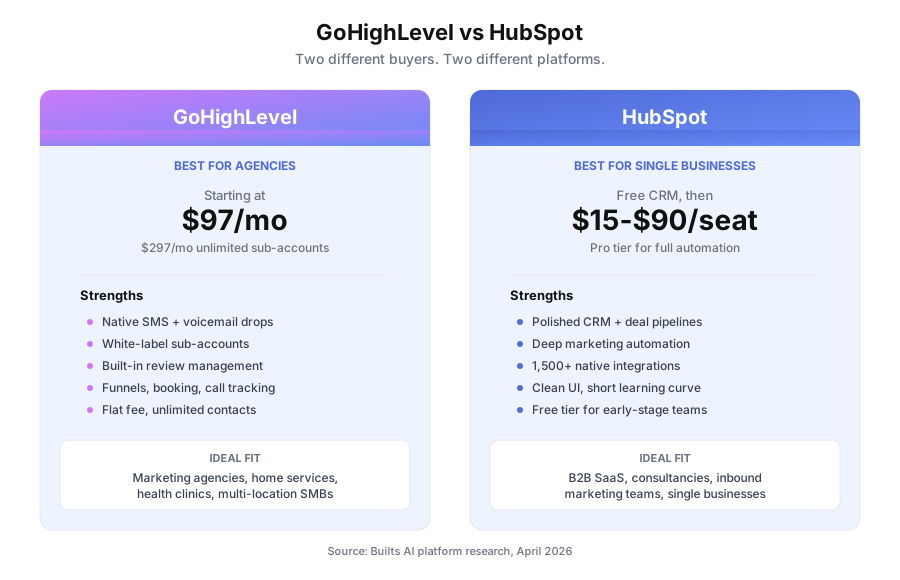
HubSpot is better for most single small businesses because its CRM is cleaner, its onboarding is faster, and its free tier is genuinely useful. GoHighLevel wins when you’re a marketing agency, a home-service business needing SMS automation, or a multi-location brand replacing five separate tools with one flat-fee platform.
The decision rarely comes down to features alone. According to Gartner’s 2026 Digital Marketing Survey, 67% of small businesses regret their marketing platform choice within 18 months because they picked based on price instead of fit.
Here’s the quick-decision framework I use with clients:
- Pick HubSpot if you’re a single business under 50 people, your team values clean UX, and integration depth matters.
- Pick GoHighLevel if you run an agency, SMS is a primary channel, or you’re replacing 5+ point tools.
- Pick neither if you need enterprise-grade attribution or vertical-specific CRM like real estate or healthcare.
How Do GoHighLevel and HubSpot Compare on Pricing?
GoHighLevel starts at $97/month with unlimited contacts on every plan. HubSpot starts free for basic CRM and scales to $90/seat/month for Professional marketing automation. The total cost flips dramatically based on team size, channel needs, and how many client accounts you manage.
According to Forrester’s 2025 Martech Pricing Benchmark, the average small business spends $340/month across 4.2 marketing tools. Both platforms promise consolidation, but they do it with very different pricing logic.
| Scenario | GoHighLevel | HubSpot |
|---|---|---|
| Free tier | None (14-day trial) | Free CRM forever |
| Single business, basic CRM | $97/month | $15/seat/month Starter |
| Single business, full marketing | $97/month flat | $90/seat/month Professional |
| 5-person marketing team | $97/month | $450/month Professional |
| Agency, 10 client accounts | $297/month Unlimited | $900+/month (10x individual) |
| SMS included | Yes, native | $75/month add-on |
| Reputation management | Included | $200+/month third-party |
HubSpot’s per-seat model punishes growing teams. A 10-person marketing department pays $900/month on HubSpot Professional before adding SMS or landing pages.
GoHighLevel’s flat-fee model punishes tiny solo operators. A freelancer who only needs a contact database would spend $1,164/year on GHL versus $0 on HubSpot’s free tier.
What Are the Key Feature Differences Between GoHighLevel and HubSpot?
GoHighLevel packs more tools into one subscription, including native SMS, funnel builders, call tracking, and review management. HubSpot delivers deeper quality on each individual tool, especially CRM, marketing automation, and reporting. It’s consolidation breadth versus per-feature depth.
According to TrustRadius’s 2026 Marketing Automation Report, GoHighLevel users rate “tool consolidation” as their top benefit at 4.6/5. HubSpot users rate “ease of use” highest at 4.5/5. Different winners for different jobs.
| Feature | GoHighLevel | HubSpot |
|---|---|---|
| CRM and contacts | Adequate | Excellent |
| Email marketing | Good | Excellent |
| SMS marketing | Native, strong | Add-on, limited |
| Marketing automation | Good | Excellent (Professional+) |
| Landing page builder | Included | Professional+ |
| Appointment scheduling | Included | Free basic, paid advanced |
| Review management | Included | Not native |
| Call tracking | Included | Not native |
| White-label agency mode | Core feature | Not available |
| Course / membership hosting | Included | CMS Enterprise only |
| Reporting and analytics | Adequate | Excellent |
| Integrations ecosystem | ~200 apps | 1,500+ native |
| Mobile app quality | Functional | Polished |
| Interface quality | Complex | Clean and intuitive |
| Free tier | None | Generous free CRM |
Which Has Better Marketing Automation Workflows?
HubSpot has deeper CRM-driven automation with complex branching, lead scoring, and property-based triggers. GoHighLevel has broader multi-channel automation combining email, SMS, voicemail, and review requests in a single workflow. HubSpot wins on precision, GoHighLevel wins on channel coverage.
HubSpot’s workflow engine, which shipped its v3 update in March 2026, now handles 500+ enrollment triggers per workflow and supports AI-powered branching based on deal stage or engagement score. The platform reports 2.1 million active workflows running globally.
GoHighLevel’s workflow builder ships with pre-built templates for common service-business scenarios: missed-call text-back, appointment reminder sequences, post-service review requests. According to GHL’s 2025 user survey, 78% of agency accounts activate the SMS appointment reminder template in their first week.
Real-world example: a dental clinic running a new-patient sequence. On HubSpot Professional, you’d build an email nurture using custom contact properties, then pay $75/month for the SMS add-on to send reminders. On GoHighLevel, the same sequence including SMS reminders, missed-call text-back, and automated review requests works out of the box on the $97 plan.
For a B2B SaaS tracking complex deal stages, HubSpot’s CRM-native automation handles the job more elegantly. For a local service business running lead-to-appointment sequences, GoHighLevel is faster to configure and cheaper to run.
Which CRM Is More Powerful — GoHighLevel or HubSpot?
HubSpot’s CRM is measurably stronger with better contact records, deal tracking, and custom properties. GoHighLevel’s CRM is functional but feels cluttered and offers less flexibility for complex sales pipelines. For teams where CRM quality is the primary buying criterion, HubSpot wins without much debate.
According to G2’s 2026 CRM satisfaction data, HubSpot scores 4.4/5 overall versus GoHighLevel’s 4.1/5, with the biggest gap on “ease of setup” (HubSpot 4.3 vs GHL 3.7). HubSpot’s contact timeline shows every email, call, form submission, and meeting in a unified view, making it easy for sales reps to prep before a call.
GoHighLevel’s contact view is functional but buries activity history under separate tabs. Custom properties max out at 100 per contact on GHL versus unlimited on HubSpot Professional.
Where GHL’s CRM shines: pipeline management for short sales cycles common in service businesses. The drag-and-drop opportunity board is easier to set up than HubSpot’s Deals module and handles appointments-as-opportunities naturally.
If you’re running a consultancy or B2B SaaS with multi-month sales cycles, HubSpot’s CRM depth pays off. If you’re running a home-service business closing deals in days, GHL’s simpler pipeline is enough.
How Do SMS and Messaging Capabilities Compare?
GoHighLevel wins decisively on SMS. It includes native two-way texting, bulk campaigns, SMS automation sequences, ringless voicemail drops, and missed-call text-back on every plan. HubSpot treats SMS as an add-on feature with fewer capabilities and higher per-message costs.
According to Twilio’s 2026 State of Customer Engagement Report, SMS response rates average 45% versus email’s 8% for service-business appointment confirmations. That gap makes SMS a critical channel for local businesses, home services, healthcare, and any workflow requiring fast response.
GoHighLevel bills SMS on a pass-through model through Twilio, costing roughly $0.0075 per segment for US numbers. A dental practice sending 2,000 appointment reminders per month pays about $15 in SMS costs on top of the $97 subscription.
HubSpot’s SMS add-on starts at $75/month for 1,000 messages, with additional messages at $0.02 each. The same 2,000 messages cost $95 on HubSpot versus $15 on GoHighLevel, a 6x difference before counting the add-on subscription fee.
For any business where SMS is a primary communication channel — restaurants confirming reservations, clinics confirming appointments, agencies sending client updates — GoHighLevel’s native SMS infrastructure saves real money.
Which Platform Has Better Integrations and Extensibility?
HubSpot has a significantly larger integration ecosystem with over 1,500 native connectors including Salesforce, Shopify, Zoom, Slack, and major enterprise data warehouses. GoHighLevel offers around 200 native integrations and relies heavily on Zapier and custom webhooks for anything outside common use cases.
According to HubSpot’s 2026 Partner Program report, 73% of HubSpot customers activate at least three third-party integrations in their first 90 days. The App Marketplace includes deep connections to ERPs like NetSuite, e-commerce platforms like WooCommerce, and helpdesks like Zendesk.
GoHighLevel’s native integrations focus on channels agencies use: Facebook Ads, Google Ads, Twilio, Mailgun, and Stripe. Anything enterprise — a custom-built ERP, a Snowflake warehouse, or a legacy industry CRM — requires Zapier or a developer building against GHL’s API.
If your operations rely on Shopify inventory syncing, Salesforce data exports, or Xero accounting integration, HubSpot’s ecosystem is substantially less work. If your stack is simpler and lives inside Google, Meta, and Twilio, GoHighLevel’s native connections cover the essentials.
When Should You Choose GoHighLevel Over HubSpot?
Choose GoHighLevel when you run a marketing agency managing multiple clients, when SMS is a primary communication channel, when you’re replacing 5 or more tools with one subscription, or when reputation management and call tracking matter. Its flat-fee economics and all-in-one bundle beat HubSpot in those scenarios.
According to Agency Analytics’ 2026 Agency Software Report, 61% of marketing agencies with under 25 employees now use GoHighLevel as their primary client delivery platform, up from 42% in 2024. The growth reflects GHL’s unique positioning.
Strong fit scenarios:
- Marketing agencies. White-label sub-accounts, branded mobile app, and $297 flat fee for unlimited clients are purpose-built for agency economics.
- SMS-heavy local businesses. Home services, health clinics, restaurants, and auto shops where two-way texting drives bookings.
- Multi-location brands. Franchisees needing consistent automation across 10+ locations without paying per-seat.
- Service businesses consolidating tools. Replacing Calendly, Mailchimp, Podium, CallRail, and Typeform with one $97 subscription.
If your business falls into any of these buckets, GoHighLevel likely saves money and reduces vendor sprawl.
When Should You Choose HubSpot Over GoHighLevel?
Choose HubSpot when you’re a single business (not an agency), when CRM sophistication is your top priority, when your team values an intuitive interface, or when you need deep integrations with Salesforce, Shopify, or enterprise tools. HubSpot’s free tier also wins for early-stage teams with zero budget.
According to HubSpot’s 2026 Annual Report, 60% of new HubSpot customers start on the free CRM tier and upgrade within 12 months as they scale. That onramp doesn’t exist on GoHighLevel, which requires a $97/month commitment from day one.
Strong fit scenarios:
- B2B SaaS and consultancies. Sales cycles measured in months where CRM depth and lead scoring matter.
- Inbound marketing teams. Blog content, gated assets, and multi-touch attribution are HubSpot’s core strength.
- Solo operators and startups. The free tier genuinely covers early-stage needs without forcing a $97 commitment.
- Teams with non-technical admins. HubSpot’s UI is significantly cleaner and onboarding is 2-4 weeks shorter on average.
If your primary need is an elegant CRM your team will actually use, HubSpot delivers a better day-to-day experience.
What About Migration Between the Two Platforms?
Migrating between GoHighLevel and HubSpot is technically feasible but requires 20 to 40 hours of rebuild work. Contacts and basic CRM data export cleanly, but email templates, automation workflows, landing pages, and custom properties must be rebuilt from scratch in the destination platform.
According to Salesforce’s 2025 CRM Migration Survey, 44% of SMB migrations exceed their planned timeline, usually because teams underestimate workflow rebuild time. For a business with 30+ active HubSpot workflows, budget 4 to 6 weeks before fully cutting over.
Migration cost estimator:
- Contact export and import: 2-4 hours
- Email template rebuild: 4-8 hours
- Workflow recreation: 10-20 hours
- Landing page rebuild: 4-8 hours
- Team training: 4-8 hours
Most successful migrations happen in parallel: run both platforms for 30 days, migrate one workflow at a time, and only shut down the old platform after new automations hit their performance benchmarks.
Which Platform Wins for Marketing Agencies?
GoHighLevel wins decisively for marketing agencies. Its sub-account architecture, white-label capability, and flat $297/month for unlimited clients were built specifically for agency economics. HubSpot has no equivalent multi-tenant model, and managing separate HubSpot Professional instances for each client is financially unsustainable past 3 to 5 accounts.
According to the 2026 Agency Pricing Report from Databox, the median marketing agency charges clients $1,800/month for managed services but pays $89/month per client in tool costs. GHL’s flat-fee model drops that tool cost below $30/month per client at 10+ accounts, expanding agency margins directly.
HubSpot offers a Solutions Partner Program with volume discounts, but the per-seat structure still compounds unfavorably. A 15-client agency would spend $1,350/month on HubSpot Professional versus $297/month on GoHighLevel Unlimited — a $12,636 annual difference.
The only agencies where HubSpot makes sense are enterprise-focused consultancies serving clients who already run HubSpot internally. In that scenario, you’re not picking a platform for yourself; you’re operating inside the client’s existing instance.
For everyone else running a marketing agency in 2026, GoHighLevel is the default choice.
Which Platform Should You Pick?
Here’s the decision in one sentence: if you’re a marketing agency or SMS-heavy service business, pick GoHighLevel; if you’re a single business that values CRM depth, clean UX, and integration breadth, pick HubSpot.
Either way, the platform only pays off once the pipelines and follow-up sequences are wired up — the work our sales automation builds cover on both platforms.
For related reading, see our GoHighLevel Review and our Best CRM for Small Business comparison.
Still unsure which platform fits your specific workflow? Book a free automation audit and we’ll assess your team size, channel mix, integration needs, and budget, then give you a direct recommendation based on real fit — not vendor marketing.