90% of renters want to handle rental processes digitally, according to Buildium’s 2024 Tenant Preferences Survey, and 61% already pay rent online, per the National Apartment Association’s 2024 report. Your tenants expect digital communication. If your 2 or 3-person team is still copying emails, tracking spreadsheets, and fielding phone calls for every maintenance request, you’re burning 15 to 25 hours a week on work that should run itself.
We built AcquireX Properties Capital, a 3-person multifamily investor in Ontario, four automation systems that tripled their portfolio capacity without a single new hire. Here’s the playbook, the math, and the specific workflows that made it work.
Where do small PM teams actually lose time?
Small property management teams lose 15 to 25 hours a week on five repeatable workflows: rent follow-up, maintenance coordination, lease renewals, move-in/move-out handling, and investor reporting. Volume scales with units managed, but team size doesn’t. That’s the math problem automation solves.
According to Statistics Canada’s 2024 SEPH data, a Canadian full-time employee costs $45,000 to $65,000 per year. A coordinator spending 20 hours a week on tenant communication costs $23,000 to $33,000 annually on purely repeatable work. That’s before counting the units you can’t take on because the team is already capped.
| Communication task | Frequency | Manual time | Cost when delayed |
|---|---|---|---|
| Rent reminders and late follow-up | Monthly | 3 to 5 hrs | Late payments, cash flow drag |
| Maintenance intake and routing | Ongoing, 5 to 20 per week | 5 to 10 hrs | Tenant churn, legal risk |
| Lease renewal outreach | 60 to 90 days pre-expiry | 2 to 4 hrs | Silent vacancies |
| Move-in/move-out coordination | Per turnover | 3 to 5 hrs | Lost rent days |
| Investor/owner reporting | Monthly or quarterly | 4 to 8 hrs | Investor churn |
At AcquireX, deal analysis, the work that actually drives returns, was getting buried under tenant emails and ledger updates. That’s the pattern we see at almost every small portfolio — our property management case study walks through how a solo manager handling 120 units rebuilt three systems (tenant communication, maintenance routing, landlord reporting) in 4-6 weeks and freed capacity for 40% more units without hiring.
How do you automate rent collection without annoying tenants?
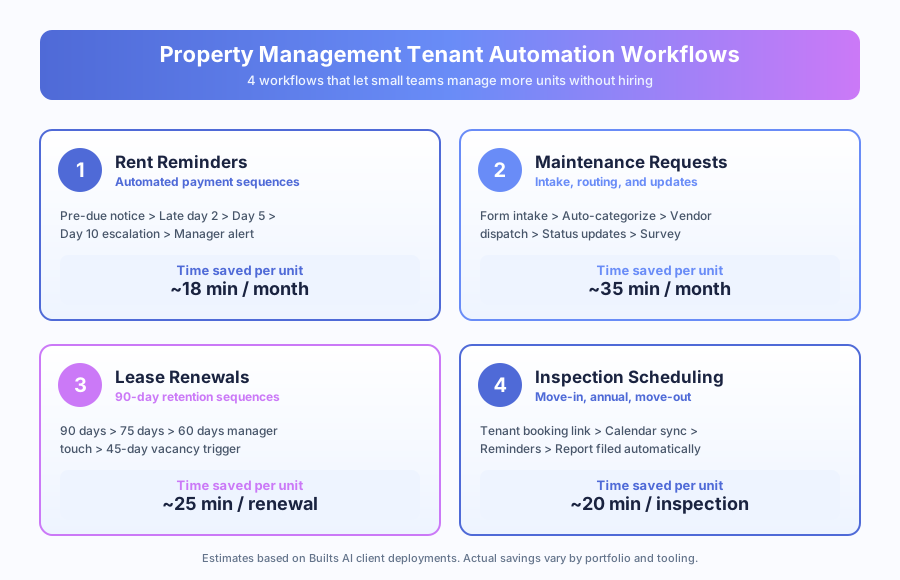
Automated rent workflows send pre-due reminders, flag missed payments, escalate through a defined sequence of friendly, firm, and final notices, and log everything in your property management software. Staff only get pulled in when a tenant needs real human attention, not for the 95% of payments that happen on time.
According to National Apartment Association data from 2024, properties using automated payment workflows see 15% to 20% faster collection times. On 100 units averaging $1,500 rent, a 5-day improvement in collection speed moves roughly $25,000 in receivables timing each month. That compounds fast on multifamily portfolios with dozens of doors.
A typical automated rent sequence:
- 5 days before due date: Friendly email plus SMS reminder with payment link
- Due date: Payment confirmation or missed-payment flag in PM software
- Day 2 late: Late notice with fees calculated per lease terms
- Day 5 late: Escalation with payment plan options
- Day 10 late: Alert to property manager for personal outreach
- Any payment received: Auto confirmation, receipt, and ledger update
Step 5 is the only one humans touch. Steps 1 through 4, and step 6, run on rails. For most teams, that’s 60% of rent-collection hours gone in the first month. If you want to see how other small teams set this up, our guide on the best AI tools for small business in 2026 walks through the tool selection.
What does automated maintenance handling look like?
Automated maintenance routes tenant requests to the right vendor by issue type, sends acknowledgment within minutes, pushes status updates as work progresses, and closes with a satisfaction check. Tenants feel heard. Vendors get clear work orders. Your team manages by exception dashboard, not by phone.
Buildium’s 2024 Property Manager Report found maintenance response time is the number one driver of tenant satisfaction, and properties acknowledging requests within 4 hours retain tenants 23% longer than those taking more than 24 hours. That retention premium alone usually pays for automation in the first quarter.
| Step | Trigger | Automated action |
|---|---|---|
| Request submitted | Form, email, or SMS | Acknowledgment within 2 minutes; issue auto-categorized |
| Vendor assignment | Category matched | Routed to preferred vendor; work order generated |
| Scheduling | Vendor confirms | Tenant notified of date and time; calendar synced |
| Completion | Vendor marks done | Tenant gets satisfaction survey; invoice logged |
| Follow-up | 48 hours post-completion | One reminder if survey unanswered |
The stack: DoorLoop, Buildium, or AppFolio handles the data layer. Twilio or equivalent handles SMS. n8n or Make connects everything and runs the logic. For the underlying routing patterns, our breakdown on how to automate support ticket routing applies directly to maintenance intake.
Emergencies get their own path. A keyword filter (flood, fire, no heat, gas smell, leak) bypasses the standard queue, fires SMS and phone alerts to the on-call manager, and dispatches a priority vendor. Every workflow we build includes that escalation branch before it goes live.
How do you prevent silent vacancies with renewal automation?
Renewal automation starts outreach 90 days before lease expiry, sends renewal offers with market-aligned rates, tracks responses, and only escalates to your team when a tenant declines or goes silent. It kills the silent vacancy, the tenant who leaves because nobody asked them to stay.
According to Forrester’s 2024 Total Economic Impact studies, business process automation averages roughly 200% ROI in year one. For property management, vacancy prevention is where that ROI concentrates. One month of vacancy on a $1,500 unit is $1,500 in lost rent plus $500 to $2,000 in turnover costs: cleaning, repairs, marketing, and showing hours.
A typical renewal sequence:
- 90 days out: Renewal offer email with terms and local market comparison
- 75 days out: Follow-up if no response, with a “want to talk?” CTA
- 60 days out: Alert to property manager for personal outreach
- 45 days out: If declining, trigger the vacancy marketing workflow
- Signed renewal: Auto-update lease record, send confirmation, schedule walkthrough
The insight most teams miss: most tenant departures aren’t about price. The National Apartment Association’s 2024 member survey identified the top three reasons tenants leave as maintenance response time, communication quality, and feeling unvalued. Renewal automation addresses all three at once because it forces timely, personal-feeling outreach at the exact moment tenants are deciding.
How do you automate inspection scheduling?
Inspection automation sends tenants a booking link, syncs chosen slots to vendor and manager calendars, fires reminders 24 and 2 hours out, and auto-files the inspection report back to the property record. Move-in, annual, and move-out inspections all run from the same template with different triggers.
According to McKinsey’s 2024 Global Survey on AI and automation, 60% of occupations have at least 30% of tasks that could be automated with current technology. Inspection coordination sits squarely in that 30%: it’s calendar work, reminder work, and form-filling, which are exactly the things automation handles cleanly.
A workable inspection workflow:
| Inspection type | Trigger | Booking window |
|---|---|---|
| Move-in | Lease signed | 48 hours before move-in date |
| Annual | Lease anniversary | 2-week self-serve window |
| Move-out | Notice received | 72-hour window before move-out |
| Drive-by / compliance | Quarterly cron | No tenant booking needed |
The saved time compounds because inspections generate paperwork, and automation eliminates the “filing it later” step that always becomes “filing it never.” Reports upload to the property record within minutes of completion. On a 100-unit portfolio, that’s roughly 33 hours a month back from inspection coordination alone.
How did AcquireX Properties triple their portfolio?
AcquireX Properties Capital is a 3-person multifamily investor based in Ontario, operating across multiple Canadian provinces. Before automation they were capped: deal analysis took days, tenant communication was purely reactive, and investor reports were a late-night quarterly scramble. Growth was physically impossible without hiring.
Four automation systems rewrote the math:
System 1: Deal analysis. Property listing data flows into an analysis pipeline that auto-calculates cap rates, cash-on-cash returns, and projected IRR. What took 2 to 3 days of spreadsheet work now takes hours. The team evaluates 3x more deals in the same window.
System 2: Tenant and property management. Rent reminders, maintenance routing, renewals, and inspection scheduling all run automated. Tenants get faster responses. The team manages by dashboard, not by inbox.
System 3: Investor reporting. Quarterly reports generate from live property data, including occupancy, rental income, expenses, and returns per property. Personalized PDFs go to each investor on a schedule. No more late nights before investor calls.
System 4: Vendor coordination. Work orders dispatch automatically, status updates push to tenants and owners, and invoices land in the right accounting buckets without manual tagging.
Outcome: 3x portfolio capacity with the same 3 people and 80% faster deal analysis. The full breakdown is in the AcquireX Properties Capital automation case study.
What stack do small PM teams actually need?
The right stack depends on portfolio size. The principle stays constant: your property management software owns the data, the automation layer owns the communication logic, and the gap between them is where manual work hides.
| Portfolio size | Property management | Communication | Automation layer |
|---|---|---|---|
| Under 50 units | DoorLoop, TenantCloud | Email plus Twilio SMS | Zapier or Make |
| 50 to 200 units | Buildium, AppFolio | Email, SMS, tenant portal | n8n or Make |
| 200+ units | AppFolio, RentManager | Full portal and mobile app | Custom n8n plus API work |
The common thread: keep your system of record clean, then let the automation layer handle every predictable communication. Don’t try to automate in your PM software alone. Its built-in workflows are too rigid for the branching logic real operations need.
How do you actually get started?
Start with the workflow that costs you the most when it goes late. For most teams, that’s maintenance response (tenant satisfaction) or rent collection (cash flow). Map every step. Decide between DIY for simple 2 to 3 step workflows with Zapier or Make, or agency-built for multi-system setups with error handling, monitoring, and emergency escalation branches.
Don’t try to automate everything at once. Ship one workflow, measure hours saved for two weeks, then move to the next. That’s how AcquireX got from zero to four systems, and it’s the only approach that doesn’t burn your team out mid-build.
Contact us and we’ll map your property management workflows, identify the highest-ROI automations, and send a written report within 48 hours. Whether you manage 20 units or 200, the bottlenecks follow predictable patterns, and we’ve seen them all. If you want to see exactly what we build for real estate teams and property managers, see our AI customer service for real estate page.