A Zillow lead pings your inbox at 2:47 PM on a Tuesday. You’re at a showing. Your partner is on a call. Four hours later, someone finally replies, and that buyer has already booked tours with three other agents. According to a Harvard Business Review study (Oldroyd, 2011; updated by Drift in 2023), responding within 5 minutes makes you 100x more likely to qualify a lead than waiting 30 minutes. Four hours isn’t slow. It’s invisible. That’s the gap real estate automation closes, and it’s how a 3-person team we worked with tripled its portfolio in 14 months without adding a single hire.
Why does speed-to-lead decide who wins the deal?
Speed-to-lead is the single biggest predictor of real estate conversion. Buyers and sellers contact multiple agents at once, and the first relevant reply usually wins. Automation closes the gap between inquiry and response from hours to seconds, so you’re not depending on someone being glued to their phone at 9 PM on a Sunday.
The math is brutal. According to Buildium’s 2024 Property Management Industry Report, 90% of prospects want online communication options from real estate teams, and they’re not waiting by the phone for a callback. If you get 50 leads a month and your average response time is 3 hours, you’re losing roughly 60% of those conversations before you say hello.
According to Forrester’s 2024 Total Economic Impact studies, the average ROI on business process automation reaches 200% in the first year. For real estate, the payoff compounds because a single recovered commission often covers the entire tool stack for a year.
What does the automated follow-up sequence actually look like?
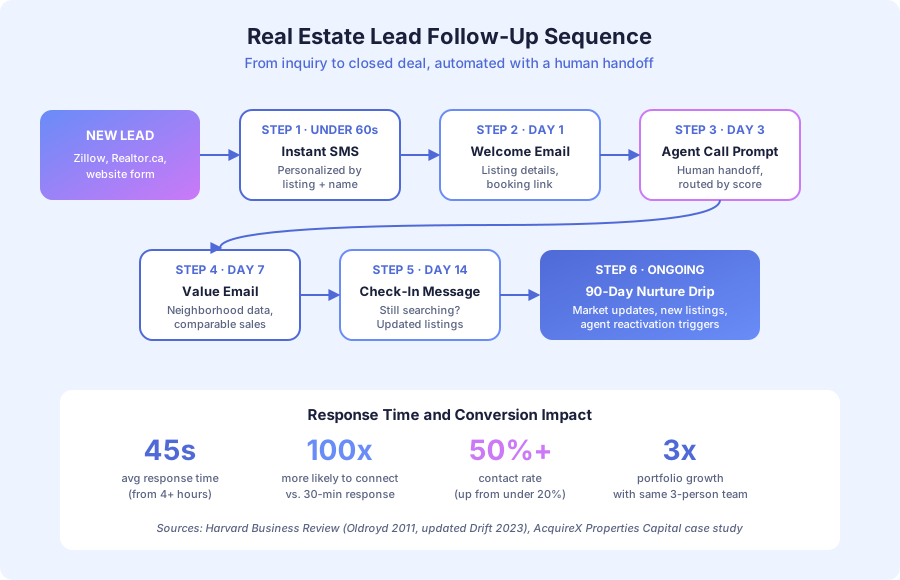
An automated sequence fires the moment a new lead hits your CRM. Step one is a personalized SMS in under 60 seconds. Step two is a welcome email on day 1. Step three is an agent call prompt on day 3. Step four is a value email on day 7. Step five is a check-in on day 14. Step six is an ongoing nurture drip.
Here’s the stack most teams land on:
| Layer | Tools | Job |
|---|---|---|
| Lead sources | Zillow, Realtor.ca, Facebook Ads, website forms | Capture inquiries |
| CRM | Follow Up Boss, kvCORE, BoomTown | Store contacts, track activity |
| Automation | n8n, Make, Zapier | Route leads, trigger messages |
| Messaging | Twilio SMS, HubSpot, Gmail | Deliver texts and emails |
| Scheduling | Calendly, ShowingTime | Book showings automatically |
At AcquireX Properties Capital, every new Zillow and Realtor.ca lead gets a personalized text within 45 seconds. The message references the property address, neighborhood, and price range. It reads like an agent typed it while walking between showings, because the template was built to sound that way. That first-touch sequence, from instant text through qualification and routing, is exactly what we build as lead follow-up for real estate teams.
Which steps belong to the machine and which belong to the agent?
Automate anything that doesn’t need judgment or empathy. That means instant responses, qualification, routing, scheduling, document collection, and drip sequences. Keep humans on showings, negotiations, objections, and relationship conversations. The rule at AcquireX is simple: automation handles everything before the first real chat and everything after the deal closes.
Here’s the split, ranked by impact:
1. Instant lead response. The highest-ROI automation. A new lead triggers a personalized SMS and email in under 60 seconds. According to the National Association of Realtors’ 2024 Technology Survey, 97% of homebuyers use the internet during their search. They expect fast digital answers, not voicemail tag.
2. Lead qualification and routing. The system checks budget, timeline, property type, and location against your criteria. Hot leads get routed to an agent’s phone. Warm leads get a scheduled follow-up. Cold leads enter a nurture drip.
3. Showing scheduling. Instead of back-and-forth texting to find a time, leads book directly from a link in the first response. Confirmations sync to the agent’s calendar and fire reminders to both parties.
4. Document collection. For investment clients, collecting proof of funds, LOIs, and ID manually eats hours. An automated portal sends requests, tracks completion, and chases missing items.
5. Investor reporting. AcquireX automated their monthly investor updates. Property data pulls from the accounting system, populates a template, and sends to the list. A full day of work now runs on autopilot.
What should stay human in real estate forever?
Negotiations, objection handling, and trust-building stay human. These need body language, tone, and real-time adaptation. Automation handles the 80% of tasks that are repetitive so agents can pour the recovered time into the 20% that actually closes deals. Top teams automate logistics and reinvest in face-to-face work.
I’ve watched teams automate too deep and lose leads in the process. Automated birthday texts are fine. Automated replies to “I’m nervous about this neighborhood” destroy trust instantly. The line is clear. Machines run logistics. Humans run strategy and emotion.
According to NAR’s 2024 Member Profile, top-producing agents spend 33% of their time on prospecting and lead generation. Automation doesn’t shrink that number. It makes every minute of it dramatically more productive, because the admin drag is gone and every touchpoint is already logged. The pattern translates straight to mortgage brokers too — see our mortgage broker lead follow-up case study for how a 3-agent brokerage cut response time to under 2 minutes, reduced document chasing by 70%, and closed 35% more files on the same lead volume without hiring.
How did AcquireX Properties Capital triple their portfolio with 3 people?
AcquireX went from a small portfolio to tripling it in 14 months with a 3-person team. They automated lead follow-up, deal analysis (80% faster), investor reporting, and document collection. They didn’t hire. They built systems. The recovered time went into negotiation, market analysis, and relationship work, the three things that actually grow a real estate business.
Before automation, a lead came in, someone eventually checked email, typed a reply, pasted it into the CRM, and sometimes remembered a follow-up. Average response time was 4 to 6 hours. Contact rate sat under 20%.
After automation, a lead comes in, gets a personalized SMS in 45 seconds, enters Follow Up Boss with full tracking, gets scored, and gets routed. The agent picks up the conversation when it matters. Contact rate jumped above 50% in the first month.
The deal analysis piece is worth a callout. They built automated comp reports that pull MLS data and score properties against their investment model. What took 2 hours of spreadsheet work now takes 20 minutes of review. According to McKinsey’s 2024 report on AI in real estate, firms using automation in deal analysis see 30% to 50% reductions in time-to-close. AcquireX hit the top of that range.
How do you set this up without writing code?
You don’t need to code. Start with one workflow: connect your top lead source to your CRM, then fire an instant personalized response. Follow Up Boss, kvCORE, and BoomTown have built-in automation. For deeper logic, n8n and Make give you visual builders. Most teams ship their first automation live in under a week.
Here’s the starter sequence we recommend:
- Pick your highest-volume lead source. Usually Zillow or your website.
- Connect it to your CRM. Follow Up Boss and kvCORE both have native Zillow integrations.
- Write 3 to 5 response templates. Personalize by property type, price range, and location using merge fields for the lead’s name and listing.
- Set the trigger. New lead arrives, system sends SMS and email within 60 seconds.
- Add qualification. Route hot leads to an agent’s phone. Send warm leads into a scheduled call queue.
The whole setup lands in a few hours. ROI shows up on the first lead that converts because it got a response in 45 seconds instead of 4 hours.
What mistakes kill real estate automation before it starts?
The biggest mistake is generic messaging. “Thanks for your inquiry, we’ll be in touch” converts nothing. The second is automating without a handoff, so leads get stuck in the sequence forever. The third is skipping metrics. Every workflow needs response time, contact rate, conversion rate, and time-to-human tracking from day one.
Common pitfalls I see on every audit:
| Mistake | Why It Fails | The Fix |
|---|---|---|
| Generic first response | Feels robotic, no differentiation | Property-specific merge fields |
| No human handoff | Leads loop in automation | Clear triggers for agent pickup |
| Automating negotiations | Breaks trust at the worst moment | Keep deal-stage comms human |
| No nurture sequence | Cold leads never come back | 90-day drip with market updates |
| No metrics dashboard | Can’t improve what you can’t see | Track response, contact, conversion |
Each of these has cost teams real commissions. The fix for all of them costs a few hours of setup.
How do you measure whether the automation is paying off?
Track four metrics: average response time (target under 60 seconds), contact rate (percentage of leads you actually reach), lead-to-appointment conversion, and days from first touch to closed deal. Compare each against your pre-automation baseline. AcquireX saw contact rates climb from under 20% to above 50% in the first month.
Set up a simple dashboard in your CRM. Follow Up Boss and kvCORE ship with built-in reporting. BoomTown has the strongest lead source attribution of the three. The numbers you want after 30 days:
- Response time under 60 seconds (down from hours)
- Contact rate above 40% (up from 15% to 20%)
- Lead-to-showing conversion rising month over month
- Agent admin time dropping by at least 50%
If the numbers aren’t moving, the issue is almost always message quality or handoff timing, not the automation plumbing. Rewrite the templates and tighten the triggers before touching the workflow engine.
The takeaway: automate the delay, keep the humans
Real estate lead automation isn’t about removing the personal touch. It’s about making sure the personal touch happens when it matters. AcquireX Properties Capital proved that 3 people can operate at the capacity of 9 when the first 60 seconds of every lead interaction runs on rails. The automation handles the speed. The humans handle the relationships. That combination wins deals, and it’s what every top team will be running by 2027.
Ready to build a lead follow-up system for your real estate team? See how we work with real estate teams, check out our dedicated AI customer service for real estate page, read how AcquireX tripled portfolio capacity with automation, or book a 30-minute workflow audit to map your first automation.