A solo property manager handling 120 rental units for 15 different landlords cut tenant communication overhead by 80%, dropped maintenance coordination from 45 minutes per request to under 10, and freed capacity for 40% more units without hiring. Before automation, the business was capped around 80 units where manual follow-up consumed more time than new fees justified. According to AppFolio’s 2024 Property Management Industry Pulse, managers spend 35% of their time on communication tasks that are at least partially automatable. This case study shows which three systems unlocked scale, how they connect, and what the results looked like across the first quarter.
What did 120 units of manual management actually look like?
Before automation, a solo property manager was putting in roughly 50-60 hours per month on pure admin: rent reminders, maintenance coordination, and landlord reporting. That’s on top of leasing, inspections, and tenant relations. The math didn’t scale.
The scale problem becomes clear when you run the numbers on routine tasks alone. Rent reminders went to tenants who paid late: around 30 per month (25% of units, a typical lapse rate per NAA research). Each required a personalized message with amount, due date, and payment link. Maintenance requests ran 15-25 per month across the portfolio. Each one needed intake, vendor contact, tenant coordination, and follow-up, averaging 30-45 minutes of coordination time.
Landlord reports added another 7-8 hours monthly. Fifteen landlords, each expecting a summary pulled from rental records, expense logs, and maintenance history. Even at 30 minutes per landlord, that’s a full workday.
According to AppFolio’s 2024 Property Management Industry Pulse, managers spend 35% of their time on tenant communication tasks that could be automated. For a solo operator, that 35% isn’t an efficiency gap — it’s the ceiling on how many units they can manage before the business stops making financial sense. The manager wasn’t bad at the job. The process was wrong for the volume.
Why does manual management hit a ceiling around 80 units?
Property management revenue scales with unit count, but without automation, admin overhead scales with it too. Somewhere between 50 and 80 units, maintenance coordination alone becomes a full-time job. Adding more units past that point costs more time than the new fees bring in.
The math is brutally simple. A 10% management fee on a $2,000/month unit earns $200. If that unit generates 20 minutes of monthly communication plus one maintenance request every two months (another 40 minutes averaged), you’re at an hour per unit. At 80 units, that’s 80 hours per month on routine admin — two full work weeks — before a single inspection or lease renewal.
McKinsey’s 2024 Global Survey on AI and Automation found 60% of occupations have at least 30% of tasks that are automatable. Property management sits well above that average. Rent reminders, payment confirmations, lease renewal notices, vendor coordination messages, and landlord report generation are all pattern-based tasks that don’t need professional judgment.
The judgment calls stay human. Handling difficult tenants, negotiating lease terms, assessing maintenance urgency, advising landlords on pricing. Automation handles the volume around those decisions.
What three systems did the property manager build?
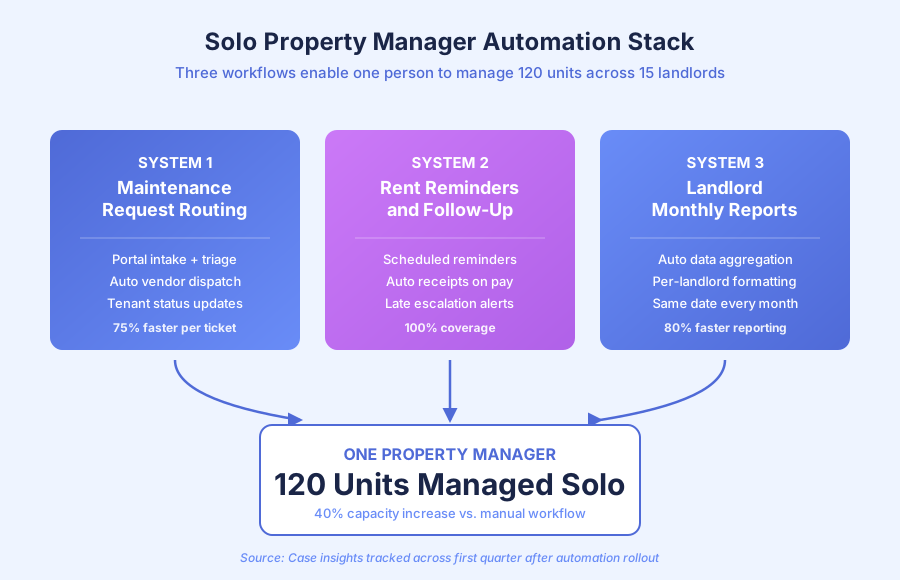
Three automation systems replaced the routine admin work: tenant communication, maintenance request routing, and landlord reporting. Together they absorb roughly 40-50 hours of monthly work that previously blocked growth. Each system runs independently but shares tenant and property data from a central records layer.
System 1: How does the tenant communication automation work?
The tenant communication system handles the full lifecycle of routine messages: rent reminders, payment confirmations, lease renewal notices, and maintenance status updates. It eliminates the “did you get my payment?” and “when’s the repair?” questions by answering them before tenants ask.
The flow:
- Rent reminders. On the 25th of each month, a personalized reminder sends to every tenant with the amount due, due date, and payment portal link. On the 2nd (if unpaid), a follow-up sends. On the 5th, a formal notice generates and the manager receives an alert.
- Payment confirmations. When payment posts, a receipt sends within minutes.
- Lease renewals. 90 days before expiry, a renewal offer goes out, with follow-ups at 60 and 30 days. If no response by day 75, the manager is pulled in.
- Maintenance updates. When a work order is assigned, the tenant gets an update with expected timing. When complete, another confirms resolution.
Tenant calls and texts dropped 80% within the first month. The answers were already sent.
System 2: How does automated maintenance routing work?
The maintenance system gives tenants a structured intake portal and automates the coordination workflow behind every request. It applies the same support ticket routing principles that work for any inbound-heavy service business. The manager moves from coordinator to exception handler.
The flow:
- Tenant submits via portal link or SMS keyword.
- System categorizes by type (plumbing, electrical, HVAC, appliance, structural) and urgency (emergency vs. routine).
- Emergencies: manager receives an immediate alert with full request details.
- Routine: system routes to the pre-configured vendor for that property type, attaching unit address, access instructions, and tenant description.
- Vendor confirms proposed timing, automatically logged.
- Tenant receives an auto-update with the scheduled window.
- When the vendor marks complete, tenant and landlord get notifications.
- If a request stays open past 5 business days, the manager gets escalated.
Per-request coordination time dropped from 30-45 minutes to under 10 for routine jobs. A 2024 NAA report notes that maintenance response time is the single biggest driver of tenant satisfaction in multifamily operations.
System 3: How does automated landlord reporting work?
Each month, the system generates a personalized report per landlord covering their specific portfolio. The manager reviews and sends rather than building from scratch. Reporting time dropped from 30-45 minutes per landlord to 5-10, and reports now arrive on the same date every month.
The flow:
- On the 1st of each month, the system pulls data per landlord portfolio: rent collected vs. expected, outstanding balances, maintenance costs, open work orders, and occupancy status.
- Report is formatted with the landlord’s name and a property-by-property breakdown.
- Manager reviews the draft and adds notes for the month.
- Report sends with one click on the 5th.
Related reading: see the property management tenant automation playbook for the full workflow breakdown, and how to automate document collection from clients for tenant onboarding patterns that pair well with this stack.
What were the measurable results after 90 days?
The first-quarter numbers showed 80% less communication overhead, 75% faster maintenance handling, 80% faster reporting, and capacity for 40% more units. Capacity was the metric that mattered commercially — the same one-person operation became scalable without hiring.
| Metric | Before Automation | After Automation | Change |
|---|---|---|---|
| Tenant communication overhead | 50-60 hrs/month | ~12 hrs/month | 80% reduction |
| Maintenance coordination time | 30-45 min/request | Under 10 min | 75% faster |
| Landlord reporting time | 30-45 min/landlord | 5-10 min/landlord | 80% faster |
| Late rent follow-up coverage | Manual, inconsistent | Automated, systematic | 100% coverage |
| Units manageable (same person) | Ceiling ~80-90 | 120+ (growing) | 40% capacity increase |
The capacity increase matters more than the hours saved. Those reclaimed hours went to landlord acquisition and quality control, not just to a shorter workday. Per the NAA’s 2024 Survey of Operating Income & Expenses, management staffing cost per unit is the single largest controllable expense for small property managers — cutting it via automation instead of layoffs is the version that works for solo operators.
What did landlords actually notice?
Reporting consistency was the most visible change from the landlord’s perspective. Every landlord now receives a detailed, identically formatted report on the 5th of each month without exception. Several landlords said the automated reports were better than what they had produced for themselves.
Previously, reports arrived on inconsistent dates in varying formats with different detail levels depending on how much time was available. After automation, landlords got a consistent, professional document every month. The consistency became a competitive differentiator during new landlord pitches — prospects saw the format in the sales conversation and signed faster.
A 2024 Zillow Rental Manager survey found that 61% of independent landlords cite “clear, timely reporting” as a top-three factor when choosing a property management company. Automation made that factor effortless to deliver at scale.
What can other property managers take from this?
Three principles apply to any property management operation at the point where manual processes are limiting growth. They work for 30-unit solo operators and 300-unit small teams. The specific tools differ by portfolio type, but the workflow structure doesn’t.
1. Automate the same-question cycle first. Rent reminders, payment confirmations, and maintenance status updates generate the majority of tenant contact volume. Eliminating those questions with proactive answers reclaims more time than any other single change. Start here.
2. Structured maintenance intake beats open-ended requests. When tenants can describe an issue in free text or phone calls, every request needs triage. A structured intake form that captures type, urgency, and access notes routes jobs correctly the first time, without back-and-forth. This is also where the biggest vendor satisfaction gains show up.
3. Landlord reporting consistency builds trust faster than the content. A landlord who receives the same format, on the same date, every month, with accurate numbers, trusts their property manager more than one who sends detailed reports inconsistently. Automation makes consistency effortless — and consistency is what renews contracts.
Could this work for your property management operation?
The tenant communication, maintenance routing, and reporting pattern described here scales from small portfolios (20-30 units) to larger operations (200+ units). Vendor rules and report formats differ by portfolio, but the workflow structure is consistent across residential property management — we build it as AI customer service for property management companies.
If you’re hitting the manual management ceiling, a 30-minute audit can map where your time is actually going and which flows would reclaim the most hours first. Book a free automation audit and we’ll identify where manual coordination is capping your unit count.