Four AI tools keep showing up in small business buying conversations in 2026: Manus, ChatGPT, Claude, and Perplexity. They’re often framed as competitors. They’re not. Each one is optimized for a different job, and 89% of small businesses now use AI in some capacity, up from 36% in 2023 (US Chamber of Commerce, 2026). The question isn’t which tool wins overall — it’s which tool handles which task. This guide maps the four tools to the work businesses actually do and shows how combining two or three beats any single-tool setup.
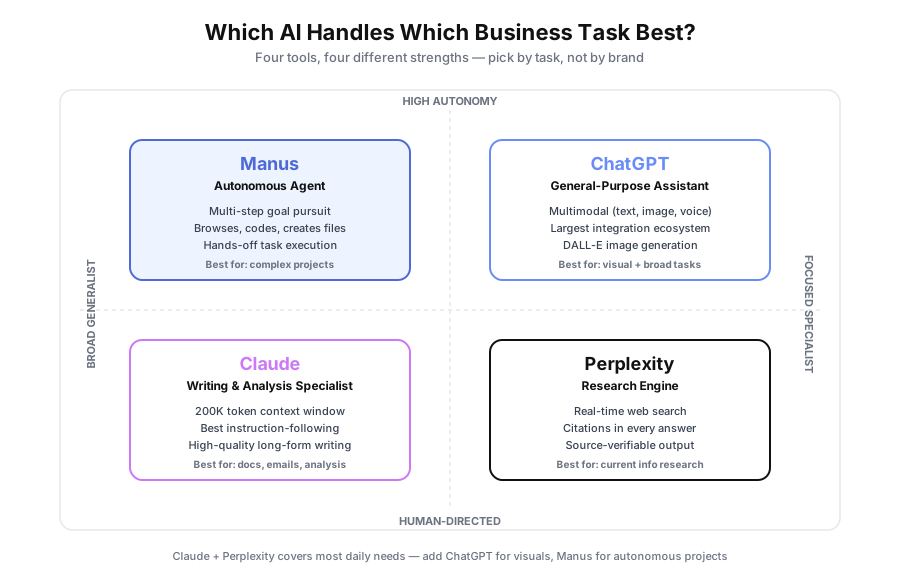
Manus vs ChatGPT vs Claude vs Perplexity: Quick Comparison
Claude wins for writing and long-document analysis. ChatGPT wins for multimodal work and integrations. Perplexity wins for research with citations. Manus wins for autonomous multi-step task execution. Each tool is optimized for a different job — the right pick depends entirely on the task.
| Tool | Best for | Pricing | Pick if |
|---|---|---|---|
| Claude | Writing, long docs (up to 1M context) | $20/month | Daily writing + document analysis |
| ChatGPT | Multimodal (image, voice, code) | $20/month | Image generation + app ecosystem |
| Perplexity | Research with inline citations | $20/month | Competitor research, fact-checking |
| Manus | Autonomous multi-step agent tasks | From $20/month | Hands-off complex projects |
What are Manus, ChatGPT, Claude, and Perplexity designed to do?
Each tool was built for a different core job. Manus is an autonomous agent that pursues goals across multi-step tasks. ChatGPT is a multimodal generalist with the largest app ecosystem. Claude is a writing and long-document specialist. Perplexity is a research engine that cites every source. No tool does all four jobs well.
Manus AI is an autonomous agent. You give it a goal, and it browses the web, executes code, and creates files with minimal human direction. Launched in March 2025 by Singapore-based Butterfly Effect (with a self-reported 86.5% GAIA Level-1 score at launch), it has shipped quickly since: Wide Research runs up to 100 parallel sub-agents, and the Manus 1.5 and 1.6 releases through late 2025 added one-prompt web-app generation.
ChatGPT (GPT-5.6) is OpenAI’s flagship conversational assistant, now running the GPT-5.6 model family. It handles text, images, audio, and code. ChatGPT reached 900 million weekly active users by February 2026 (TechCrunch, 2026), making it the largest AI assistant by user base.
Claude (Sonnet 5) is Anthropic’s assistant, built for careful reasoning, instruction-following, and long-context work. Sonnet 5 is the default model on Free and Pro plans, with the frontier Fable 5 tier above it, and current models accept up to 1 million tokens of context — roughly 2,500 pages (Anthropic, 2026).
Perplexity is an AI-powered search engine. Every answer comes with inline citations. It passed 780 million queries per month by mid-2025, the last officially confirmed figure (Perplexity, 2025), and now ships Comet, its own browser, free on desktop and mobile.
Which AI is best for business writing?
Claude is the best for business writing. It follows detailed style instructions more reliably than ChatGPT, produces fewer filler phrases, and handles long-form drafts consistently. ChatGPT is a solid second choice with better multimodal support. Perplexity isn’t a writing tool. Manus can write, but it’s overkill for routine drafts.
For day-to-day writing — emails, proposals, client reports, internal memos — Claude’s instruction-following makes the difference. Ask it for “a 300-word proposal summary in a skeptical tone” and you’ll get exactly that. ChatGPT tends to drift toward generic business phrasing unless you push back.
| Tool | Writing quality | Speed | Best for |
|---|---|---|---|
| Claude | Excellent | Fast | Nuanced, instruction-heavy writing |
| ChatGPT | Strong | Fast | General writing + visuals |
| Perplexity | N/A | N/A | Not a writing tool |
| Manus | Variable | Slow | Writing embedded in complex tasks |
A 2024 study by McKinsey found that generative AI can cut content drafting time by 40–60% for knowledge workers (McKinsey, 2024). Claude captures the upper end of that range when users write detailed prompts.
Which AI wins for research with current information?
Perplexity wins for research that needs current, sourced information. It searches the web in real time, cites every claim inline, and lets you click through to verify. ChatGPT and Claude have web search modes, but neither treats citation as a core feature. For competitor analysis, regulatory research, or market data, Perplexity cuts verification time dramatically.
Here’s where design intent matters. ChatGPT and Claude were built as assistants first and had web search bolted on later. Perplexity started as a research tool. Every answer lists its sources as numbered citations, and you can click into each one.
| Tool | Citation quality | Real-time web | Source verification |
|---|---|---|---|
| Perplexity | Inline, clickable | Native | Easy |
| ChatGPT (with web) | Partial | Available | Harder |
| Claude (with web) | Partial | Available | Harder |
| Manus | Variable | Native | Depends on task |
Gartner reported in 2024 that 62% of knowledge workers waste time verifying AI-generated claims (Gartner, 2024). Perplexity’s citation-first design removes most of that friction. For a deeper look at how these three tools stack up specifically on research tasks, see our Perplexity vs ChatGPT vs Claude for research comparison.
Which AI handles long documents best?
Claude handles long documents best. Its current models accept up to 1 million tokens of context — roughly 2,500 pages — and the app is built around document work: large uploads, Projects for persistent context, consistent recall. ChatGPT’s GPT-5.6 models reach similar ceilings via API, but the in-app experience caps sooner. Perplexity isn’t built for document analysis.
Long document analysis breaks most AI tools. Lawyers, consultants, and analysts routinely deal with 100-page contracts, lengthy research papers, and transcripts that won’t fit in smaller context windows. Claude’s window means you paste the whole document once instead of chunking it into four or five passes.
| Tool | Context window | Document accuracy | Best use |
|---|---|---|---|
| Claude | Up to 1M tokens | Excellent | Contracts, research, transcripts |
| ChatGPT | Up to ~1M (API); lower in-app | Strong | Mid-length analysis |
| Manus | Variable | Good | Document review in tasks |
| Perplexity | Limited | N/A | Not designed for this |
In Anthropic’s benchmark testing, Claude models have answered 99% of “needle in a haystack” questions correctly across the full context window (Anthropic, 2024), and the 1M-token window went to general availability on current models in early 2026. That reliability across document length is why Claude dominates this category for business users working with legal, financial, or research documents.
Which AI is best for autonomous multi-step tasks?
Manus is the best for autonomous multi-step tasks because it was built from scratch as an agent, not an assistant. Give it a goal — “research the top 10 competitors in my industry and build a comparison spreadsheet” — and it browses, extracts data, and creates files without constant prompting. ChatGPT and Claude can use tools, but they’re reactive.
The difference is hands-off time. With ChatGPT or Claude, you prompt, wait, review, prompt again. With Manus, you describe the goal and walk away. For projects that would normally take 3–4 hours of back-and-forth with a chat assistant, Manus can finish while you’re in meetings.
| Tool | Autonomy level | Multi-step native | Task duration |
|---|---|---|---|
| Manus | Very high | Yes | Hours, hands-off |
| ChatGPT | Medium (with tools) | Partial | Minutes, interactive |
| Claude | Medium (with tools) | Partial | Minutes, interactive |
| Perplexity | Low | No | Seconds, single-query |
Pricing is no longer the barrier it was at launch: the free tier includes 300 daily-refresh credits, and Manus Pro starts at $20/month with 4,000 monthly credits (Manus, 2026). The catch now is credit burn — credits don’t roll over, and one complex multi-hour run can eat a meaningful share of a monthly allowance. For an explainer on how Manus works and where it fits, see our What Is Manus AI? guide.
Which AI is best for image generation and multimodal work?
ChatGPT is the best for image generation and multimodal work. Its GPT Image model is built into the Plus tier (OpenAI retired DALL-E in mid-2026 and replaced it with the stronger GPT Image line), and GPT-5.6 handles text, images, voice, and video input in one conversation. Claude can analyze images but can’t generate them. Perplexity and Manus have limited multimodal support.
Multimodal work matters more every year. Marketing teams need quick image concepts. Product teams annotate screenshots. Sales teams explain charts. ChatGPT handles all three in one conversation without switching tools.
| Tool | Image generation | Image analysis | Voice input |
|---|---|---|---|
| ChatGPT | GPT Image native | Strong | Yes |
| Claude | No | Strong | Limited |
| Perplexity | No | Basic | No |
| Manus | No | Task-dependent | No |
ChatGPT’s Advanced Voice Mode launched in late 2024 and handles real-time conversation in multiple languages (OpenAI, 2024). For teams that routinely work across text, images, and voice, ChatGPT removes friction the other three tools can’t match yet.
Which AI has the strongest ecosystem and integrations?
ChatGPT has the strongest consumer ecosystem. It has the largest app library, the most third-party integrations, and the widest adoption among SaaS platforms. Claude is growing quickly with strong enterprise integrations. Perplexity and Manus are earlier-stage and support fewer business tool connections. If your workflow depends on connecting AI to existing software, ChatGPT is the default.
Businesses rarely use AI in isolation. They connect it to CRM, email, project management, calendar, and analytics tools. ChatGPT’s ecosystem advantage comes from being first to market with an API and having the widest adoption among SaaS platforms as an integration partner.
| Tool | App/integration library | API maturity | Business tool connections |
|---|---|---|---|
| ChatGPT | Largest | Mature | Widest |
| Claude | Growing | Mature | Strong enterprise |
| Perplexity | Limited | Basic | Few |
| Manus | Early | Evolving | Few |
The enterprise API race has actually flipped: Menlo Ventures’ 2025 mid-year LLM market update put Anthropic at 40% of enterprise LLM API spend, ahead of OpenAI at 27% and Google at 21% (Menlo Ventures, 2025). But for consumer-facing app integrations — the connectors a small business plugs into its existing SaaS stack — ChatGPT’s 900-million-user ecosystem is still the widest, and it remains the safest bet for integration-heavy workflows.
How much does each tool cost for small business use?
Paid tiers for Claude Pro, ChatGPT Plus, Perplexity Pro, and Manus Pro all now start at $20/month. Most small businesses get the best return by combining Claude ($20) and Perplexity ($20) for $40/month total. Adding ChatGPT for visuals brings the stack to $60/month, and Manus Pro tops out the full four-tool stack at $80 — still cheap compared to one hour of staff time per week.
| Tool | Free tier | Paid tier | What you get |
|---|---|---|---|
| Claude Pro | Yes, limited | $20/month ($17 billed annually) | Higher usage, Projects, Sonnet 5 default |
| ChatGPT Plus | Yes, limited | $20/month | GPT-5.6, GPT Image, voice, apps |
| Perplexity Pro | Yes, limited | $20/month | Frontier model access, file uploads, Comet Plus |
| Manus Pro | Yes, 300 credits/day | From $20/month | 4,000 monthly credits for agent runs |
For context, the average hourly wage for US office workers is roughly $35 per hour (BLS, 2024). A $60/month AI stack pays for itself if it saves less than two hours of staff time per month. Most businesses save that in the first week. See our ChatGPT vs Claude for Business comparison for a deeper cost-benefit breakdown between those two tools specifically.
What’s the best practical workflow for using all four?
The best practical workflow routes each task to the tool that handles it best. Use Claude for writing and long document analysis. Use Perplexity for current-information research. Use ChatGPT for image generation and ecosystem integrations. Use Manus for autonomous multi-hour projects. This routing approach outperforms any single-tool setup by 30–50% on quality and time saved.
Daily writing and communication goes to Claude. Emails, proposals, reports, internal memos, and document summaries all benefit from Claude’s instruction-following and long context.
Research with current information goes to Perplexity. Competitor analysis, market research, regulatory checks, and anything time-sensitive — the inline citations save verification time.
Image generation and multimodal tasks go to ChatGPT. Marketing visuals, quick concept art, screenshot annotation, and voice-driven conversation all stay in one tool.
Autonomous multi-step projects go to Manus when access is available. Full-day research projects, complex data gathering, and multi-file outputs work better hands-off than hand-held.
API automation and integrations usually land on ChatGPT API or Claude API depending on the use case. ChatGPT for ecosystem breadth, Claude for long-context enterprise work.
This is the approach we recommend to every small business client we work with. It’s cheaper than enterprise AI seats and more effective than forcing one tool to cover every use case. It’s also the routing logic behind the custom AI workflows we build for clients — the tools do the work, your team stays in one place.
Ready to build AI into your workflow the right way?
Book a free automation audit and we’ll map your actual daily tasks to the right AI tools — then show you how to integrate them into the software your team already uses. No vendor bias, no one-size-fits-all recommendations. Just a clear plan for where AI delivers the most business impact for your specific workflow.