Manus AI went viral in March 2025 when demo videos showed a single agent researching a market, building a spreadsheet model, writing code, and producing a full report from one instruction. Within days, the waitlist passed 2 million sign-ups according to reporting in MIT Technology Review. A year and a half later, the core question for small business owners is simpler: is Manus actually better than Claude or ChatGPT for real work, or is it a preview of a future that hasn’t quite arrived?
Here’s what Manus AI is, how the architecture works, and when it makes sense versus the AI tools you’re already paying for.
What is Manus AI?
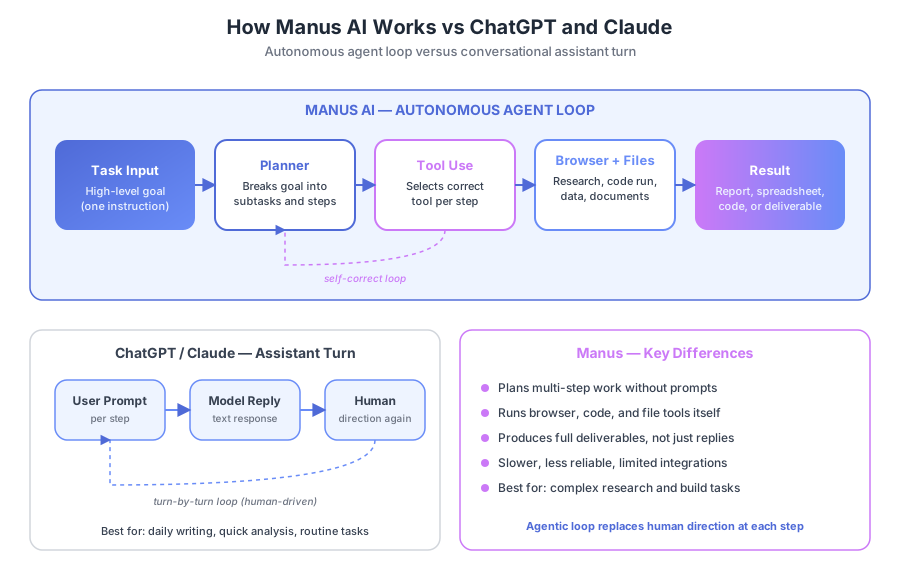
Manus AI is an autonomous agent built by Butterfly Effect, the startup behind the Monica assistant, launched in invite-only preview in March 2025. You give it a single high-level goal, and it plans the subtasks, uses a browser, runs code, edits files, and returns a finished deliverable without turn-by-turn prompting. It’s designed as an agent, not an assistant.
Who built Manus AI and when did it launch?
Manus was built by Butterfly Effect, an AI company founded in 2022 that previously built the popular browser-based Monica assistant; it relocated its headquarters from China to Singapore in mid-2025. The Manus preview launched on March 6, 2025 via invite codes, and TechCrunch reported the waitlist reached 2 million users within the first week. The product has moved fast since: paid tiers went public, Wide Research shipped in July 2025 (running up to 100 parallel sub-agents on one task), and the Manus 1.5 and 1.6 releases in late 2025 added full web-app generation from a single prompt.
What problem is Manus AI trying to solve?
Manus is aimed at the gap between “asking an AI a question” and “getting a finished project.” ChatGPT and Claude reply in chat turns and need constant steering. Agentic systems like Manus try to handle the steering themselves, so one goal produces one deliverable. That’s useful for long research tasks but hard to get right consistently, which is Manus’s biggest ongoing challenge.
How does Manus AI actually work?
Manus runs a loop: it takes a goal, plans the steps, picks a tool (browser, code runtime, file editor), executes, checks the result, and adjusts. Monica’s technical posts describe it as a multi-agent system coordinating specialized sub-agents. The key design choice is that Manus drives the loop itself, rather than waiting for you to prompt each step.
The four core components of the Manus architecture
Based on Monica’s public documentation and Ars Technica’s March 2025 teardown of leaked system prompts, Manus has four main pieces working in sequence.
| Component | What it does | Rough equivalent in Claude or ChatGPT |
|---|---|---|
| Planner | Breaks the goal into ordered subtasks | User asking model “make a plan” step |
| Tool router | Picks the right tool for each step | Function calling or tools API |
| Executor | Runs the browser, code, or file action | User running code, opening a tab |
| Verifier | Checks output and self-corrects | User reviewing and reprompting |
The result is that Manus can run for 10-30 minutes on one task, while Claude or ChatGPT usually produce a reply in 10-60 seconds per turn and expect you to direct the next step.
What tools does Manus have access to?
Manus’s published tool set includes a sandboxed web browser, a Python and shell code runtime, a file system for reading and writing documents, and image and data processing utilities. That’s similar to Claude’s computer use and ChatGPT’s Advanced Data Analysis plus browsing, but wired into a long-running autonomous loop rather than a single chat turn.
What can Manus AI actually do well?
Manus is strongest at tasks that are long, structured, and involve multiple tool types. The viral demos that drove 2 million sign-ups weren’t fake. Independent testers at The Information and MIT Technology Review confirmed Manus can handle genuine end-to-end research and build tasks that would take a human analyst 3-6 hours of focused work.
Research and synthesis
Give Manus a complex topic and it will open multiple tabs, pull information, weigh sources, and produce a structured report with citations. The March 2025 demos included a competitor landscape for a SaaS category and a market-entry analysis with charts and a reference list.
End-to-end project execution
Manus completes tasks that cross capabilities: research, then code, then a spreadsheet, then a summary document. That sequence is where ChatGPT and Claude still need a human to glue the steps together. When Manus’s plan is right, the finished deliverable feels genuinely autonomous.
Data analysis and simple builds
Monica’s demos show Manus pulling a public dataset, writing Python to clean and analyze it, generating charts, and producing findings as a PDF. It can also build small working tools, like an internal calculator or a simple scraper. These are the use cases where the agent loop saves the most time.
Where does Manus AI fall short?
Manus’s weaknesses are the same as most agentic systems in 2025-2026: reliability, speed, integrations, and access. When Manus’s plan starts wrong, the 20-minute run can produce a polished but incorrect deliverable. Claude and ChatGPT, with a human in the loop, catch those mistakes faster. That reliability gap is the biggest reason most businesses shouldn’t make Manus their primary tool yet.
Reliability and error compounding
In tests published by The Information in April 2025, Manus completed about 60 percent of multi-step business tasks end-to-end without human correction, versus roughly 85-90 percent success rates for Claude and ChatGPT when a human guides each step. When Manus makes a wrong assumption in step 2, steps 3-8 amplify it.
Speed, cost, and access
A task Manus runs in 20 minutes is often done in 8-12 minutes by a skilled Claude or ChatGPT user. Access and pricing are no longer the barrier — anyone can sign up, the free tier includes 300 daily credits, and Pro starts at $20/month with 4,000 monthly credits. The new watch-out is credit consumption: one long autonomous run can burn a real share of a monthly allowance, and credits don’t roll over. For daily business use, Claude Pro and ChatGPT Plus at a flat 20 dollars per month remain more predictable.
Business tool integrations
Claude and ChatGPT plug into the tools small businesses actually run on: Gmail, Slack, Notion, HubSpot, Google Drive, and hundreds more via Zapier and native connectors. Manus’s integrations are narrower and focused on standalone tasks, which limits its fit for day-to-day operations.
Where does Manus AI fit alongside Claude and ChatGPT?
This is the short version. For the full head-to-head with benchmarks, pricing, and use-case scoring across all four major tools, see our Manus vs ChatGPT vs Claude vs Perplexity comparison — that’s the right read if you’re choosing between them. The quick orientation: Manus wins on autonomy for long multi-step projects; Claude and ChatGPT win on reliability, speed, price, integrations, and daily business work. The practical model for most teams is a daily driver plus selective agent use, not a switch.
| Dimension | Manus AI | ChatGPT Plus | Claude Pro |
|---|---|---|---|
| Autonomy on multi-step tasks | High | Moderate | Moderate |
| Daily writing and email | Overkill | Excellent | Excellent |
| Long document analysis | Good | Good | Excellent |
| Business tool integrations | Limited | Strong | Strong |
| Availability (August 2026) | General access, free + paid tiers | Global | Global |
| Reliability for routine tasks | Variable | High | High |
| Complex research projects | Strong | Needs guidance | Needs guidance |
| Published price reference | From 20 USD/month (Pro, 4,000 credits) | 20 USD/month | 20 USD/month |
Sources: Manus, OpenAI, and Anthropic pricing pages, as of August 2026.
When Manus AI is the right choice
Pick Manus when the task is long, structured, and would normally take a human analyst several focused hours. Examples include a full competitor landscape, a market entry analysis, a data cleaning and modeling project, or building a small internal tool from scratch. These are the jobs where the agent loop genuinely replaces human steering.
When Claude or ChatGPT is the right choice
Pick Claude or ChatGPT for everything else, which is most business work: drafting emails, answering customer questions, meeting notes, quick analysis, writing marketing copy, coding small fixes, working inside Google Workspace or Microsoft 365, or anything that needs to integrate with your existing tools and run reliably every day.
What does Manus AI mean for small business AI strategy?
Manus is a signal: agentic AI is moving faster than most small businesses realize, and the gap between “assistant you prompt” and “agent that runs” is closing. Gartner’s 2026 AI Hype Cycle placed agentic AI in the “slope of enlightenment” early, meaning tools are becoming usable but haven’t hit mainstream reliability. That’s exactly where Manus sits right now.
The practical 2026 playbook
Keep Claude or ChatGPT as your daily driver for writing, analysis, and integrations. Add workflow automation (Make, n8n, or Zapier) for repetitive tasks. Test Manus or similar agents on 1-2 specific long projects per quarter to learn what agent-driven work looks like. As agents mature in 2027, you’ll already have the foundation to plug them in.
Why the foundation matters more than the tool
The businesses that benefit from agentic AI in 2027 are the ones that already have documented processes, clean data, and automation in place in 2026. Tools change every six months. Foundations don’t. Builts AI’s own client data shows automation projects pay back in 6-12 weeks regardless of which AI model is powering them, because the time savings come from the workflow, not the brand on the chatbot.
Should you try Manus AI?
If you’re curious, yes. Sign up at manus.im, try it on one real project, and compare the output to what Claude or ChatGPT would produce with 20 minutes of your guidance. You’ll learn more from one real test than from ten demo videos. Just don’t rebuild your stack around it yet.
For related reading, see our article on How Agentic AI Will Transform Small Business Operations by 2027 and our guide on What Are AI Agents? A Plain-English Guide for Business Owners.
For a direct tool comparison, see our article on Manus vs ChatGPT vs Claude vs Perplexity: Which AI Does Business Work Best?.
Book a free automation audit and we’ll map out where current-generation AI and automation can eliminate the most time-consuming manual work in your operation right now, with a clear path to plug in agentic tools as they mature.