Business research has one requirement that separates it from casual AI use: information must be current, and sources must be verifiable. According to Perplexity’s 2025 user data, 65% of professional users say source verification is their main reason for picking Perplexity over ChatGPT.
That requirement creates a clear use case for Perplexity, and clear situations where ChatGPT or Claude wins. This comparison breaks down which tool saves the most time for each type of business research, based on real workflows across competitive intelligence, document analysis, and research-backed writing.
What’s the Fundamental Difference Between Perplexity, ChatGPT, and Claude?
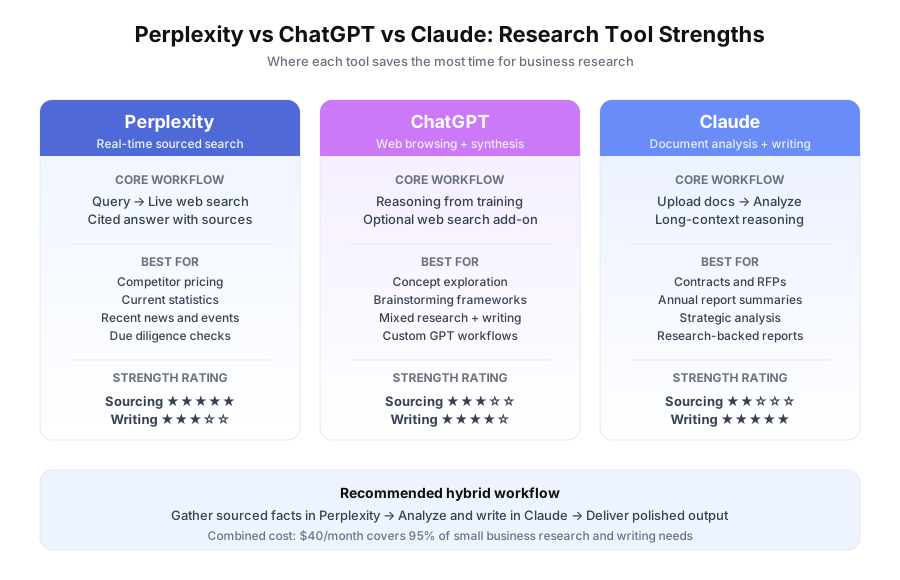
Perplexity is an AI search engine built for retrieval and citation. ChatGPT and Claude are AI assistants trained on large datasets with web search added as a feature. The architectural difference determines which tool wins for which research task.
Perplexity searches the web in real time when you ask a question. It retrieves current pages, synthesizes the information into a response, and cites sources inline. Every claim has a numbered citation you can click through.
ChatGPT and Claude synthesize from training data with knowledge cutoffs. Both offer web browsing, but it’s an add-on to their reasoning engine rather than the core design. Even the current flagships — GPT-5.6 and Claude Sonnet 5 — still rely on browsing for anything published after their training cutoffs.
The practical impact: Perplexity is designed from day one for current, sourced information. ChatGPT and Claude are designed for reasoning, writing, and conversation, with search bolted on.
Which AI Research Tool Is Best for Competitive Intelligence?
Perplexity is the best tool for competitive intelligence. Competitor pricing, product launches, funding news, and recent reviews change frequently. Perplexity searches current sources and cites them, while ChatGPT and Claude may return pricing or product details from training data that’s 12-24 months old.
Consider these typical research questions:
- What are a competitor’s current pricing tiers?
- When did they launch their enterprise product?
- What have recent reviews been saying about their latest release?
Perplexity handles all three in seconds with citations. ChatGPT’s web browsing can answer them, but the sources aren’t as consistently surfaced, and verification takes longer. According to Gartner’s 2025 Market Guide for AI Research Tools, teams using dedicated AI search tools cut competitor research time by 58% compared to manual methods.
For weekly competitor monitoring, due diligence on potential partners, or vendor evaluations, Perplexity’s sourced answers save hours of manual verification per project.
Which Tool Finds Current Industry Statistics Fastest?
Perplexity finds current industry statistics fastest because it retrieves live data with source attribution. Statistics shift constantly: SaaS churn rates, email open rates by industry, and small business tech adoption figures all change year over year. Perplexity pulls the most recent studies and cites them.
Here’s the difference in action:
| Research query | Perplexity result | ChatGPT/Claude result |
|---|---|---|
| Average SaaS churn rate 2026 | Current benchmark with cited study | May reference 2023 data |
| Small business CRM adoption | Live survey data | Training-era percentage |
| Email open rate by industry | Current Mailchimp/HubSpot figures | Possibly outdated |
A 2025 Forrester report found that 42% of business stats cited in AI assistant responses without web search were more than 18 months old. That gap matters when you’re building a business case or client proposal. Perplexity’s real-time retrieval eliminates the dating problem entirely.
When Is ChatGPT the Better Research Choice?
ChatGPT is the better choice for conceptual research, brainstorming, and mixed research-plus-writing workflows. It shines when you need reasoning through implications, exploring second-order effects, or structuring a framework. These tasks don’t require citations, they require synthesis.
Good ChatGPT research use cases:
- Explaining strategic implications of a market trend for your business
- Brainstorming go-to-market approaches for a new service
- Structuring an analytical framework for a decision
- Writing first drafts that combine research with reasoning
According to OpenAI’s 2025 usage report, 71% of ChatGPT Plus users run workflows that mix research with writing in a single conversation. That hybrid workflow is where ChatGPT’s design pays off: you can brainstorm, structure, and draft without switching tools.
ChatGPT’s Custom GPTs also let you build reusable research templates. A Custom GPT with specific prompts, uploaded context, and retrieval settings can standardize recurring research tasks across a team.
When Should You Pick Claude for Business Research?
Claude is the right pick for document-heavy research and long-form analysis. Its current models accept up to 1 million tokens of context (roughly 2,500 pages), handling contracts, RFPs, annual reports, and lengthy PDFs that Perplexity can’t process in one pass. Claude also produces the highest-quality written output of the three.
Document analysis tasks where Claude wins:
- Analyzing a multi-year contract for risk clauses
- Summarizing a 200-page competitor annual report
- Reviewing an RFP and generating a response outline
- Extracting specific data from lengthy regulatory filings
Anthropic’s 2025 model card put Claude at 92% on document question-answering benchmarks versus 87% for OpenAI’s flagship on the same tests. For tasks where you upload your own documents, Claude’s combination of context length and reasoning quality is hard to beat.
The catch: Claude doesn’t search the web by default. For research that needs current facts plus document analysis, you’ll still want to pair it with Perplexity.
How Do Pricing and Features Compare Across All Three Tools?
All three tools charge $20 per month for their Pro tiers, but they include different capabilities. Perplexity Pro adds model choice and unlimited queries. ChatGPT Plus adds image generation and Custom GPTs. Claude Pro adds Projects and priority access to the largest context window.
| Tool | Free tier | Paid tier | What paid adds |
|---|---|---|---|
| Perplexity | Limited queries, Sonar model | Pro: $20/month | Frontier OpenAI/Anthropic/Google models, unlimited queries, file uploads, Comet Plus |
| ChatGPT | Older model, limited features | Plus: $20/month | Full GPT-5.6, image generation, web search, Custom GPTs |
| Claude | Sonnet 5, limited usage | Pro: $20/month | Higher usage, Projects, large context, priority access |
According to a 2025 G2 buyer survey, 48% of small business AI tool buyers run two or more AI subscriptions simultaneously. The $40 per month combination of Perplexity Pro plus Claude Pro or ChatGPT Plus covers most research and writing workflows without forcing you to compromise on either sourcing or synthesis.
What’s the Best Multi-Tool Research Workflow for Small Business?
The highest-productivity workflow gathers sources in Perplexity and writes in Claude or ChatGPT. This split matches each tool to its strength: Perplexity for sourced, current facts, Claude or ChatGPT for reasoning and high-quality written output. A single tool can’t match the combination.
Here’s the three-step workflow most small business teams adopt:
Step 1 (gather): Perplexity Research current facts, statistics, and sourced information. Copy the key facts and citations into a working document. Time: 15-20 minutes for a typical research task.
Step 2 (analyze): Claude Upload your working document to Claude, plus any relevant internal files (contracts, RFPs, internal reports). Ask Claude to synthesize, find patterns, and identify gaps. Time: 10-15 minutes.
Step 3 (write): Claude or ChatGPT Produce the final deliverable: proposal, report, briefing document, or recommendation. The AI writes from your analyzed sources with full citations intact. Time: 20-30 minutes.
Total time for a research-backed deliverable: under an hour. Compare that to 3-4 hours of manual research, analysis, and writing without AI tools.
Which AI Research Tool Should You Pick First?
Pick Perplexity first if your research needs current, sourced information. Pick Claude first if you’re analyzing your own documents or producing written deliverables. Pick ChatGPT first if you want a single tool for mixed research, brainstorming, and writing with Custom GPT workflows.
Here’s a quick decision guide based on your primary research task:
| Research task | Best tool |
|---|---|
| Current competitor pricing | Perplexity |
| Industry statistics for 2026 | Perplexity |
| Recent news about a company or market | Perplexity |
| Analyzing a document you’ve uploaded | Claude |
| Writing a research-backed report | Claude |
| Deep strategic analysis and reasoning | Claude or ChatGPT |
| Quick factual question with source needed | Perplexity |
| Summarizing a long article or PDF | Claude |
| Brainstorming frameworks or approaches | ChatGPT |
| Building reusable research templates | ChatGPT (Custom GPTs) |
According to a 2025 Productiv SaaS Index, 61% of small business teams using AI tools report the biggest productivity gains come from matching tools to tasks rather than standardizing on one. The $40 per month Perplexity Pro plus Claude Pro or ChatGPT Plus combination is the pattern most research-heavy teams settle on. When teams want that routing wired into their actual tools — CRM, docs, reporting — that’s a custom workflow project rather than another subscription.
For related reading, see our comparison of ChatGPT vs Claude for Business and our guide on How to Write AI Prompts That Actually Work for Business.
Book a free automation audit and we’ll design the right AI tool configuration for your team’s specific research and writing workflow, including how to integrate these tools into your existing processes.