A customer messaged a retail brand on Instagram at 7:43 PM on a Saturday, asking if the Blush jacket was in stock in medium at the Westmount store. Nobody saw the message until Monday. By then, 42% of the brand’s Instagram DMs that month had gone unanswered completely. After unifying email, DMs, Facebook messages, phone, and web chat into one AI automation layer, the brand cut customer inquiries by 70%, dropped response time from 4 hours to under 5 minutes, and brought the unanswered DM rate below 5%. According to Zendesk’s 2024 CX Trends report, 60% of customers will switch to a competitor after a single poor service experience, so the coverage gap was costing revenue directly.
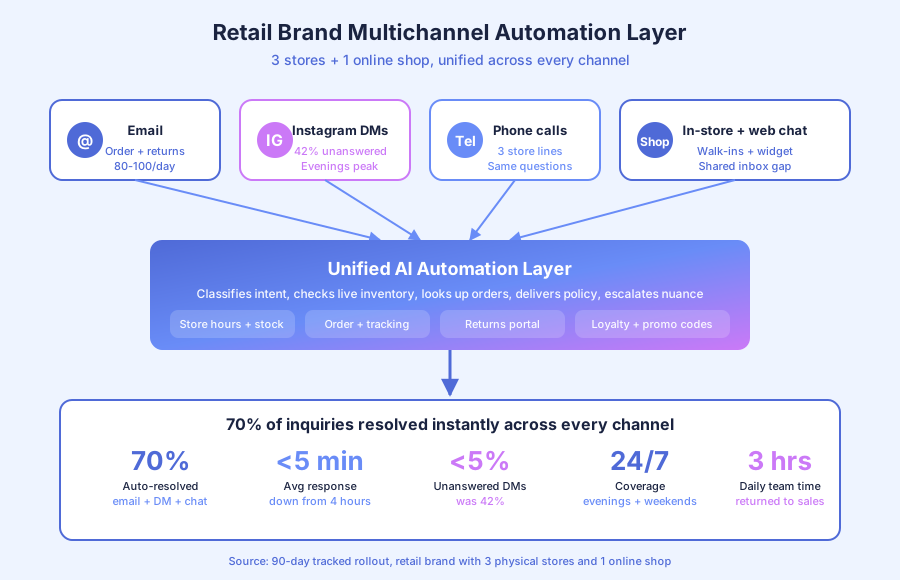
What results did the retail brand actually get?
Answer Capsule: Over 90 days, the brand auto-resolved 70% of inquiries across email, Instagram DMs, Facebook, web chat, and phone transcripts. Response time dropped from 4 hours to under 5 minutes. Unanswered Instagram DMs fell from 42% to below 5%. Staff recovered roughly 3 hours per day for floor sales and content work.
Here’s the 90-day scoreboard the brand tracked internally:
| Metric | Before | After | Change |
|---|---|---|---|
| Response time (all channels) | 4 hrs avg; 8+ evenings | Under 5 min | 98% faster |
| Auto-resolved inquiries | 0% | 70% | No human touch |
| Unanswered Instagram DMs | 42% | Under 5% | Coverage restored |
| Returns processed manually | 100% | ~30% | Self-serve portal |
| Team time on routine replies | 3-4 hrs/day | Under 1 hr/day | 70%+ reduction |
| E-commerce email volume | 80-100/day | 25-35/day | 65% drop |
The numbers line up with Salesforce’s 2024 State of the Connected Customer report, which found 80% of buyers consider the experience a company provides as important as its products. Fast, consistent replies translated directly into chat-to-purchase conversion gains, especially on product availability questions where speed is everything.
What did the multichannel problem look like before automation?
Answer Capsule: The brand had five inbound channels handled by three different people on different schedules. Instagram DMs were checked by the social media manager, emails by the e-commerce coordinator, phone calls by whichever store got dialed, and web chat went to a shared inbox nobody owned. Three identical questions produced three completely different service experiences.
The social media manager checked Instagram during business hours. The e-commerce coordinator checked the shared inbox when they could. Phone calls hit whichever store line the customer dialed. The web chat widget forwarded messages to an inbox three people had access to and none of them owned.
A Saturday-evening DM waited until Monday. A mid-afternoon email got a reply in a few hours if the coordinator was at their desk. A phone call to the Westmount store got answered on the spot.
Same question, three different answers, three different wait times. The brand’s own customer service audit found that 42% of Instagram DMs never received a reply at all. Those customers didn’t complain. They just stopped buying.
How much revenue was fragmentation costing?
Answer Capsule: Direct cost: missed Instagram DMs, abandoned carts tied to slow chat widget responses, and returns that sat for 3 days creating frustrated customers who returned instead of exchanging. Indirect cost: a 42% unanswered rate became a brand signal. Zendesk’s 2024 CX Trends report puts the competitor-switching rate at 60% after one bad experience.
The direct revenue leak was visible in four places:
- Instagram DMs: 42% unanswered; most were purchase-intent questions about stock
- Web chat: Cart abandonment correlated with widget response times over 10 minutes
- Returns: 3-day processing delays turned exchange candidates into refund requests
- After-hours: Evening and weekend messages got no coverage at all
The indirect cost was worse. According to Zendesk’s 2024 CX Trends report, 71% of customers say the most frustrating service experience is repeating their question to multiple agents. The brand’s fragmented channels were creating exactly that pattern, even within a single purchase journey.
For a retail brand competing on product quality and brand identity, service inconsistency reads as disorganization. And disorganization reads as risk.
What did the unified automation system include?
Answer Capsule: One intelligent inbox ingested email, web chat, Instagram DMs, Facebook messages, and SMS. An AI layer classified every message, auto-answered the routine ones using live inventory and order data, and escalated nuance to humans with full context attached. The same logic applied to every channel, 24/7, with consistent answers across all of them.
How does the unified inbox work?
Answer Capsule: Every inbound message from every channel routes into one shared inbox with channel source and customer history attached. The team no longer checks five platforms. Every agent sees the full conversation history across channels, purchase records, and prior returns before they reply.
What changed operationally:
- No more toggling between Instagram, Facebook, Gmail, the chat dashboard, and store voicemail
- No messages falling through gaps between platforms during shift changes
- Full customer context (order history, prior DMs, return history) visible on every thread
- Shared ownership with clear routing rules instead of ad-hoc inbox sharing
The inbox itself is the foundation. The AI layer sits on top and decides what to do with each message. The same architecture underpins our E-commerce Customer Support Automation Playbook.
What does the AI automation layer actually handle?
Answer Capsule: It classifies incoming messages into six categories and responds automatically using live inventory, order data, and policy documents. Store hours, product availability, returns, order status, loyalty, and discount codes all resolve without human involvement. Everything else escalates with context attached.
Six automated categories drove the 70% resolution rate:
- Store hours and location: Responds with hours for the specific store the customer asked about, or all three if unspecified
- Product availability: Checks live in-store and online inventory, suggests in-store reservation link if applicable
- Return and exchange policy: Delivers the policy with a direct link to the self-serve returns portal
- Order status: Looks up by email, responds with current status and tracking link
- Loyalty program: Returns program details and the customer’s current points balance for registered members
- Discount codes: Checks validity, returns expiry date and terms
What escalates to humans: product recommendations needing context, complaints, custom orders, and exceptions outside policy. Escalated messages arrive with the full thread, any auto-response attempt, and the customer’s purchase history pre-loaded. The platform selection logic mirrors our Intercom vs Zendesk vs Tidio comparison.
How does after-hours coverage work?
Answer Capsule: The automation runs 24/7, so Saturday-evening Instagram DMs and Sunday-morning emails get instant replies before the stores even open. The 42% unanswered DM rate dropped to under 5% in the first month. Most remaining non-responses were spam or unclear messages the system correctly declined to answer.
Evening and weekend coverage was the biggest single unlock. The brand’s peak DM volume hit on Friday nights and Saturday evenings, exactly when no human was monitoring. After automation, those windows went from 0% coverage to 100% coverage with under-60-second response times.
Sunday-morning product questions that used to wait for Monday opening now got answered before the customer even finished their coffee. Several of those interactions converted into same-day in-store visits.
How did the team’s work change?
Answer Capsule: The social media manager stopped answering the same 20 questions every day and shifted to community engagement, content, and tagged-post conversations. E-commerce email volume dropped from 80-100 to 25-35 per day. Store staff stopped fielding escalation calls from online. Headcount stayed the same; focus shifted up-market.
The social media manager got roughly 2-3 hours per day back. That time went into:
- Content creation and campaign planning
- Responding to tagged posts and comments
- Managing relationships with repeat customers and brand advocates
- Coordinating with the in-store teams on product launches
The e-commerce coordinator’s inbox shrank by 65%. The remaining emails were substantive: wholesale inquiries, custom order requests, detailed feedback, and the occasional escalation. Response quality on those improved because the coordinator wasn’t context-switching between 80 FAQ replies.
Store staff stopped being the accidental escalation point. Before automation, customers who couldn’t get a DM response often called the nearest store. That traffic dropped, and store phone time fell with it. Floor attention improved as a direct result, which is why we treat AI customer service for retail stores as a sales-capacity investment rather than a support cost.
What principles apply to other multi-location retail brands?
Answer Capsule: Three patterns hold across retail: fragmented channels produce fragmented service, the same question deserves the same answer everywhere, and routine-inquiry automation is really an investment in sales capacity. The ROI shows up in hours recovered for high-value work, not just time saved on replies.
1. Fragmented channels produce fragmented service. Your brand is the sum of every touchpoint, including the Saturday-night DM nobody answered. Unification is the prerequisite for consistency.
2. The same question deserves the same answer. When store hours, return policy, and stock info are delivered instantly and identically across every channel, the brand reads as competent. When answers vary by channel, the brand reads as disorganized.
3. Automation is sales capacity, not just cost savings. Every hour spent answering “what are your return hours?” on Instagram is an hour not on the floor, not curating product, not building loyalty relationships. The real ROI is the work that capacity enables.
Could this pattern work for your retail operation?
Answer Capsule: Yes, if you run across physical and digital channels, in any category: fashion, home, specialty food, beauty, sporting goods. The specific knowledge base differs, but the channel unification, classification, and escalation architecture is consistent. Start with the two highest-volume channels and expand from there.
The fastest wins come from unifying Instagram DMs with web chat first, since those two channels share the most purchase-intent traffic. Email and phone transcript handling can follow in month two. Returns self-serve typically launches in month three once the FAQ coverage has matured enough to catch edge cases.
For related reading, see our E-commerce Customer Support Automation Playbook, our guide on How to Create a Support Ticket Routing System Without Writing Code, and our comparison of the best AI chatbot builders for small business.
Book a free automation audit and we’ll map your current channel coverage, flag where unanswered inquiries are leaking revenue, and model the auto-resolution rate you could realistically hit in 90 days.