They kept joining. They stopped coming. They cancelled.
That cycle accounted for most of a 3-location boutique gym’s 28% annual churn across 1,500 members — right at the IHRSA 2024 industry average of 28-30%. Six months after launching three automations — new member onboarding, usage-triggered retention outreach, and an FAQ chatbot — annual churn dropped to 17%. That’s a 38% reduction, roughly 165 retained members, and about $118,800 in recovered annual revenue at a $60 average monthly fee. Front desk inquiry volume fell 65%. The gym wasn’t bad. It just wasn’t watching.
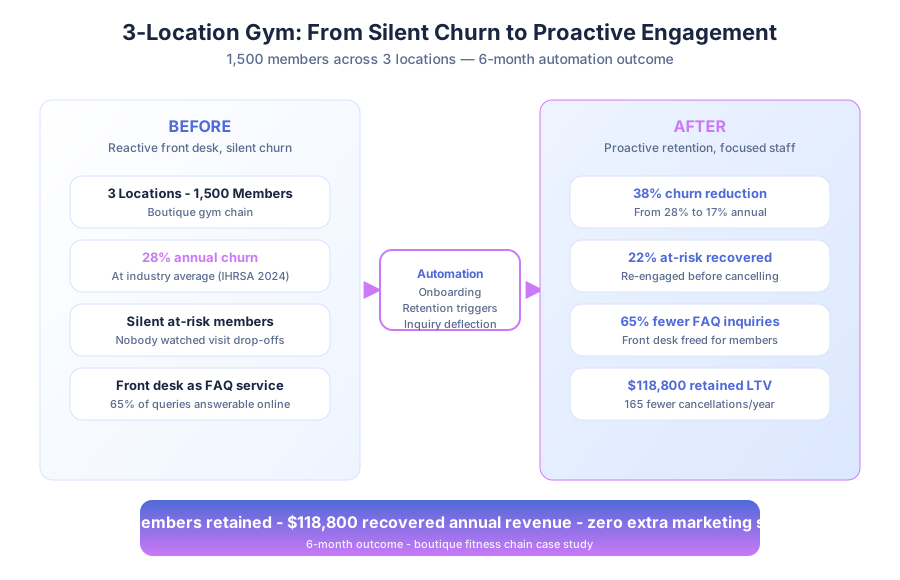
What were the measurable results after six months?
Annual churn dropped from 28% to 17%, a 38% relative reduction. Front desk inquiry volume fell 65%. Roughly 22% of members flagged as at-risk re-engaged before cancelling. Across 1,500 members at $60 monthly, the gym retained approximately 165 members per year and recovered about $118,800 in annual revenue.
| Metric | Before | After | Change |
|---|---|---|---|
| Annual member churn rate | 28% | 17% | 38% reduction |
| At-risk members recovered | Near 0% | 22% of flagged | New capability |
| Front desk inquiry volume | Routine-dominated | 65% reduction | Staff freed |
| New member 90-day retention | Baseline | Significantly higher | Onboarding impact |
| Retained revenue (annual) | — | ~$118,800 | 165 members |
The 28% starting point sits exactly at the IHRSA 2024 Health Club Membership Trends report industry average, so this wasn’t a broken gym — it was an average one. The 17% after-rate sits well below peer baseline, which is where retention economics get interesting.
Why were 1,500 members churning in silence?
Members rarely cancelled after a bad experience. They cancelled after gradual disengagement that nobody at the gym noticed or responded to. A 12-month churn analysis showed cancellations clustered in three predictable windows, each preceded by weeks of declining visits that existed in the data but went unwatched.
A front-desk team focused on check-ins and walk-in sales wasn’t set up to monitor 1,500 individual visit patterns. The data existed. The attention didn’t.
The three churn windows:
- Months 1-2: New members who never established a visit habit. Joined, visited 2-3 times, quietly stopped.
- Months 4-6: Members whose usage declined over 6-8 weeks before cancellation. Visible in the data. Invisible to staff.
- Month 12: Already-disengaged members hitting annual renewal and choosing not to continue.
In every window, members who got no outreach cancelled. Members who received a meaningful touch — a check-in, a class recommendation, a free trainer session — were more likely to re-engage. The IHRSA 2024 report cites poor engagement and communication as the leading preventable causes of gym churn, which matched the pattern exactly.
What was the front desk actually doing all day?
An audit of one full week of front desk interactions across all three locations found that roughly 65% were questions already answered on the gym’s website: class schedules, pricing, trainer packages, hours, guest passes, and freeze requests. The information existed. It just wasn’t findable in the moment the member needed it.
Every one of those inquiries was time the front desk wasn’t spending on check-ins, sales conversations, or outreach to at-risk members. According to the 2024 IHRSA Global Report, operating-margin pressure at boutique fitness operators makes staff capacity one of the highest-leverage optimization areas — and this gym was burning that capacity on FAQ work. The front desk had become an FAQ service with a side of check-in, which left zero capacity for the relationship work that actually retains members.
What three automations did the gym build?
The gym deployed three systems over approximately eight weeks: a 30-day new member onboarding sequence, a usage-triggered retention monitor with escalating outreach, and an FAQ chatbot across web, app, and WhatsApp. Each targeted a specific churn driver identified in the data analysis, and all three went live in parallel. Together they make up the standard build we deploy as AI customer service for gyms and fitness studios.
What does the new member onboarding sequence do?
Every new member at any location enters a 30-day sequence designed to establish a visit habit in the critical first month. Members who visit at least twice in their first week have dramatically higher 90-day retention than those who don’t, so the sequence is engineered around that first-week threshold.
The five touches:
- Day 1 — welcome: Home location’s class schedule, app booking instructions, personal training team intro.
- Day 3 — class recommendation: A specific class matched to their membership type with a direct booking link.
- Day 7 — check-in: How the first week is going, plus the three most popular classes at their location this week.
- Day 14 — trainer intro: Free 20-minute goal-setting consultation offer, no commitment.
- Day 30 — month 1 milestone: Acknowledgment of their first month plus what’s new for month two.
Members who completed their first class within the first week had a 40% higher 90-day retention rate than those who didn’t. The sequence is built to engineer that first visit.
How does the usage-triggered retention monitor work?
The retention system watches each member’s visit frequency against their own four-week baseline — not a generic threshold. When frequency drops 50% below baseline for seven consecutive days, the member is flagged at-risk and enters an escalating outreach sequence based on days since their last visit.
Escalation timeline:
- Day 10 without a visit: Friendly check-in — “Haven’t seen you this week. Here’s what’s happening at your location.”
- Day 17: Class recommendation with a specific booking link tied to their past preferences.
- Day 24: Free personal trainer consultation offer — no commitment, no upsell.
- Day 31: Direct, honest message — “We miss you. If something about your membership isn’t working, we want to hear it.”
- After day 31 with no response: Flagged for front desk personal outreach.
22% of members who received the automated retention sequence re-engaged before cancelling. At an average membership value of $60/month across 1,500 members, recovering roughly 1 in 5 flagged members produced the bulk of the overall churn reduction.
What does the FAQ chatbot handle?
A self-service FAQ chatbot runs across the gym’s website, mobile app, and a WhatsApp number promoted at all three locations. It handles the high-volume, repeatable questions instantly and escalates anything that needs judgment to the front desk with full conversation context attached.
Automated coverage:
- Class schedule queries (current week for the member’s home location)
- Personal training package pricing and availability
- Guest pass policy and booking
- Membership pause and freeze requests (submits and confirms timeline)
- Facility hours across all three locations
- Equipment and amenity questions
Billing disputes, complaints, and complex membership changes escalate to the front desk with the full chat transcript attached, so staff don’t have to re-interview the member. Front desk inquiry volume dropped 65%, and the remaining 35% were the high-value conversations that benefit from human attention.
Why does proactive communication prevent cancellations?
Members who cancel rarely have a dramatic breaking point. They disengage gradually, the disengagement goes unnoticed, and by the time they decide to cancel, the habit is already broken. Cancellation is the final step of a journey that started weeks earlier — which is why early detection outperforms late intervention.
Catching that journey at day 10 rather than at the cancellation call interrupts the trajectory before it completes. The 2024 IHRSA member retention research consistently ranks “the gym reaches out when I’m absent” as one of the strongest predictors of renewal intent, ahead of equipment quality and class variety.
The mechanism is also psychological. A message that acknowledges the member’s absence — “Haven’t seen you this week” — signals that the gym noticed. That signal changes the member’s perception of the relationship, even if they don’t immediately book a class. Not every flagged member re-engages, but 22% is a meaningful recovery rate, and it compounds month over month.
What did the revenue math look like?
The 38% churn reduction across 1,500 members translates directly into retained revenue. Dropping annual churn from 28% to 17% means roughly 165 fewer cancellations per year (1,500 members times the 11-percentage-point delta). At the gym’s $60 average monthly fee, that’s approximately $118,800 in recovered annual revenue from members the gym already had.
Why the math matters:
- No new marketing spend required. The 165 retained members were already paying. The automation cost was one-time setup plus a small monthly platform fee.
- Lifetime value compounds. Each retained member keeps paying in month 13, 14, 24. The $118,800 is only year one.
- Replacement cost avoided. Acquiring 165 new members to replace the lost ones would have required significant ad spend at current CAC benchmarks for boutique fitness.
For any membership business, the cheapest member is the one you don’t lose. Retention automation shifts the cost structure toward keeping existing members rather than constantly replacing them.
What can other fitness businesses take from this?
Three principles apply to any membership-based fitness or wellness operation — boutique studios, yoga, martial arts, CrossFit, or larger chains. The specific thresholds shift with visit frequency patterns, but the structural pattern holds.
1. Churn prevention requires early detection, not late intervention. A member who has decided to cancel has already disengaged. A member whose visits are dropping is still a member. The 10-day inactivity flag catches people at the start of the journey, not the end.
2. First-month engagement determines 90-day retention. The visit habit either forms in the first month or it doesn’t form at all. An onboarding sequence designed to drive the first class, then the second, dramatically improves the odds.
3. Front desk capacity for relationships is the real growth lever. A team that isn’t answering the same FAQ questions 40 times a day has capacity to check in with at-risk members, convert trial visitors, and build the connections that differentiate boutique fitness from a big-box gym. That’s where retention and referrals both come from.
Could this work for your fitness business?
The pattern described here applies to boutique studios, yoga and pilates studios, martial arts schools, CrossFit boxes, and any membership-based wellness business with a visit-frequency signal and a front desk handling inquiry volume. The trigger cadence and message content change, but the mechanism is the same.
For related reading, see our guide on How to Automate Customer Onboarding Welcome Sequences, our breakdown of How to Set Up Automated Follow-Up Sequences That Actually Convert, and our guide on How to Automate Appointment Reminders for class and trainer booking workflows.
Book a free automation audit and we’ll analyze your membership data to identify where churn is happening, which members are silently disengaging, and which automation sequences would produce the highest retention impact for your specific member profile.