Every AI vendor wants you to buy their tool. Every business publication wants to write about AI adoption. Nobody is helping you decide which specific problems in your specific business are worth solving with AI, in what order, and with what metrics.
That’s what an AI strategy is. It’s not complicated. It fits on one page. And according to Deloitte’s 2025 State of Generative AI in the Enterprise report, companies with a documented AI strategy are roughly 2.8x more likely to report high ROI from AI investments than companies adopting tools opportunistically. The strategy doesn’t create the value — the thinking required to write it does.
Here’s how to build one in an afternoon, without a tech team, and without buying anything first.
What is an AI strategy for a small business?
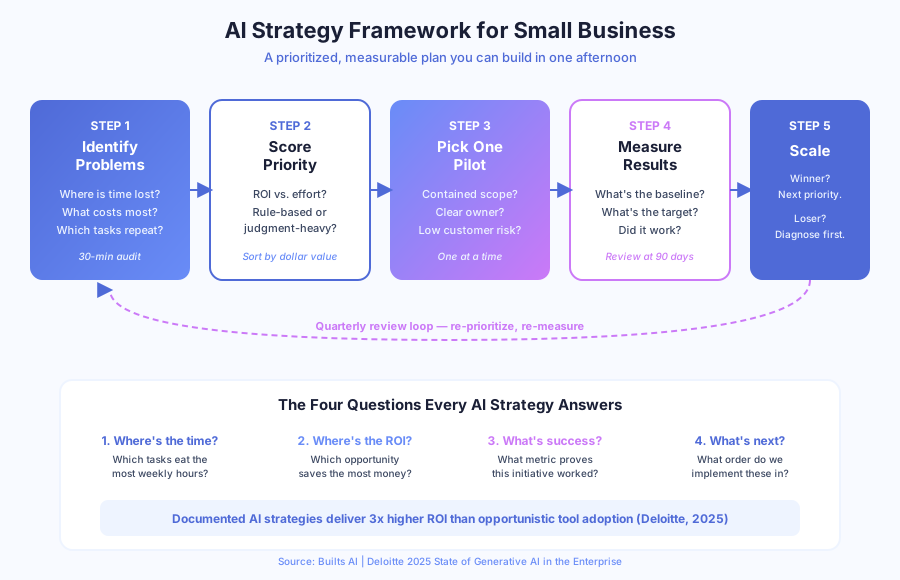
An AI strategy is a one-page, prioritized list of where AI can solve your most expensive business problems, ranked by expected return, with specific success metrics and a sequenced implementation order. It’s a decision document, not a technology roadmap.
A small-business AI strategy answers four questions:
- Where is my team spending the most time on work AI could handle?
- Which of those opportunities has the highest expected dollar value?
- What does success look like for each, in specific numbers?
- What order do we implement them in, and when do we review?
That’s it. No governance framework. No vendor evaluation matrix. No 40-tab spreadsheet. Those are relevant at enterprise scale. For a 10 to 50 person business, the strategy is a prioritized problem list with baselines and target metrics.
Per Deloitte’s 2025 survey of 2,773 business leaders, the gap between strategic and opportunistic adopters is significant: 74% of organizations with a documented AI strategy reported their most advanced initiative met or exceeded expectations, versus 38% of those without one. Documentation forces prioritization, and prioritization is where value comes from.
Why do most small-business AI efforts stall?
Most small-business AI efforts stall because they start with tools, not problems. A team buys a popular AI product, tries to fit it to something, and discovers six months later that nothing measurable changed. Without a baseline metric and a prioritized problem, any tool feels like progress.
The three most common failure patterns:
Tool-first adoption. A team buys an AI writing tool, a chatbot, and an analytics dashboard in the same quarter. Nothing integrates. Nobody owns outcomes. Six months later, the tools are paid for and half-used.
Technology-led prioritization. The IT lead picks the most technically interesting initiative. It’s a six-month build with no clear user. The business problems with real dollar value sit unaddressed.
No baseline measurement. A team automates something but never measured the “before” state. When the CFO asks what changed, nobody can answer in numbers.
According to McKinsey’s 2024 State of AI report, organizations that achieve meaningful value from AI consistently pair initiative selection with pre-launch baseline metrics. Skipping the baseline is the single most common execution mistake in small-business AI projects.
Step 1: How do I audit where my team’s time actually goes?
Spend 30 minutes mapping the major recurring activities in your business. For each, estimate the weekly hours spent across the team. You don’t need precision — you’re hunting for the big numbers: functions that consume 10, 15, 20+ hours per week that could be reduced with automation.
Here’s the template to work through:
| Function | Activity | Weekly Hours |
|---|---|---|
| Customer service | Email, chat, phone responses | ___ |
| Sales | Lead follow-up and qualification | ___ |
| Operations | Data entry, system updates | ___ |
| Finance | Invoicing, AR follow-up | ___ |
| Marketing | Content creation, scheduling | ___ |
| HR/Admin | Scheduling, onboarding | ___ |
| Reporting | Generating and formatting reports | ___ |
Ask the people doing the work, not the owner’s best guess. Owners almost always underestimate customer support and AR follow-up hours by 40-60% because that work happens in small continuous chunks rather than visible blocks. Per Salesforce’s 2024 State of Service report, customer service reps spend 69% of their time on repetitive tasks — a number most owners find shocking until they run the audit.
Step 2: How do I rate each activity for automation potential?
Rate each high-time-cost activity on a simple three-level scale. The goal is to separate work a machine can handle from work that needs a human. The highest-ROI opportunities are the ones where high time cost and high automation potential meet.
High automation potential. Rule-based, repetitive, predictable patterns, minimal judgment. Examples: answering the same 30 FAQs, moving data between two systems, sending payment reminders on a schedule. These are the wins.
Medium automation potential. Predictable structure, variable content. Examples: responding to complaints (consistent format, different details), generating weekly reports (same columns, different numbers).
Low automation potential. Judgment-heavy, relationship-driven, creative decisions. Examples: sales negotiation, strategic planning, complex client advising. Leave these alone for now.
Per MIT Sloan Management Review’s 2024 analysis of 1,500 AI projects, roughly 80% of measurable ROI from small-business AI comes from high-automation-potential activities — the unglamorous repetitive work, not the cutting-edge decision support. Chase the boring wins first. The other side of this calculation is whether to add headcount instead — our framework on automation vs. hiring walks through the per-task math (loaded hourly cost vs. one-time build + monthly tool spend) so you can rank each opportunity against the equivalent hire before committing either way.
Step 3: How do I build and sort the opportunity list?
Take your top 5 to 7 activities where high time cost meets high automation potential. For each one, calculate four numbers: current weekly hours, realistic automation percentage, hours recovered per week, and estimated annual dollar value. The annual value is your prioritization key.
Here’s an example opportunity list for a professional services firm with a 10-person team:
| Opportunity | Weekly Hrs | Automation % | Hrs Recovered | Est. Annual Value |
|---|---|---|---|---|
| Client status update emails | 6 | 80% | 4.8 | $12,500 |
| Lead inquiry follow-up | 4 | 70% | 2.8 | $7,300 + 25% conversion lift |
| Invoice and AR follow-up | 3 | 85% | 2.55 | $6,600 + cash flow gain |
| Meeting scheduling | 2 | 90% | 1.8 | $4,700 |
| Internal report generation | 4 | 75% | 3.0 | $7,800 |
Dollar value uses a blended labor cost of $50/hour. Sort by annual value. The top row is your first initiative. According to HubSpot’s 2024 State of Marketing data, lead follow-up response time under 5 minutes increases conversion by up to 21x compared to over-an-hour response — which is why lead follow-up usually rises to the top for sales-driven businesses.
Step 4: How do I define success metrics before starting?
For every initiative, define two metrics and measure the baseline before you launch anything. One metric tracks efficiency (time, volume, cost), the other tracks outcome (satisfaction, conversion, collection rate). Baselines matter because you can’t prove ROI without a “before.”
The metric structure for each initiative looks like this:
- Current baseline: Measured value before launch (e.g., average support response time: 3.5 hours)
- Target: Specific target value (e.g., under 10 minutes)
- Measurement method: Where the number comes from (e.g., weekly export from support platform)
- Review date: 90 days after launch
Two metrics, four fields. That’s the discipline. Per Gartner’s 2024 research on AI project success rates, projects launched with documented baseline metrics are approximately 2x more likely to continue past the pilot phase than projects launched without baselines.
Step 5: How do I sequence implementation across the year?
Sequencing rule: highest ROI first, filtered by contained scope and low customer risk. Never start multiple initiatives at once. Each initiative should run for 4 to 8 weeks before you begin the next one, so you get real performance data before committing budget or attention elsewhere.
Prioritization filter, in order:
- ROI. Sort descending by estimated annual value.
- Scope. Prefer initiatives touching one system and one workflow.
- Risk. Back-office first, customer-facing second.
- Learning. Build on the technical and organizational capability of the last win.
Example 12-month roadmap:
- Month 1-3: Customer support automation — FAQ deflection plus unified inbox.
- Month 3-5: Lead follow-up automation — speed-to-lead plus nurture sequence.
- Month 5-8: Accounts receivable automation — invoice plus AR follow-up.
- Month 9-12: Internal reporting automation and employee onboarding.
For a survey of which tools fit each stage, see our guide to the best AI tools for small business in 2026. If your team has no developers, our article on what no-code AI is and how to get started is a practical starting point.
Step 6: How do I review and adjust the strategy?
An AI strategy isn’t a document you file and forget. Review it quarterly, 60 minutes, four questions. The review cadence is the mechanism that separates businesses that compound AI value from businesses that accumulate partially-used tools. Skip the review and the strategy becomes decoration.
The four quarterly review questions:
- Did the last initiative hit its documented metrics? If not, why?
- What adjustments to the current automation would improve performance?
- Has anything shifted in the business that changes the priority order?
- What’s the next initiative, and when does it start?
Per Bain & Company’s 2024 research on enterprise AI adoption, organizations that conduct structured quarterly reviews of their AI portfolio report meaningfully higher cumulative ROI than those reviewing annually or on an ad hoc basis. The discipline of regular review is a larger ROI driver than tool selection.
What does a one-page AI strategy actually look like?
A one-page AI strategy fits on a single sheet: three prioritized opportunities with dollar values, the current initiative with baseline and target metrics, and the next review date. No theory, no vendor list, no technology architecture. The whole point is forced brevity — if it doesn’t fit, you’re overthinking it.
Here’s the template:
BUSINESS AI STRATEGY — [Company] — [Date]

TOP 3 OPPORTUNITIES (sorted by annual dollar value):
1. [Opportunity]: [Baseline] → [Target] | $[X]/year
2. [Opportunity]: [Baseline] → [Target] | $[X]/year
3. [Opportunity]: [Baseline] → [Target] | $[X]/year

CURRENT INITIATIVE:
What: [Initiative name]
Success metric: [Baseline] → [Target] by [Date]
Status: [In progress / Planned start: Date]
Owner: [Name]

NEXT REVIEW DATE: [Date]
That’s the strategy. The value sits in the prioritization and the metrics, not the length. For related reading, see our deep dive on the real ROI of AI automation with numbers from 50+ small business implementations and our guide on how to choose an AI automation agency and the 7 questions to ask before you sign.
Ready to build your AI strategy?
Book a free automation audit. The audit is exactly the process described in Step 1 through Step 3 of this article: we map your current workflows, build the opportunity list, and show you the specific ROI model for your highest-priority initiative. You’ll leave the session with a one-page strategy draft. No sales pressure, no commitment — just the prioritized list you need to make a decision.