Inc. Magazine’s 2026 survey found 40% of small business owners said automation reduced the number of jobs they needed to fill. Not eliminated. Reduced. They still hired people, just for different roles. That stat reframes the question most owners ask when work piles up. The question isn’t “automation OR hiring.” It’s “which one first, and for what?” Your team is stretched. Tickets are stacking up. Before you post that job listing, score the work against the 5-factor framework below and compare real cost per outcome. The answer is often a hybrid, and it’s usually cheaper than you think.
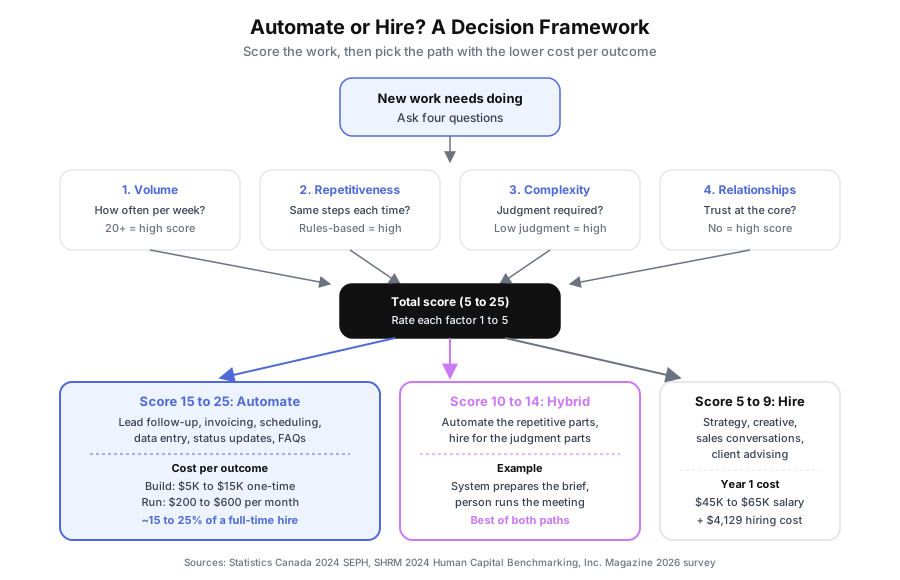
What’s the real cost difference between hiring and automating?
A Canadian full-time hire costs $45,000 to $65,000 per year loaded, takes 2 to 3 months to recruit and train, and works 40 hours per week during business hours. A comparable automation project costs $5,000 to $15,000 one-time plus $200 to $600 monthly, deploys in 2 to 6 weeks, and runs 24/7. For repetitive work, automation wins on cost every time.
Here’s the full comparison:
| Factor | New full-time hire | Automation project |
|---|---|---|
| Year 1 cost | $45,000 to $65,000 (Statistics Canada 2024 SEPH) | $8,000 to $22,000 (build + tools) |
| Recruitment cost | $4,129 average (SHRM 2024) | $0 |
| Time to productive | 2 to 3 months | 2 to 6 weeks |
| Availability | 40 hrs/week, business hours | 24/7/365 |
| Handles volume spikes | Fixed capacity | Scales automatically |
| Error rate on repetitive tasks | Rises with fatigue | Zero variation |
| Judgment calls | Yes | No |
| Year 2 cost | $45,000 to $65,000+ (raises) | $2,400 to $7,200 (tools only) |
The math is clear for repetitive processes. SHRM’s 2024 Human Capital Benchmarking Report confirms the average cost-per-hire sits at $4,129 before a single day of work. But cost isn’t the only factor, so the next question matters more.
When should you automate instead of hire?
Automate when the work follows the same steps every time, needs to happen faster than a human can respond, runs outside business hours, or scales with volume spikes. If a checklist could describe the job perfectly, a system can do it. If every instance needs fresh thinking, you need a person.
Here’s what “automate instead of hire” looks like in practice.
Automate when:
- The same steps happen in the same order, 10+ times per week
- Response time matters (leads need answers in minutes, not hours)
- The work runs outside business hours (evenings, weekends, holidays)
- One person is the bottleneck, and the work doesn’t need their expertise
- Errors are expensive (wrong invoice amounts, missed follow-ups, data entry mistakes)
Hire when:
- Every case requires different judgment
- Relationships are the core deliverable (sales, client advising, consulting)
- Creativity drives the outcome (strategy, design, writing, product)
- Emotional intelligence matters (conflict resolution, sensitive communication)
McKinsey’s 2024 Global Survey on AI and Automation found 60% of all occupations have at least 30% of their activities that could be automated with current technology. That 30% is what you automate first. To quantify the return, use the automation ROI calculator guide.
What does “automate instead of hire” look like in real businesses?
Real businesses make this trade-off every day. Here are four that chose a system over a person, and what happened next. The pattern is consistent: automation handled the repetitive volume, and the team redirected to higher-value work that actually needed their skills. Each case scored 15 or higher on the framework below.
Instead of an admissions coordinator
Thompson Career College was getting 300+ monthly inquiries with a 1 to 2 business day response time. Over 40% came in after hours. Students were enrolling at competing schools because TCC couldn’t respond fast enough. The obvious fix: hire another admissions person at $45,000+ per year.
Instead, they automated the entire inquiry response pipeline using a custom AI system integrated with their CRM. Every lead gets a personalized response in under 60 seconds. Admissions calls tripled. Harvard Business Review research (Oldroyd, 2011; updated by Drift in 2023) found responding within 5 minutes makes you 100x more likely to connect than waiting 30 minutes. TCC now responds in under one minute, around the clock, and never hired that coordinator.
Instead of a support rep
KwikUI had two founders spending half their day answering the same support questions from 3,000+ SaaS users. A dedicated support hire felt premature, and at $4,129 per hire (SHRM 2024), the recruiting cost alone was meaningful relative to runway.
They automated 65% of support tickets instead. An AI system built on their knowledge base handles FAQs, checks account status from the database, and creates a ticket for the founders only when a human is genuinely needed. Trial-to-paid conversion doubled from 4% to 8%. Churn dropped 40%. The two founders now ship features instead of answering password reset questions.
Instead of an admin assistant
Taxvisory’s founder manages 300 clients as a solo CPA. During tax season, she was working 14-hour days chasing documents and fielding “where’s my return?” calls. A part-time assistant through Indeed would have cost $25,000 to $30,000 per year.
She automated the three biggest time sinks: document upload through a secure portal, self-service scheduling via Calendly, and automatic status updates as returns progress through TaxCycle. Document chasing dropped 80%. She took weekends off during tax season for the first time in years.
Instead of an operations manager
AcquireX Properties is a 3-person real estate investment firm analyzing deals, communicating with tenants, and reporting to investors. An operations hire would have cost $55,000+ per year before benefits.
Three custom automation systems later, they tripled portfolio capacity with the same 3 people. Deal analysis that took days now takes hours, pulling comparable data from CoStar and CMHC automatically. Investor reports generate every quarter without manual compilation. The operations manager they would have hired? Never needed.
How do you score the automate-vs-hire decision?
Rate each factor from 1 (low) to 5 (high). A total of 15 or above means automate first. Below 10, hire. Between 10 and 15, run a hybrid: automate the repetitive portions and hire for the parts that need human skill. The framework works because it separates mechanical work from judgment work.
| Factor | 1 (Hire) | 3 (Either) | 5 (Automate) |
|---|---|---|---|
| Repeatability | Every case is different | Some variation | Same steps every time |
| Time-sensitivity | Days are fine | Hours matter | Minutes or seconds |
| Volume | Under 5x per week | 5 to 20x per week | 20+ per week |
| Judgment required | Complex reasoning always | Some decisions | Rules-based only |
| Relationship dependency | Core to the outcome | Partially important | Not a factor |
Scoring guide:
| Total score | Recommendation |
|---|---|
| 20 to 25 | Automate immediately. This work shouldn’t touch a person. |
| 15 to 19 | Automate first, then reassess whether you still need to hire. |
| 10 to 14 | Hybrid. Automate the repetitive parts, hire for the rest. |
| 5 to 9 | Hire. This work needs judgment, creativity, or relationships. |
Let’s apply this to Thompson Career College’s inquiry response: Repeatability 5, Time-sensitivity 5, Volume 5, Judgment 2, Relationship 1. Total: 18. Clear automate-first territory, and the results confirmed it.
Now compare hiring a senior sales closer: Repeatability 2, Time-sensitivity 2, Volume 2, Judgment 5, Relationship 5. Total: 16, but loaded toward hire factors. Context matters. A system can prepare the brief and follow up afterward. But the conversation itself? That’s always a person.
When is automation NOT the answer?
Don’t automate client negotiations. A system can schedule meetings, pull briefing data from Salesforce or HubSpot, and send follow-up summaries. But the conversation where trust gets built and deals close? That’s a person, every time. AI context prep makes the person more effective, it doesn’t replace them.
Don’t automate brand new processes. If you haven’t figured out how a workflow runs yet, automating it just means you’ll do the wrong thing faster. Get the process working manually first in Notion, Trello, or a spreadsheet. Prove the steps. Then automate what’s proven. Zapier’s own guidance matches this: automate stable processes, not experiments.
Don’t automate sensitive communication. Termination notices, complaint resolution, delivering difficult news. These need empathy. A system can route them to the right person with full context from your CRM. But a person handles the conversation.
Don’t automate to avoid hiring expertise you genuinely need. No system replaces a CPA, a developer, or a UX designer. Automation handles execution. Expertise handles decisions.
What’s the best approach for a growing team?
The highest-performing small teams automate the repetitive work first, then hire for roles that need human skill. Your first hire isn’t an admin assistant, it’s a salesperson, strategist, or specialist. The system handles everything else, and the job description gets sharper because you know exactly what’s left.
Step 1: Automate the repetitive work eating your team’s time. Lead follow-up, document chasing, invoice reminders, appointment scheduling, status updates, data entry. AI is also reshaping how small businesses screen candidates and streamline hiring workflows.
Step 2: See what’s left. Once admin work is handled, you’ll have a clearer picture of what actually needs a human. The answer is usually fewer roles than you expected.
Step 3: Hire for high-value work. Instead of an admin assistant, hire a salesperson. Instead of a support rep, hire a product designer. Instead of an operations manager, build three systems that do the operations work (like AcquireX did).
Zapier’s 2024 State of Business Automation Report found 29% of small business owners automate specifically to avoid burnout. That’s not about replacing people. It’s about protecting the people you already have from work that drains them without using their skills. Salesforce’s 2024 Small Business Trends Report ranks automation as the top operational priority for 43% of owners.
How do you get started?
Start with one question: what is my team spending time on that doesn’t require their expertise? Make a list and be specific. “Responding to the same 10 customer questions” is automatable. “Building relationships with enterprise clients” is not. “Entering data from emails into QuickBooks” is automatable. “Advising clients on tax strategy” is not.
Run the 5-factor scoring framework on your top 3 time sinks. If any score 15+, you’ve found your starting point. If they score between 10 and 14, plan a hybrid approach.
Or skip the scoring and book a free audit. We’ll map your team’s current workload in 30 minutes. You’ll get a written report within 48 hours showing which tasks cost the most time and whether automation, hiring, or both makes more sense for your situation. Free, no pitch, and you keep the report either way.