A B2B SaaS founder showed me her onboarding data last month. Of every 100 trial signups, 4 converted to paid. That’s $96 in acquisition cost burned for every $4 earned. According to Wyzowl’s 2024 study, 90% of SaaS users churn if they don’t see value in the first week. Her time-based drip (Day 1: welcome, Day 3: tips, Day 7: upgrade) treated every user identically, whether they’d explored the product or never logged back in.
She switched to behavior-triggered onboarding. Conversion jumped from 4% to 8%. That’s not a hypothetical. That’s what happened at KwikUI, and this guide shows you the exact 5-milestone framework so you can build the same system.
Why do time-based onboarding drips fail?
Time-based drip sequences ignore the only variable that matters: what the user has actually done. They send the same “finish your setup” message on day three to users who completed setup in 20 minutes and users who never logged back in. That’s not personalization, and it trains users to ignore you.
Every user moves at a different pace. A technical founder finishes setup in 20 minutes. A non-technical small business owner needs three days and a support call. Forrester’s 2024 Total Economic Impact studies report a 200% average first-year ROI on business process automation, but only when that automation actually responds to user state.
A time-based drip is automation. It’s just bad automation. The fix is behavior triggers: instead of “send email on Day 3,” build “send email when user hasn’t completed Step 2 within 48 hours of Step 1.” That single shift changes everything downstream.
What are the five onboarding milestones every sequence needs?
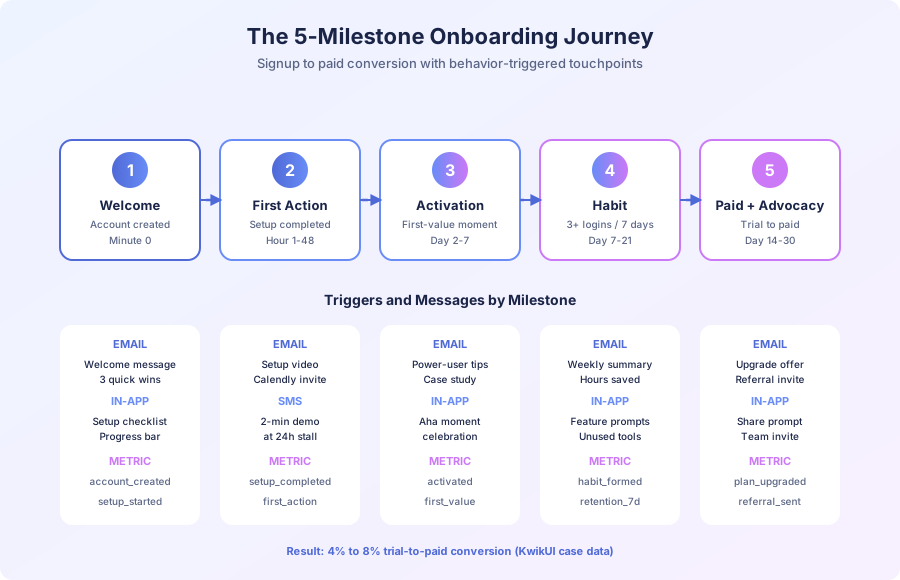
Every effective onboarding sequence moves users through five milestones: welcome (account creation), first action (initial setup), activation (first-value moment), habit (repeated usage), and advocacy (referral or upgrade). Each milestone needs its own trigger, content, success metric, and exit condition to avoid stale messages.
Here’s the framework in one view:
| Milestone | Trigger | Goal | Example Message |
|---|---|---|---|
| Welcome | Account created | Set expectations, build excitement | ”Here’s what you can accomplish this week” |
| First Action | Setup or first task done | Confirm they’re on the right path | ”You just created your first project. Here’s what to do next” |
| Activation | User hits first-value moment | Cement the aha moment | ”You saved 2 hours this week. Here’s how to save 5 more” |
| Habit | 3+ logins in 7 days | Reinforce the pattern | ”Your weekly results are in” |
| Advocacy | 30+ days active | Turn users into promoters | ”Know someone who’d benefit? Share your referral link” |
The activation milestone is the most critical. That’s the first-value moment, the point where a user gets enough benefit that walking away would cost them something. For Slack, it’s 2,000 team messages. For Dropbox, it’s saving a file to a shared folder. For KwikUI, it’s generating a first component and watching it render live.
According to OpenView’s 2024 Product Benchmarks report, SaaS products that define and optimize for a first-value moment see 60% higher retention at day 30. Define your activation event clearly. Everything else flows from that single definition.
How do you set up behavior triggers instead of time delays?
Use an event tracker (Mixpanel, Amplitude, or Segment) to capture user actions, then forward those events to your messaging tool (Customer.io, Intercom, or ActiveCampaign). Messages fire when specific things happen (or don’t happen) rather than when an arbitrary timer expires.
Step 1: Install event tracking
Add Segment as your data layer, or drop in Mixpanel’s SDK directly. Track six core events that cover every milestone: account_created, setup_completed, first_value_action, feature_used, plan_upgraded, and referral_sent. These six names become the vocabulary for every trigger you build downstream.
Step 2: Connect to your messaging tool
Segment forwards events to Customer.io, Intercom, or ActiveCampaign in real time. Skip Segment if you want, because every major messaging tool ships its own SDK. According to the 2024 Twilio Engagement Report, companies using event-based messaging see 3x higher click-through rates than those relying on time-based drips.
Step 3: Build trigger rules with exit conditions
In Customer.io, create a campaign triggered by “account_created.” Add a wait step: “Wait until setup_completed OR 48 hours pass.” If setup completes, branch to the “great job” email. If 48 hours elapse, branch to the “need a hand?” email. Then add an exit condition so users leave the moment they complete the action.
Step 4: Remove users the instant they convert
When a user finishes the target event, remove them from the sequence immediately. Every messaging tool supports exit conditions. Not using them is the single biggest source of “onboarding spam” complaints. This pattern is what cut KwikUI’s support tickets by 65% because users stopped getting stuck and then getting irrelevant reminders about getting unstuck.
How do you build a multi-channel onboarding sequence?
Combine email, in-app messages, and SMS into one coordinated sequence. Email handles education and long-form content. In-app messages guide users in the moment they need help. SMS creates urgency for time-sensitive actions. Each channel plays a distinct role, and using all three lifts activation significantly.
Channel roles and performance benchmarks
- Email: Welcomes, education, success stories, weekly summaries. Open rates average 20% to 30% per Twilio’s 2024 Messaging Trends report.
- In-app messages: Tooltips, checklists, progress bars, contextual prompts. They reach 100% of active users because they’re inside the product.
- SMS: Trial expiration alerts, booking confirmations, re-engagement for inactive users. SMS delivers a 98% open rate per the same Twilio 2024 report.
Example multi-channel flow for First Action
- User signs up. Email: welcome with 3 quick-start steps (immediate).
- User logs in. In-app: guided checklist overlay showing setup progress.
- User hasn’t completed setup after 24 hours. Email: “Need a hand?” with a Calendly link.
- User still inactive at 48 hours. SMS: “Your trial’s waiting. Here’s a 2-minute setup video.”
Tools that handle multi-channel well include Customer.io (email, in-app, push), Intercom (email, in-app, chat), and ActiveCampaign (email plus SMS, with Make connecting in-app tools). Mixpanel and Amplitude sit underneath as the analytics layer that proves which channels actually drive activation.
How do you measure activation rate and prove it’s working?
Track three numbers: activation rate (percentage hitting your first-value moment), time-to-activation (days from signup), and trial-to-paid conversion. Build a weekly dashboard in Mixpanel or Amplitude segmented by acquisition channel, plan type, and onboarding version so you can spot regressions early.
Activation rate is your primary health metric. Define the event so it represents genuine value, not just clicking around. For KwikUI, activation is “user generates and exports their first component.” For a project management tool, it might be “user creates a project and invites a team member.”
Healthy benchmarks
| Metric | Poor | Average | Good | Great |
|---|---|---|---|---|
| Activation rate | Below 10% | 10-20% | 20-40% | Above 40% |
| Time-to-activation | 7+ days | 3-7 days | 1-3 days | Same day |
| Trial-to-paid conversion | Below 3% | 3-5% | 5-10% | Above 10% |
KwikUI moved from 4% to 8% trial-to-paid conversion. Their activation rate climbed from roughly 12% to 28%. Time-to-activation dropped from 5 days to 2 days. Everything came from switching to behavior triggers and layering in-app guidance on top of email. For the full 90-day play-by-play — the three automations they layered, the milestones they tracked, and the team setup that made it possible with zero new hires — see how KwikUI doubled trial conversions and cut support 65%.
According to IDC’s 2023 Future of Work study, employees spend 30% of their time on manual data tasks. For customer success teams, that’s hours spent manually checking who’s activated and firing off one-off nudge emails. Automating both the measurement and the response frees your team for high-touch accounts. If your CRM is the hub tracking lifecycle stages, our guide on the best CRM platforms for small businesses in 2026 covers which tools sync cleanest with event data.
What does a complete onboarding workflow look like end to end?
A full workflow starts at signup, branches based on user behavior at each milestone, uses multiple channels to reach users where they are, and ends when the user either converts to paid or enters a re-engagement sequence. Here’s the complete blueprint you can copy into Customer.io or Intercom today.
Phase 1: Welcome (Minutes 0-60)
- Trigger: account_created event
- Email: welcome with 3 quick wins (immediate)
- In-app: setup checklist with progress bar (first login)
- Track: setup_started event
Phase 2: First Action (Hours 1-48)
- Trigger: setup_completed OR 48 hours elapsed
- If completed: email celebrating progress, suggesting next feature
- If not completed: email with setup video, SMS with Calendly link
- Track: first_value_action event
Phase 3: Activation (Days 2-7)
- Trigger: first_value_action completed OR 5 days elapsed
- If completed: email with power-user tips, in-app celebration
- If not completed: email with case study, personal outreach from CS
- Track: activated event
Phase 4: Habit (Days 7-21)
- Trigger: 3+ logins in any rolling 7-day window
- Email: weekly usage summary with “you saved X hours”
- In-app: feature discovery prompts for unused tools
- Track: habit_formed event
Phase 5: Advocacy (Day 30+)
- Trigger: 30 days active and activated
- Email: referral program invite
- In-app: “share with a colleague” prompt
- Track: referral_sent event
This is the exact framework I’ve deployed across multiple client engagements. At KwikUI, 3,000+ users now flow through this sequence. Support tickets dropped 65%. Churn fell by 40%. Conversion doubled. Want to run this for your own product? Talk to us and we’ll map your milestones in under 45 minutes.
What mistakes should you avoid when building onboarding automation?
The four biggest mistakes: sending too many messages too fast, not segmenting by user type, leaving users in sequences after they complete the action, and ignoring mobile. Each one turns helpful onboarding into spam and drags activation rates below the 20% floor.
Mistake 1: Message overload
Cap your sequence at one email and one in-app message per day during week one. Two emails the same day feels aggressive. Zendesk’s 2024 Customer Experience Trends report found churn drops from 15% to 11% when support interactions feel helpful rather than pushy. The same relevance rule applies to onboarding.
Mistake 2: One-size-fits-all flows
A solo user on a free trial needs different content than an IT admin setting up a team account. Create at least two onboarding tracks. Segment on signup data (company size, role, use case) and adjust milestone definitions accordingly so each user sees the path that fits their goal.
Mistake 3: Zombie sequences
If a user completes setup, remove them from the “complete your setup” sequence that same second. Customer.io, Intercom, and ActiveCampaign all support exit conditions. Use them. Nothing erodes trust faster than irrelevant automated messages arriving after the action they’re asking for is already done.
Mistake 4: Ignoring mobile
Over half of first-time logins happen on mobile, especially for B2C products. If your in-app onboarding only renders on desktop, you’re missing your biggest activation window. Test every tooltip, checklist, and progress bar on a phone before you ship the sequence to real users.
Start with the five milestones. Build one channel first (email). Get the triggers right. Then layer in in-app and SMS. Once your onboarding is live, pair it with an automated follow-up sequence to re-engage users who stall between milestones. Ready to build yours? Book a free onboarding audit — or see what a done-for-you customer onboarding system includes.