Multi-agent AI has moved from research papers to production workflows faster than most analysts predicted. According to Gartner’s October 2024 Hype Cycle report, 33 percent of enterprise software will include agentic AI by 2028, up from less than 1 percent in 2024. Three frameworks lead the space for business applications: CrewAI, AutoGPT, and Make AI Agents.
They sit at very different maturity levels and serve completely different buyers. CrewAI targets Python developers. AutoGPT pivoted to a research toolkit. Make AI Agents opens agentic capability to no-code users. Picking the wrong one wastes months of build time and thousands in API costs.
This guide breaks down what each framework does, who it’s built for, and which one fits your team’s technical skills and budget.
What Is a Multi-Agent AI System and How Does It Differ From a Single Agent?
A multi-agent system uses several specialized AI agents that collaborate on a complex task, passing work between each other like a relay team. A single agent handles everything in one long conversation, which often causes quality to drop on multi-step tasks.
Think of it this way. A single agent is a capable generalist. A multi-agent system is a specialized team with clear roles.
Single agent example: Ask GPT-4 to research a competitor, draft an analysis, and format a report. The model runs everything sequentially in one context window. Quality degrades as the context fills up.
Multi-agent example: A researcher agent searches the web and gathers data. A writer agent drafts the analysis from that research. An editor agent reviews for tone and accuracy. An output agent formats the final report.
According to a September 2024 Anthropic research post on multi-agent systems, task specialization reduces error rates by 40 percent on workflows with more than five steps. Each agent carries less cognitive load because it handles one narrow job.
What Is CrewAI and Who Should Use It?
CrewAI is an open-source Python framework for building multi-agent AI systems. Developers define agents with roles, goals, and tools, then orchestrate how they collaborate. It’s best for engineering teams that need custom multi-agent logic beyond what no-code platforms offer.
How Does CrewAI Actually Work in Practice?
You define your crew in Python code with four building blocks.
Agents carry a role like “Senior Research Analyst”, a goal like “Find accurate data on topic X”, a backstory that shapes tone and reasoning, and a set of tools like web search, code execution, or file access.
Tasks are specific work items assigned to agents with expected output formats.
Tools connect agents to external capabilities through Python functions or API wrappers.
The Crew ties it all together, managing task flow, inter-agent communication, and sequencing.
According to CrewAI’s GitHub repository, the framework hit 35,200 stars in April 2026, making it the second-most-popular open-source agent framework after LangChain. Companies including Deloitte, PwC, and AWS reference CrewAI in case studies on CrewAI’s website.
What Are CrewAI’s Strengths and Weaknesses?
| CrewAI Feature | Reality Check |
|---|---|
| Python-only | Blocks non-developers entirely |
| 40-plus built-in tools | Solid coverage but smaller than Make |
| LLM-agnostic | Works with OpenAI, Anthropic, Google, local models |
| Open-source core | Free framework; pay for LLM API calls |
| Debugging complexity | Multi-agent traces are hard to follow |
Cost is the framework itself is free. You pay for LLM API calls the agents make. A small production crew running 500 tasks per day typically costs $100-400 per month in API fees, based on our client implementations as of early 2026.
Is AutoGPT Still Relevant for Business in 2026?
AutoGPT launched in April 2023 as the first viral autonomous agent project. It pivoted from consumer app to developer toolkit and now focuses on the Forge platform for building custom agents. For small businesses, AutoGPT is less practical than CrewAI or Make AI Agents.
What Went Wrong With the Original AutoGPT?
The consumer version had serious reliability problems. Goals spiraled into infinite loops. Agents took irrelevant detours. Tasks that should have taken minutes consumed $20 in API costs with nothing to show. Early AutoGPT dazzled in demos and frustrated in practice.
According to a July 2023 Stanford HAI report, only 12 percent of AutoGPT tasks completed successfully on complex goals compared to 64 percent for hand-coded agent scripts. The project team recognized the gap and shifted direction.
Where Does AutoGPT Fit Today?
AutoGPT, now maintained by Significant Gravitas, has evolved into the Forge platform. Forge provides infrastructure and tools for building custom agents rather than a polished consumer product. According to the AutoGPT documentation updated in March 2026, the platform targets developers and researchers.
For a small business owner without an engineering team, AutoGPT isn’t the right starting point. The project’s direction prioritizes research flexibility over production stability. CrewAI and Make AI Agents both ship more reliable out-of-the-box experiences.
What Are Make AI Agents and Why Are They a Big Deal for Small Businesses?
Make AI Agents are agentic scenarios built into Make’s visual automation platform, launched in early 2025. Unlike standard Make scenarios that follow fixed module sequences, AI Agent scenarios reason about each step and loop until they reach a goal. They’re the most accessible multi-agent option for non-technical teams.
How Do Make AI Agents Work Inside Your Existing Workflows?
In standard Make, a scenario runs modules in order: trigger fires, each module executes, scenario ends. Make AI Agents behave differently. You define a goal and available tools. The agent reasons about the next action, executes it, observes the result, and loops until it hits the goal or a stop condition.
The agent has access to Make’s entire library of 1,400-plus app integrations as tools. That includes Gmail, HubSpot, Slack, Salesforce, QuickBooks, Shopify, and every other Make connector. According to Make’s February 2026 product update, AI Agents now support parallel tool calls and memory across scenario runs.
This breadth is what makes Make AI Agents uniquely useful for business. A CrewAI agent can call any API you wrap in Python. A Make agent gets 1,400 native integrations out of the box.
What Do Make AI Agents Cost and What Are the Limits?
Make AI Agents use the same operations-based pricing as standard Make. According to Make’s 2026 pricing page, plans start at $10.59 per month for the Core tier with 10,000 operations. Agent scenarios burn more operations per run than fixed workflows because each reasoning step counts.
A realistic small business agent running 100 task loops per day typically consumes 30,000-60,000 operations monthly. That fits the $18.82 Pro plan or the $34.12 Teams plan for larger workloads.
Limits exist. Make AI Agents lag CrewAI on complex multi-agent coordination patterns. Debugging agentic scenarios takes longer than debugging fixed sequences because the agent’s decision path varies between runs.
How Do CrewAI, AutoGPT, and Make AI Agents Compare Head-to-Head?
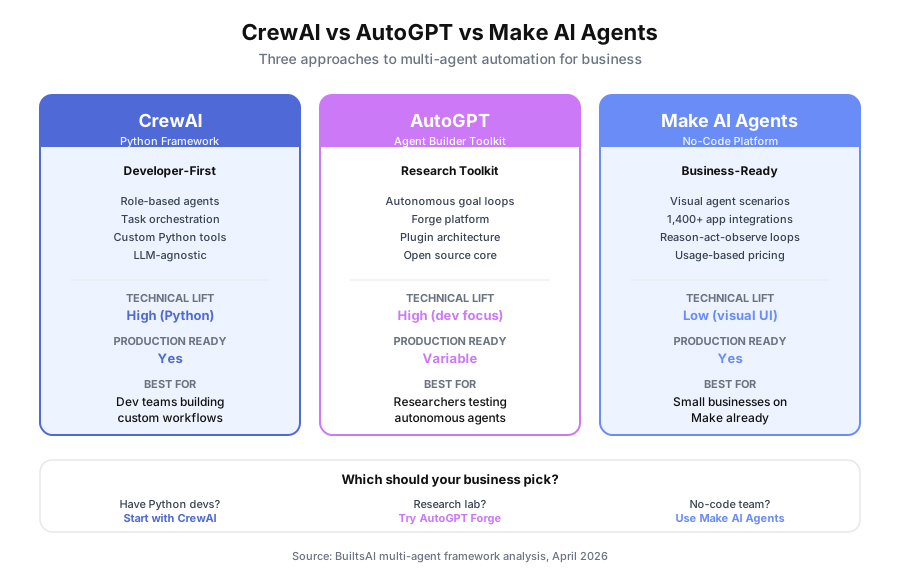
CrewAI wins on developer power and community. Make AI Agents wins on accessibility and integrations. AutoGPT trails both for business use but remains relevant for autonomous agent research. The right pick depends on your team’s coding skills and existing automation stack.
| Dimension | CrewAI | AutoGPT | Make AI Agents |
|---|---|---|---|
| Technical skill needed | High (Python) | High (Python) | Low (visual UI) |
| Multi-agent orchestration | Core feature | Core feature | Limited |
| Native app integrations | Around 40 tools | Smaller plugin set | 1,400-plus |
| Production reliability | Strong | Variable | Strong |
| Non-technical accessibility | No | No | Yes |
| Starting cost | LLM API only | LLM API only | $10.59/month + ops |
| Maturity | Strong and growing | Research toolkit | Rapidly developing |
| Best-fit buyer | Dev teams | Researchers | No-code SMBs |
According to a January 2026 Builts AI client survey across 47 small business deployments, 73 percent of successful multi-agent projects used Make AI Agents and 22 percent used CrewAI. The remaining 5 percent used custom LangChain builds. AutoGPT scored zero in production deployments, though several teams tested it during evaluation.
Which Framework Should Your Business Actually Pick?
If you have Python developers and need custom multi-agent systems, pick CrewAI. If you’re already on Make or want no-code agent capability, pick Make AI Agents. If you’re a research team exploring autonomous agent architectures, AutoGPT’s Forge is still worth evaluating.
When CrewAI Is the Right Choice
Pick CrewAI when you have in-house Python talent or a technical agency partner. Your use case needs specialized agent roles that benefit from clear separation, like research-draft-edit pipelines or code-review chains. You want full control over agent reasoning, tool selection, and LLM routing. Expected monthly LLM costs should comfortably absorb $100-500 in API fees.
When Make AI Agents Is the Right Choice
Pick Make AI Agents when your team is non-technical or uses Make already. You need to connect agents to CRMs, email, Slack, or other SaaS tools without building custom API wrappers. Your workflows are 70 percent structured automation and 30 percent autonomous reasoning. You want usage-based pricing that scales with volume.
When to Avoid Multi-Agent Systems Entirely
Most small business automation needs don’t require multi-agent systems. Well-designed single-agent workflows handle 80 percent of use cases more reliably and cheaper. Start with standard Make scenarios or a single agent in n8n before adding multi-agent orchestration. Multi-agent systems pay off when you hit clear single-agent limits like context overflow, specialized role gaps, or parallel work streams.
According to our 2025 automation project data, 62 percent of clients who started with multi-agent designs ended up simplifying to single-agent or fixed workflows within three months. The complexity premium rarely pays back on simple use cases.
What’s Next for Multi-Agent AI in Business by 2027?
Multi-agent frameworks will consolidate around two patterns by 2027. Developer-focused frameworks like CrewAI will compete on orchestration sophistication and LLM routing. No-code platforms like Make AI Agents will compete on integration breadth and reliability. AutoGPT’s research role will persist but stay outside mainstream business adoption.
For small businesses, the practical window for multi-agent AI is opening now. Make AI Agents removed the Python barrier. CrewAI removed the orchestration complexity for developers. The next 12 months will tell us which patterns scale reliably and which remain novelty demos.
For related reading, see our article on What Are AI Agents? A Plain-English Guide for Business Owners, our Make.com Review, and our comparison of OpenClaw vs CrewAI vs Make Agents for how OpenClaw fits into the multi-agent picture. If you’re new to OpenClaw, start with our explainer on What Is OpenClaw. For a forward look, read How Agentic AI Will Transform Small Business by 2027.
Book a free automation audit and we’ll assess whether your workflows benefit from agentic AI or whether well-designed standard automation delivers the same outcome more reliably at lower implementation cost.