Agentic AI — software that plans and executes multi-step work without a human approving each step — will be the default way small businesses run routine operations by 2027. Gartner’s 2025 Emerging Technology Hype Cycle projects mainstream adoption within 2 years, faster than cloud or mobile reached the same milestone. Stanford’s 2025 AI Index reports inference costs have dropped roughly 80% since 2023, which makes per-workflow agents affordable for 10-person teams. The shift isn’t “better chatbots.” It’s AI that owns lead qualification, support escalation, and AR follow-up end to end. This guide covers what changes, what doesn’t, and the exact prep work that separates fast adopters from everyone else.
What Is Agentic AI and How Will It Change Small Business?
Agentic AI is a system that receives a goal, breaks it into steps, uses tools like email, CRM, and calendar, and adapts when a step fails. Unlike a chatbot that answers one prompt at a time, an agent owns the outcome. For small businesses, this turns task-level automation into workflow ownership — the agent runs the process, not the person.
The practical difference comes down to ownership. A 2026 tool drafts a follow-up email when you ask. A 2027 agent receives the goal “qualify every inbound lead” and runs the pipeline from first touch to booked call on its own.
Current prompt-response tools are reactive. You provide input, the model returns output, you evaluate. An agent flips that. It holds the goal, plans the work, calls the tools, checks the results, and escalates exceptions. According to McKinsey’s “State of AI in 2024” report, 65% of organizations already use generative AI in at least one function, but most are still at the prompt-response stage.
The gap between those two states is where small business productivity will move over the next 24 months. The human’s role shifts from running each step to setting goals and reviewing exceptions — leadership work instead of task work.
One useful mental model: today’s AI is a junior staffer who needs a task list. An agent is a junior staffer who reads the SOP and runs the process. The SOP matters more than the AI model in both cases, which is why documentation work pays off faster than tool selection.
What Will Agentic AI Actually Do for Small Businesses in 2027?
Three workflows are in late-stage development now and will be broadly accessible to small businesses inside 18 to 24 months: full-cycle support agents, autonomous lead qualification pipelines, and proactive operations agents that monitor data and act without a trigger. Each owns a complete process from start to outcome, not a single task inside it.
Full-cycle customer support agents
Today’s AI handles tier-one FAQ questions and escalates everything else. By 2027, support agents handle the full escalation chain. When a question exceeds the knowledge base, the agent pulls order history, checks policy, drafts a response, flags whether an exception applies, prepares the case for human review if needed, and sends the reply once approved.
Intercom’s 2024 Customer Service Trends Report found AI already resolves 50% of support conversations without human intervention for leading teams. By 2027, that number pushes higher as agents plan multi-step resolutions instead of single replies.
Autonomous lead qualification pipelines
In 2026, automation sends email sequences on triggers and ranks leads by score. Sales reps still work the queue manually. By 2027, qualification agents own the pipeline from form submission to booked call. The agent reads the inquiry, checks CRM history, asks qualifying questions, scores answers, books the right meeting type, and creates the CRM record with full context.
The salesperson’s first touch with a qualified lead is the sales call — not the qualification conversation. HubSpot’s 2024 State of Marketing Report shows companies using AI for lead scoring see 50% higher lead-to-customer conversion rates.
Proactive operations agents
The newest category: agents that monitor business data continuously and act without an incoming trigger. An AR agent watches aging reports, runs reminder sequences at defined intervals, escalates stubborn accounts for human review, and prepares collections docs. A retention agent watches usage patterns, flags churn signals, and runs re-engagement outreach.
Per Gartner’s 2025 Emerging Technology Hype Cycle, agentic AI will reach mainstream adoption within 2 years — faster than cloud computing, mobile, or social media reached equivalent milestones.
What the three categories have in common
All three own a full workflow instead of a single task. All three pull from multiple tools. All three escalate to humans only when a defined exception rule fires. And all three log every action they take, which is what makes them trustworthy enough to run without constant supervision. Small businesses that understand this pattern can map their own repeatable processes onto it and predict which ones an agent will handle well.
How Does the 2026-2027 Agent Roadmap Look in Practice?
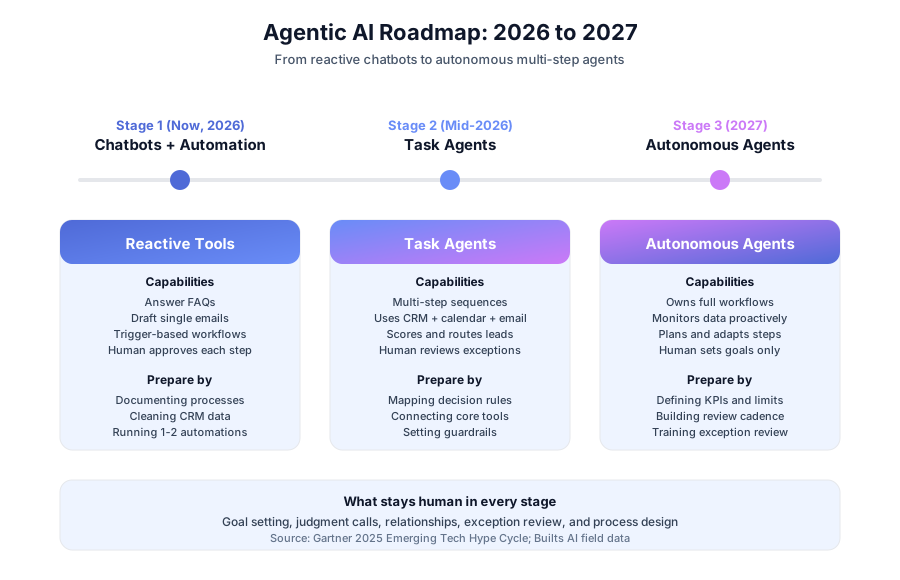
The evolution runs through three stages: reactive tools in 2026, task agents mid-2026 to early 2027, and autonomous multi-step agents in 2027. Each stage expands what the AI owns — from one response, to a short chain of steps, to an entire workflow — while the human’s role moves from approving each step to reviewing exceptions and setting goals.
| Stage | Timing | What the AI does | Human role |
|---|---|---|---|
| Reactive tools | 2026 | Answers FAQs, drafts single emails, runs trigger-based flows | Approves each step |
| Task agents | Mid-2026 to early 2027 | Executes 5-10 step sequences, routes and books leads | Reviews exceptions |
| Autonomous agents | 2027 | Owns full workflows, monitors data, plans and adapts | Sets goals, reviews KPIs |
The table matches what Builts AI sees in current deployments. Most small businesses in April 2026 sit at stage one with one or two task agents in early pilots. The move from stage one to stage two is mostly process documentation, not technology. The move from stage two to stage three is mostly trust — running agents in shadow mode for a few weeks before letting them execute actions without approval.
A useful benchmark: businesses that ran one current-generation automation in 2024 and two in 2025 are already deploying task agents in early 2026. Businesses that start with no automation experience in 2026 will likely reach stage three sometime in late 2027, assuming they start now.
What Separates Fast Adopters From Everyone Else?
Three factors decide how fast a small business deploys agentic AI: documented processes, clean integrated data, and existing automation experience. Businesses with all three move from concept to production agent in 4 to 6 weeks. Businesses missing all three need 4 to 6 months, most of it spent writing process docs and fixing CRM data — work that should have happened in 2026.
Documented processes
Agents execute processes. Undocumented processes can’t be executed because the system has no map. Businesses that have written lead qualification criteria, support escalation rules, onboarding steps, and AR cadence can deploy agents against those docs. Businesses that haven’t must write them first.
The 2026 action: document your top three highest-volume processes with explicit decision criteria. Do it now, for readiness — not for automation today.
Clean integrated data
Agents read from your CRM, inbox, calendar, and financial data. Data quality sets agent quality. A lead qualification agent working from a CRM where lead source is logged in 60% of records can only personalize for 60% of leads. An AR agent working from inconsistent payment terms sends wrong reminders.
IBM’s 2024 Global AI Adoption Index found 42% of companies say data quality is their top barrier to AI deployment. Auditing core data is the highest-ROI prep work a small business can do in 2026.
Existing automation experience
Businesses already running workflows in Make, Zapier, or n8n deploy agents significantly faster. They have the integrations, the staff buy-in, and the exception-handling habits. Platforms like OpenClaw are already bridging traditional automation and agentic workflows — for a comparison, see OpenClaw vs CrewAI vs Make Agents.
Teams with zero automation experience start from scratch on all three dimensions when agentic tools are ready. Start one automation now — even a simple one — to build the muscle.
The point isn’t that automation and agents are the same thing. They aren’t. The point is that the habits you build while running a basic Zap — watching logs, writing exception rules, training staff to trust the output — are exactly the habits you need to run an agent safely. Skip the warm-up and the first agent deployment becomes painful.
How Much Will Agentic AI Cost by 2027?
Current-generation agent stacks run roughly $200 to $600 per month in software and model usage for most small business workflows. Stanford’s 2025 AI Index reports inference costs fell roughly 80% from 2023 to 2024, and that trend continues. By 2027, a single workflow agent should cost $50 to $150 per month, with the bigger investment being setup, process documentation, and integrations — not ongoing compute.
| Cost bucket | 2026 (current) | 2027 (projected) |
|---|---|---|
| Model usage per workflow | $80-$250/mo | $20-$60/mo |
| Automation platform | $50-$200/mo | $50-$200/mo |
| Setup and integration | $1,500-$6,000 one-time | $1,000-$4,000 one-time |
| Ongoing review and ops | 2-4 hrs/week | 1-2 hrs/week |
The numbers assume one production workflow, not a fleet of agents. A business running five workflows doesn’t pay five times the setup — shared integrations and process docs compound. Expect the second agent to cost roughly 40% of the first in setup time and the third to cost roughly 25%, because CRM cleanup, API keys, and staff training are already done.
One caveat on pricing: model costs fall fast but API rate limits and vendor markups can hold prices steady for end users. The Stanford AI Index covers raw inference cost per million tokens, not what platforms charge. If your vendor raises prices in 2027, the underlying compute is still getting cheaper — shop around.
What Won’t Change Even in 2027?
Agentic AI amplifies human judgment. It doesn’t replace it. A 10-person business running agents should operate at the routine throughput of a 30-person team, but the 10 humans focus on decisions that need judgment, relationships that need empathy, and creative work that needs originality. Goal setting, exception review, and process design stay human — those are the skills that gain value.
The Bureau of Labor Statistics’ 2024 employment projections still show customer service and sales roles growing through 2033, just with AI augmentation changing the job mix. Small businesses that assume agents replace headcount misread the pattern. The pattern is reallocation — people move from processing to judgment, from execution to design.
The preparation that matters most in 2026 is building operations that are clear enough for an agent to follow and documented enough for a human to teach. That work serves the business whether agents arrive on schedule or six months late.
Which Tools Will Power Small Business Agents in 2027?
The platform options for running agents split into three groups: workflow automation tools adding agent features, dedicated agent frameworks, and all-in-one business agents. Most small businesses will land on workflow automation with agent nodes — Make, n8n, Zapier — because the integrations, visual builder, and support are already in place. Dedicated frameworks like CrewAI and LangGraph matter when custom logic or specialized memory patters are needed.
| Tool type | Examples | Best for | Typical setup time |
|---|---|---|---|
| Workflow automation with agent nodes | Make, n8n, Zapier, OpenClaw | Lead, support, AR workflows | 1-3 weeks |
| Dedicated agent frameworks | CrewAI, LangGraph, AutoGen | Custom logic, multi-agent teams | 3-8 weeks |
| Vertical business agents | Intercom Fin, Salesforce Agentforce | Category-specific workflows | 2-4 weeks |
Most small businesses in 2027 will pick one workflow automation platform and run three to five agents inside it rather than stitching together five different tools. The cost of context-switching and integration maintenance usually outweighs the benefit of picking the “best” tool per workflow. Pick the platform your ops team can operate independently.
What Are the Risks of Deploying Agentic AI Early?
The biggest risk is acting on bad data or unclear rules. An agent that emails the wrong customer, waives the wrong fee, or runs a reminder sequence against a paid invoice causes more damage than a slow human doing the same job. The fix is boring operational hygiene: clean CRM fields, written decision rules, guardrails on dollar amounts and send rates, and weekly human review of agent decisions for the first 60 days.
Anthropic’s own research on AI safety notes that production agents should have bounded permissions — explicit limits on what they can change, spend, or send. That pattern holds for small business deployments too. Start every workflow with narrow scope, a kill switch, and a log of every action the agent takes. Expand scope only after the logs look clean for two weeks straight.
Cybersecurity risk matters too. An agent with access to email, CRM, and billing is a high-value target. The 2024 Verizon Data Breach Investigations Report found 68% of breaches involved a human element. Agents reduce some human error but create new attack surfaces around API keys and tool permissions — budget for the security review up front.
How Should a Small Business Prepare in 2026?
Four actions position a small business to deploy production agents in Q1 2027: run one current-generation automation for a high-ROI process, document your three highest-volume workflows with decision rules, audit CRM and billing data quality, and track baseline metrics so you can measure agent impact later. Each step costs time more than money, and each one compounds.
- Run one current-generation automation — pick a high-ROI process and ship it in Make, n8n, or Zapier. Build the experience of designing, watching, and fixing automated work.
- Document your top three processes with explicit decision criteria. Lead qualification rules. Support escalation paths. AR follow-up cadence.
- Audit CRM and billing data for the fields an agent would need. Fix the top five gaps.
- Track baseline metrics — lead response time, support resolution rate, AR days outstanding — so you can measure the delta when agents deploy.
Businesses that do this work in 2026 deploy production agents in Q1 2027 and run months ahead of competitors who start from scratch.
The honest take: most of this prep work is unglamorous. Writing decision rules, fixing CRM fields, and tracking baseline metrics doesn’t look like AI adoption. It looks like operations hygiene. That’s exactly why it matters — the businesses that treat AI readiness as a tooling problem will spend 2027 fighting data issues, while the ones that treated it as an operations problem will be shipping agents.
For related reading, see What Are AI Agents? A Plain-English Guide for Business Owners and Generative AI vs Workflow Automation: Which One Should You Invest In First.
Book a free automation audit and we’ll assess your agentic AI readiness — documentation completeness, data quality, integration foundation — and build a 12-month roadmap from current-generation automation to agentic deployment.