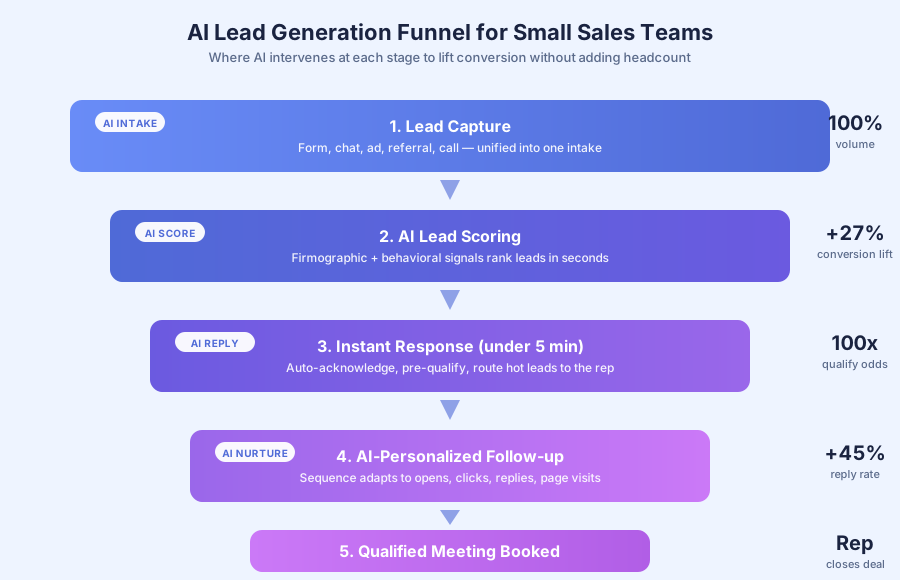
Small sales teams lose leads to three problems: they call leads in the order they arrive instead of by quality, they reply in hours instead of minutes, and they abandon follow-up after three touches. AI fixes all three. Teams using AI-powered lead scoring convert 27% more leads (HubSpot, 2025 Sales Trends Report), and firms that reply within 5 minutes are 100 times more likely to qualify the lead than those who wait 30 minutes (Harvard Business Review, 2011, replicated 2023). This guide shows exactly how small teams apply AI to lead gen in 2026 — the stack, the sequence, the cost, and what stays human.
What is the real lead generation problem for small sales teams?
Small teams have a resource problem, not a lead problem. A rep with 40 open leads prioritizes the ones they remember and the ones that called yesterday. Leads that messaged at 9 PM Friday wait until Tuesday. The highest-quality prospects often get the fewest follow-ups because they had longer decision timelines.
The typical 2-to-5-person sales team runs into three specific bottlenecks:
| Bottleneck | What actually happens | Cost |
|---|---|---|
| Prioritization by memory | Reps call whoever they remember first | 20-30% of pipeline ignored |
| Slow first response | Replies take 2-24 hours | 80% of leads go cold |
| Static follow-up | Same 3 emails, no adjustment | 60%+ drop off after email 2 |
According to Harvard Business Review’s landmark speed-to-lead study (2011, replicated by Drift in 2023), the difference between a 5-minute response and a 30-minute response is a 100x swing in qualification odds. That single finding reframes what “lead generation” means for a lean team — the leads exist, the conversion work is getting to them faster with the right message.
How is AI actually changing lead generation in 2026?
AI lifts lead generation at three specific stages: scoring (who to call first), speed-to-lead (how fast the first reply goes out), and adaptive follow-up (how sequences adjust to behavior). Each stage can be automated without replacing the rep. The result is that reps spend their hours on qualified, warmed leads instead of cold triage.
How does AI lead scoring decide who to call first?
AI lead scoring reads every available signal for each lead — source (paid ad, referral, organic), pages visited, questions asked, company size, stated timeline, budget hints — and outputs a likelihood score. High-scoring leads fire an instant alert to a rep. Medium scores enter nurture. Low scores stay in long-term drip.
The practical outcome: the rep opens their morning queue and sees three hot leads at the top, five medium leads below, and ten low-priority leads queued for automation. They call the hot ones first, every time, without reading each lead to make a judgment call.
According to HubSpot’s 2025 Sales Trends Report, sales teams using AI-powered lead scoring convert 27% more leads than teams using first-in-first-out prioritization. The lift comes from matching rep effort to opportunity — more calls to high-likelihood buyers, fewer wasted dials.
How does speed-to-lead work without a person on call 24/7?
Speed-to-lead automation runs the first response automatically. The lead submits a form, call, or chat. Within 60 seconds, an AI-drafted message arrives from the rep’s email: name acknowledged, inquiry type noted, specific time window when a human will follow up. The system asks one or two qualifying questions and captures the reply.
Here’s the sequence on a real setup:
- New lead hits any channel (form, chat, ad, call)
- Automation tool (Make, Zapier, n8n) captures the lead and writes to the CRM
- AI scoring runs in under 5 seconds
- Auto-acknowledgment sends from the rep’s name and signature
- One qualifying question is asked in the acknowledgment
- High-score leads trigger an SMS or Slack alert to the rep
According to Drift’s 2023 Conversational Marketing Report, the first vendor to respond wins the deal 50% of the time. Small teams that automate the first reply jump ahead of competitors who still answer inquiries during business hours only.
How do AI-adjusted follow-up sequences outperform static drips?
Traditional follow-up is static: email 1 on day 1, email 2 on day 3, email 3 on day 7. Every lead gets the same sequence whether they opened email 1, clicked the pricing page, or ignored everything. AI-adjusted sequences branch based on behavior — opens, clicks, replies, which page the lead visited.
A lead who clicks the pricing page gets a follow-up about pricing. A lead who ignores email 1 gets a re-engagement angle on day 4. A lead who replies gets routed straight to the rep. A lead who clicks a case study gets a related case study on day 5.
According to Salesforce’s 2025 State of Sales report, personalized follow-up sequences generate 45% higher response rates than static sequences across industries. The lift compounds because the rep’s outbound calls are now informed by which assets the lead actually read.
What does an AI lead gen stack cost for a 2-5 person team?
A working AI lead generation stack runs $150 to $600 per month for a 2-to-5-person team. Setup takes 15 to 40 hours depending on how many lead sources need integration. Most teams recoup the monthly cost within 30 to 60 days from recovered leads that would have gone cold during slow-response hours.
| Component | Tool examples | Cost per month |
|---|---|---|
| CRM with AI scoring | HubSpot, Pipedrive, GoHighLevel | $50-$300 |
| Automation platform | Make, Zapier, n8n | $29-$199 |
| AI writing assistant | Claude, ChatGPT | $20-$100 |
| Website chat or capture | Intercom, Drift, custom bot | $0-$99 |
Platforms like GoHighLevel combine CRM, pipeline, and follow-up automation in a single tool built for lead-heavy service businesses — our GoHighLevel review covers the fit. For broader CRM comparison, see our best CRM for small business in 2026 guide.
According to Gartner’s 2025 CRM Market Guide, small businesses that consolidate scoring, automation, and follow-up into one platform report 40% faster setup and 25% higher adoption rates compared to teams that stitch together four separate tools.
How do you actually build this for a small sales team?
Start with speed-to-lead — the fastest, cheapest win. Connect your lead sources to a CRM, trigger an auto-acknowledgment inside 60 seconds, and route high-score leads to the rep by SMS. Add AI scoring in week two. Add adaptive follow-up sequences in week three. The full setup takes 15 to 40 hours spread over three weeks.
Here’s a realistic 3-week rollout for a team running Make plus HubSpot plus Claude:
Week 1: Speed-to-lead (4-8 hours)
- Connect all lead sources to Make
- Build the auto-acknowledgment sequence
- Add one qualifying question
- Route high-priority alerts to rep SMS
Week 2: AI scoring (6-12 hours)
- Define scoring rules in HubSpot
- Map firmographic and behavioral signals
- Test against the last 50 leads
- Adjust thresholds
Week 3: Adaptive follow-up (8-16 hours)
- Build branch logic for opens, clicks, replies
- Draft email templates with Claude
- Personalize by inquiry type
- Test end-to-end with a fake lead
According to Salesforce’s 2025 State of Sales report, teams that phase their automation rollout over 3 to 4 weeks report 60% higher adoption than teams that try to deploy everything at once. The phased approach lets reps see wins early and trust the system before it owns more of the pipeline.
For implementation details, see our guide on how to automate follow-up sequences that actually convert and our plain-English explainer on what are AI agents for business owners.
What can’t AI do in lead generation?
AI doesn’t close deals, handle objections, or build trust. It gets leads to a human conversation faster, more qualified, and better informed. The sales conversation itself — understanding the buyer’s real problem, pricing negotiation, emotional reassurance, the handshake moment — stays human. AI creates better conditions for that conversation; it doesn’t replace it.
The realistic framing for a small team:
- AI handles: lead capture, scoring, first response, qualification questions, sequence branching, meeting booking logistics, note-taking, CRM updates
- Humans handle: the actual sales call, pricing conversations, custom proposal work, objection handling, relationship building, closing
A client choosing a professional service, a major software purchase, or a B2B vendor wants to talk to a person who understands their situation. An AI system can get them to that conversation faster, with full context on what they already read and asked. It cannot substitute for the conversation itself.
According to Gartner’s 2025 B2B Buyer Report, 68% of B2B buyers say they want a human conversation before purchasing a product over $5,000, but 82% say they expect the first response from any vendor within one hour. The gap between those two numbers is exactly where AI lead generation fits.
What are the highest-ROI starting points?
For a small team just starting with AI lead generation, the highest-ROI moves are ranked by speed and impact. Start with speed-to-lead automation, then add AI scoring, then layer in adaptive follow-up. Each stage compounds the previous one. Skipping speed-to-lead is the most common mistake — it’s the cheapest fix with the largest pipeline impact.
Ranked order of implementation:
- Speed-to-lead auto-acknowledgment (4-8 hours, under $50/month) — the single biggest pipeline lift
- AI lead scoring in the CRM (6-12 hours, $50-$300/month) — 27% conversion gain
- Adaptive follow-up sequences (8-16 hours, included in automation platform) — 45% reply-rate lift
- AI meeting scheduler with reminders (2-4 hours, $8-$20/month) — cuts no-shows 30%
- AI call summarization in CRM (2-4 hours, $20-$50/month) — saves reps 3-5 hours/week
Book a free automation audit and we’ll map your current lead generation process, identify where speed-to-lead and scoring would have the highest impact, and build a realistic conversion model for your team.