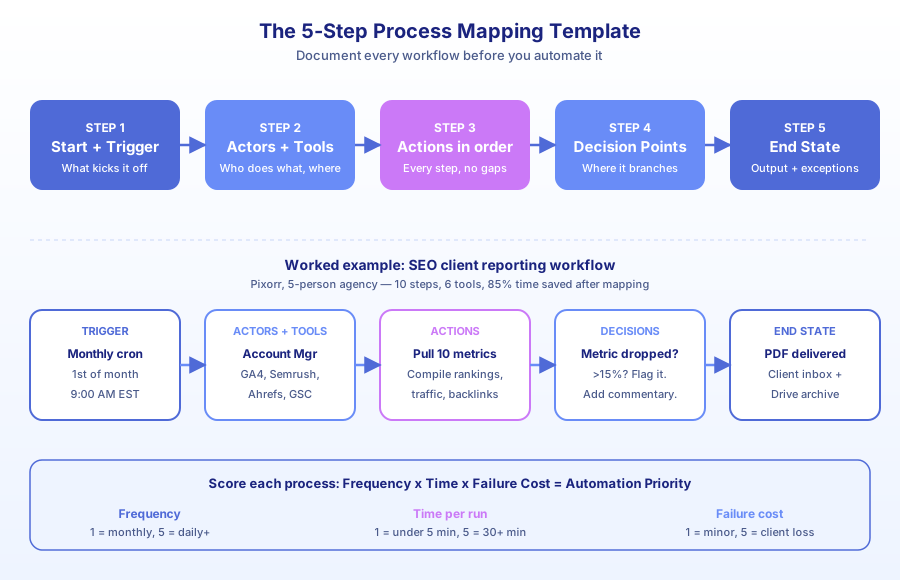
Pixorr, a 5-person SEO agency, tried to automate client reporting. They picked a tool, connected Google Analytics 4, and hit “go.” Two weeks later, they scrapped it and started over. The problem wasn’t the technology. It was that nobody had mapped the 10 steps across 6 tools that made up their actual reporting process. Per Process Street’s 2024 Automation Benchmark, teams that document first hit ROI 2.3x faster than those who skip to tools. That single stat should tell you where to start: not with software, but with a spreadsheet and a map.
Why does mapping matter more than picking the right tool?
Mapping forces you to understand what actually happens before you change it. Most teams overestimate how simple their workflows are and forget the exceptions, workarounds, and “oh, Sarah checks that spreadsheet on Fridays” steps. Per Deloitte’s 2023 Global Automation Survey, 78% of documentation-first organizations hit faster time-to-value.
Automation doesn’t fix broken processes. It accelerates them. If your process is messy, automation makes the mess faster.
We’ve built automation systems for immigration firms, SaaS companies, career colleges, and solo CPAs. Every successful project started with a map. Every failed project started with a tool. The pattern is consistent enough that we now refuse engagements where the client wants to skip mapping.
Per Gartner’s 2023 Data Quality report, poor data quality costs organizations an average of $12.9 million per year, and most of that damage comes from automating broken inputs into broken outputs.
What are the 5 steps to map any business process?
The method works for any process in any industry. It breaks down into: name the trigger, list every action, capture every decision, document every exception, then score and prioritize. Each step takes 15-30 minutes for a typical workflow. Total time for a single process map: 1-2 hours.
Here’s the sequence we use with every client.
Step 1: Name the process and define the trigger
Every process starts with something. A form submission, an email, a calendar event, a Slack message, a time of day. Write down exactly what kicks it off.
If you can’t name the trigger, you don’t have a process. You have a habit. Habits are harder to automate because they depend on a person remembering to do the thing.
Step 2: List every action in order
Walk through the process as if you’re training a new hire. Don’t skip steps. Don’t assume anything is obvious. If someone opens a browser tab, write that down. If they copy-paste from one tool to another, write that down.
Per McKinsey’s 2024 workforce analysis, 60% of occupations have 30%+ automatable tasks, and most of those hide in the “obvious” steps people forget to mention.
Step 3: Capture every decision point
Where does the process branch? “If the client is in Ontario, do X. If not, do Y.” Decision points are where most automation projects fail because nobody documented the logic.
A process with 3 decision points has 8 possible paths. A process with 5 has 32. Map them before you build them.
Step 4: Document every exception
What happens when things go wrong? The file is missing. The client doesn’t respond. The data doesn’t match. Exceptions aren’t edge cases. They’re where the real work lives.
Per IDC’s 2023 Future of Work study, employees spend 30% of their time on manual data tasks, and most of that time goes to handling the 15% of cases that don’t follow the happy path.
Step 5: Score and prioritize
Rate each process on three factors: Frequency (how often), Time (how long per run), and Failure Cost (what happens when it breaks). Multiply all three. The highest scores get automated first.
What does a process mapping template look like?
A good template has one row per step and columns for trigger, tool, action, decision point, output, and exception handling. Don’t leave blanks. If a column doesn’t apply, write “N/A” so you know you considered it. This format forces completeness and makes handoffs easy.
Here’s the template we use with every client:
| Step # | Trigger | Tool Used | Action | Decision Point | Output | Exception Handling |
|---|---|---|---|---|---|---|
| 1 | New form submission | Typeform | Capture lead data | Is this a qualified lead? | Lead record | Incomplete form: send follow-up email |
| 2 | Lead qualified = Yes | HubSpot CRM | Create contact record | Does contact already exist? | CRM entry | Duplicate: merge records |
| 3 | CRM entry created | Google Calendar | Book discovery call | Slot available within 24h? | Calendar event | No slots: add to waitlist |
| 4 | Call completed | Google Docs | Generate proposal | Custom scope needed? | Proposal PDF | Non-standard: flag for manual review |
| 5 | Proposal sent | Gmail | Send follow-up sequence | Did client open email? | Email sent | Bounce: try alternate contact |
| 6 | Proposal signed | DocuSign | Trigger onboarding | All documents received? | Signed agreement | Missing docs: send collection request |
This is what Pixorr’s reporting process looked like after they mapped it properly. Ten steps. Six tools: GA4, Semrush, Ahrefs, Google Search Console, Google Sheets, and Google Docs. Before mapping, their team thought the process was five steps. It was actually ten, with three decision points and four exception paths they’d been handling ad hoc.
After mapping, Pixorr automated the workflow and cut reporting time by 85%. They reclaimed a full work week per month. The map made that possible.
How do I handle exceptions without overcomplicating my map?
Document exceptions that happen more than 5% of the time. Everything rarer gets a “flag for human review” catch-all. This keeps your map focused without ignoring reality. The 5% threshold comes from engagement data across 40+ automation projects and matches what most workflow tools can realistically handle.
For each exception, capture three things:
- What triggers it. “Client submits form without attaching ID documents.”
- What happens now. “Admin sends manual follow-up email, waits 3 days, follows up again.”
- What should happen. “System auto-sends document request with checklist link, escalates after 48 hours.”
Skylarks International, a 15-person immigration consultancy, used this exact approach. Their document collection process had 12 exception paths. After mapping, they automated the 4 most common ones (covering 80% of cases) and cut document collection time by 70%. The remaining 20% still gets human attention, but that’s 80% fewer manual interventions per week.
Per Gartner’s 2023 Data Quality report, poor data handling costs organizations $12.9 million per year on average, and exceptions are where most of that leakage happens.
How do I score processes to decide what to automate first?
Rate each process on a 1-5 scale for three dimensions: how often it runs, how long it takes, and what happens when it fails. Multiply all three for an automation priority score. The math is simple and the results are usually surprising. Most teams think their biggest pain is their biggest opportunity. It usually isn’t.
| Dimension | Score 1 | Score 3 | Score 5 |
|---|---|---|---|
| Frequency | Monthly or less | Weekly | Daily or more |
| Time per occurrence | Under 5 minutes | 10-20 minutes | 30+ minutes |
| Failure cost | Minor inconvenience | Lost revenue opportunity | Client loss or compliance risk |
A daily process (5) taking 30 minutes (5) with compliance risk (5) scores 125. A monthly process (1) taking 2 minutes (1) with low stakes (1) scores 1. Automate the 125 first.
Per Forrester’s 2024 Total Economic Impact studies, automation ROI averages 200% in year one. But that average hides a huge range. The difference between 50% ROI and 400% ROI is almost always which process you automated, not which tool you picked.
Taxvisory, a solo CPA managing 300 clients, scored their workflows and found document chasing was highest: daily, 20+ minutes per client, and late documents meant missed filing deadlines. After automating document collection with Airtable and Calendly, they cut 80% of chasing and got weekends back during tax season.
What are the most common process mapping mistakes?
Five mistakes kill most mapping projects before they deliver value. Each one is easy to spot once you know what to look for, and each one has a fix that takes less than an hour. We’ve seen every one of these across client work with Ontario firms, immigration consultancies, SaaS companies, and professional services.
Mistake 1: Mapping the ideal process instead of the actual process. Your map should reflect reality, not aspirations. If someone copy-pastes data from Salesforce into a Google Sheet every Tuesday, write that down. Fix it later.
Mistake 2: Skipping the person who actually does the work. Managers usually know 70% of the process. The person clicking the buttons knows the other 30%, including all the workarounds.
Mistake 3: Ignoring the tools involved. Every tool switch is a potential automation point. Per McKinsey’s 2024 workforce analysis, 60% of occupations have 30%+ automatable tasks, and most involve moving data between tools.
Mistake 4: Making it too granular too early. Map at the “action” level first (“enter data into CRM”), not the “click” level. You’ll go deeper when you build the automation.
Mistake 5: Mapping once and never updating. Processes drift. Your map should be a living document. Review quarterly or after any major tool change.
When should I map processes myself versus hiring an expert?
DIY mapping works when you have clear ownership, a single department, and fewer than 20 steps. Bring in outside help for cross-functional processes, failed previous attempts, or compliance-heavy workflows. The rule of thumb: if one person can describe the full process, you can map it yourself. If it takes three people, you probably need a facilitator.
AcquireX Properties Capital, a 3-person real estate team in Ontario, mapped their own deal analysis workflow and tripled their portfolio capacity with the resulting automation. Small team, clear process, strong result.
Per UiPath’s 2024 Automation Maturity report, organizations that progress from Level 1 to Level 3 maturity see 4x higher adoption rates. That progression almost always requires structured mapping support at some point.
Signs you should bring in outside help:
- The process involves more than 3 departments
- No single person can describe the end-to-end flow
- You’ve tried automating this process before and it failed
- The process handles sensitive data with compliance requirements
- You need the automation running within 4 weeks
Per Celonis’s 2024 Process Intelligence report, the median time-to-value for business process automation is 6 weeks. If you spend 2 weeks mapping well, you’re still delivering in under 2 months. Skip mapping and spend 6 weeks building the wrong thing, and you’re back to zero.
What should I do after my process map is complete?
A finished map is a starting point. Take your highest-scoring process and build a proof-of-concept automation. Use Make, n8n, or Zapier for the first version. Don’t aim for perfection. Aim for “better than manual.” Run the automation in parallel with the manual process for 1-2 weeks, then measure time saved, errors eliminated, and capacity freed.
Per Deloitte’s 2023 Global Automation Survey, 73% of organizations report positive ROI within 12 months of their first automation deployment. The ones that document first get there faster.
Your next steps:
- Pick your highest-scoring process from the prioritization table
- Build the automation using the map as your blueprint
- Run it in parallel with the manual process for 1-2 weeks
- Measure: time saved, errors eliminated, capacity freed
- Iterate based on real data, not assumptions
If you’re not sure where to start, book a free automation audit and we’ll walk through your specific processes to identify the highest-ROI targets. For a foundational overview, read our guide on what business process automation is and why it matters. If you’ve already mapped your workflows and want to pick specific automation candidates, our guide on how to audit workflows and find automation candidates is the logical next step.
Process mapping isn’t glamorous. It’s not the exciting part of automation. But it’s the part that determines whether your project returns 50% or 400%. Every team we’ve worked with that skipped mapping regretted it. Every team that invested 1-2 weeks up front got to value faster.
Start with the spreadsheet. Map what’s real. Then automate what matters.