Last March, a senior strategist at Pixorr burned three full days building monthly reports for 42 clients. She pulled GA4 data, exported Semrush CSVs, screenshotted Search Console, and pasted numbers into Google Slides. By Thursday she still had six reports left, no time for actual SEO work, and a team burning out on copy-paste. Six months after rewiring the stack, that same workload takes 14 hours a month, reports ship 85% faster, and retention has climbed from 78% to 91%. At 50 clients, the math is brutal: AgencyDashboard’s 2026 benchmark pegs manual reporting at 5-10 hours per client per month, or 250-500 hours a year on reports alone.
Why is manual reporting the silent tax on SEO agencies?
Reporting is the hidden drain on agency growth. Every client wants a branded monthly report delivered on time, and most agencies still build them by hand. AgencyDashboard’s 2026 SEO Industry Benchmark Report puts manual reporting at 5-10 hours per client per month. At 50 accounts, that’s 6-12 full work weeks a year.
The bigger issue is who does the work. It’s usually your senior strategist, the person who should be auditing technical issues, reviewing content, and running client calls. Instead they’re copying numbers between tabs. According to Stridec’s 2026 SEO Industry Report, 86% of SEO professionals now use AI tools, but most adoption sits in content and keyword research, not reporting pipelines. Reporting is where small agencies still bleed the most hours.
What did Pixorr’s reporting look like before automation?
Pixorr is a 5-person SEO agency in Toronto running 42 client accounts across e-commerce, SaaS, and local service brands. Before automation, a single monthly cycle consumed a full work week. Each report touched four tools, two humans, and a pile of manual copy-paste that scaled linearly with the client roster.
Here’s the old process, timed:
| Step | Tool | Time per client |
|---|---|---|
| Pull organic traffic data | Google Analytics 4 | 15 min |
| Export keyword rankings | Semrush | 20 min |
| Pull backlink metrics | Ahrefs | 10 min |
| Grab Search Console impressions | Google Search Console | 10 min |
| Compile into report template | Google Slides | 45 min |
| Write commentary and insights | Manual | 30 min |
| Client-specific customization | Manual | 15 min |
| Email delivery | Gmail | 5 min |
| Total per client | ~2.5 hours |
Multiply 2.5 hours by 42 clients and you get over 100 hours a month. For a 5-person team, one person was doing nothing but reports for 2.5 weeks straight. That copy-paste layer is exactly what reporting automation for marketing agencies is built to remove. AgencyDashboard’s 2026 benchmark shows automated data collection and formatting cuts per-client reporting time to 20-30 minutes. Pixorr aimed lower: 20 minutes flat, including human review.
What exactly did Pixorr automate and what stayed human?
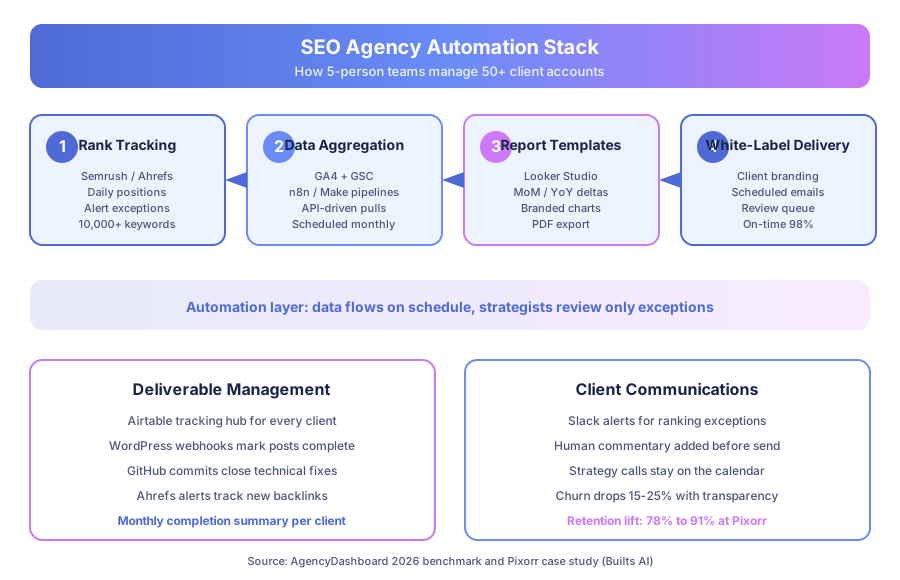
Pixorr automated the machine work and kept the brain work human. That’s the split that actually moves the needle. Automation handled data pulls, compilation, and delivery. Strategists kept commentary, judgment calls, and client conversations. No AI-written reports, no data dumps, no shortcuts on the parts that keep clients renewing.
The machine side:
- Data pulls from GA4, Semrush, Ahrefs, and Search Console on the first Monday of each month
- Metric compilation into per-client Looker Studio dashboards
- Month-over-month and year-over-year comparisons calculated automatically
- Chart generation and branded PDF export
- Reports dropped into a review queue, then delivered via Gmail on schedule
The human side stayed focused on what clients actually pay for: 3-5 sentences of custom commentary per report, anomaly investigation when traffic moves sideways, strategy calls, and content planning. Stridec’s 2026 SEO Industry Report notes 86% of SEO pros use AI tools, but Pixorr’s system doesn’t use AI to write reports. It uses automation to erase the manual data transfer that ate 80% of reporting time. The review stage still takes a trained strategist 15-20 minutes per client, and that’s the point.
How does automated rank tracking work at 50-client scale?
Rank tracking breaks first when agencies grow. At 10 clients you can eyeball dashboards. At 50 clients tracking 200-plus keywords each, you’re looking at 10,000-plus positions to monitor, and nobody is clicking through that every day. You need automation that only interrupts humans when something real happens.
Pixorr runs rank tracking in three layers. Layer one is daily position monitoring: Semrush tracks every keyword for every client automatically, no manual action. Layer two is alert-based exceptions. A keyword jumping from position 11 to 5 triggers a Slack ping. A target keyword dropping from page 1 to page 3 triggers another. Each alert routes to the assigned strategist with context: client, keyword, URL, position history.
Layer three is monthly aggregation. When the reporting automation runs, it calls Semrush’s API, calculates the metrics clients care about (top 3, top 10, top 20, average position delta), and drops them into each report. AgencyDashboard’s 2026 benchmark shows agencies using automated rank tracking save 20-30 hours a month compared to manual. For Pixorr, the alert layer was the real win. Strategists stopped checking dashboards on Friday afternoons and only touched rank data when it needed a decision.
What tools make up a modern SEO agency automation stack?
The stack matters less than the connections between the tools. Any competent keyword tracker plus any competent dashboard plus any competent automation engine will beat manual reporting. What breaks is when data doesn’t flow automatically from source to report without a human babysitting the pipe.
Here’s a reference stack for a 50-client agency:
| Layer | Tool options | Purpose |
|---|---|---|
| Traffic analytics | Google Analytics 4 | Organic sessions, conversions, user behavior |
| Search performance | Google Search Console | Impressions, clicks, CTR, average position |
| Keyword tracking | Semrush, Ahrefs, SE Ranking | Positions, keyword research, competitor data |
| Backlink monitoring | Ahrefs, Majestic, Moz | Link acquisition, toxic link alerts |
| Reporting dashboard | Google Looker Studio, AgencyAnalytics | Data visualization and client-facing reports |
| Automation engine | n8n, Make, Zapier | API connections, scheduled pulls, alerts |
| Delivery | Gmail, branded PDF export | Scheduled white-label report delivery |
Pixorr runs Semrush, Ahrefs, GA4, and Search Console into Looker Studio, with n8n as the connector. They picked Looker Studio over AgencyAnalytics because their clients wanted heavily branded, custom-designed reports that matched their own brand guidelines, not a templated agency look. AgencyAnalytics is faster to deploy if you don’t need that level of customization. For context on how n8n and Make compare as connectors, see our Make.com review.
What should always stay human inside an SEO agency?
Automation is a tool, not a replacement for thinking. Agencies that automate too aggressively ship reports nobody reads, because they’re pure data dumps with no human insight. That’s worse than slow manual reports. Four things should always stay on the human side of the line, no exceptions.
Strategy calls. The 30-minute monthly or bi-weekly conversation where you explain what happened, why, and what’s next. Pixorr clients repeatedly say the calls are why they stay. No automation replaces the trust built in a live discussion.
Content planning. AI can suggest topics and volume. Humans decide how to angle it for a specific audience and how it fits the broader strategy. That call requires understanding the client’s business, not just their keyword profile.
Anomaly investigation. When traffic drops 30% overnight, the system flags it. A strategist figures out whether it’s a Google algorithm update (check Search Engine Roundtable), a technical issue (check Screaming Frog), or a competitor move (check Semrush’s organic competitors view).
Client relationships. AgencyDashboard’s 2026 benchmark ties automated reporting to higher retention, not because the PDFs are prettier, but because strategists have time for the relationship work that keeps clients renewing.
How do you automate deliverable tracking across 50 clients?
Reports are one deliverable. SEO retainers also include content calendars, technical audit fixes, link building campaigns, and on-page work. At 50 clients, tracking who’s owed what and when is its own full-time job. Pixorr runs deliverable tracking out of Airtable, with the automation layer doing most of the bookkeeping.
Each client has an Airtable record with their retainer scope, monthly deliverables, deadlines, and completion status. When a blog post goes live on WordPress, a webhook marks that deliverable complete. When a technical fix is deployed through GitHub, a commit closes the ticket. When a new backlink lands in Ahrefs, the system logs it against the link building target for that client.
At the end of every month, the client report includes a promised-versus-delivered summary: “We promised 4 blog posts, 2 technical fixes, and 10 new backlinks. Here’s what shipped.” Forrester’s 2024 Total Economic Impact methodology links transparent deliverable tracking to 15-25% lower churn in professional services. No more “did we send that audit yet?” Slack threads, no more digging through email for approvals. The system tracks it, strategists confirm it, clients see it.
What results did Pixorr actually get after six months?
Six months after switching on the automated pipeline, Pixorr’s numbers shifted across every dimension that matters to a small agency: time per report, delivery consistency, strategist capacity, and client retention. These aren’t projections. They’re the internal metrics their operations lead shared in the full case study.
| Metric | Before automation | After automation |
|---|---|---|
| Time per client report | ~2.5 hours | ~20 minutes |
| Monthly reporting hours (42 clients) | 100+ hours | ~14 hours |
| Report delivery consistency | 70% on time | 98% on time |
| Strategist time on SEO work | ~60% | ~85% |
| Client retention (6-month) | 78% | 91% |
Pixorr reclaimed 86 hours every month, more than a full work week. Their 5-person team now runs 42 accounts with capacity for 10-15 more without hiring. The 85% reporting speedup is the headline, but the downstream effect is bigger: strategists spending 85% of their time on actual SEO work (up from 60%) produced better client results, which drove retention from 78% to 91%.
The full Pixorr case study covers the implementation timeline and the specific n8n workflows. For a step-by-step pipeline build, see how to automate client reporting.
Stridec’s 2026 SEO Industry Report argues the agencies pulling ahead aren’t the ones with the most tools. They’re the ones who’ve erased manual data transfer between tools. The data lives in GA4, Semrush, Ahrefs, and Search Console regardless. The only question is whether a human is copying it between tabs or a machine does it while your team focuses on the work that moves rankings. For a 5-person agency, that answer is obvious, and it’s worth 86 hours a month.
Ready to wire up a reporting pipeline like Pixorr’s? Book a free automation audit and we’ll map your current stack against the 50-client benchmark.