KwikUI had 3,000 trial users and a 4% conversion problem. Two founders, zero customer success staff, and a Slack channel crammed with “how do I…” questions from users who’d never find the feature that would’ve sold them. They didn’t need more signups. They needed the signups they had to actually experience the product before the trial ran out.
According to Wyzowl’s 2024 SaaS Onboarding Study, 90% of SaaS users churn if they don’t see value within the first week. Not month one. Week one. For a UI component library like KwikUI, users who don’t build their first component inside 72 hours are gone.
After replacing time-based email drips with behavior-triggered onboarding, KwikUI doubled conversion from 4% to 8%, cut churn 40%, and dropped support tickets 65%. Same two founders. Completely different business.
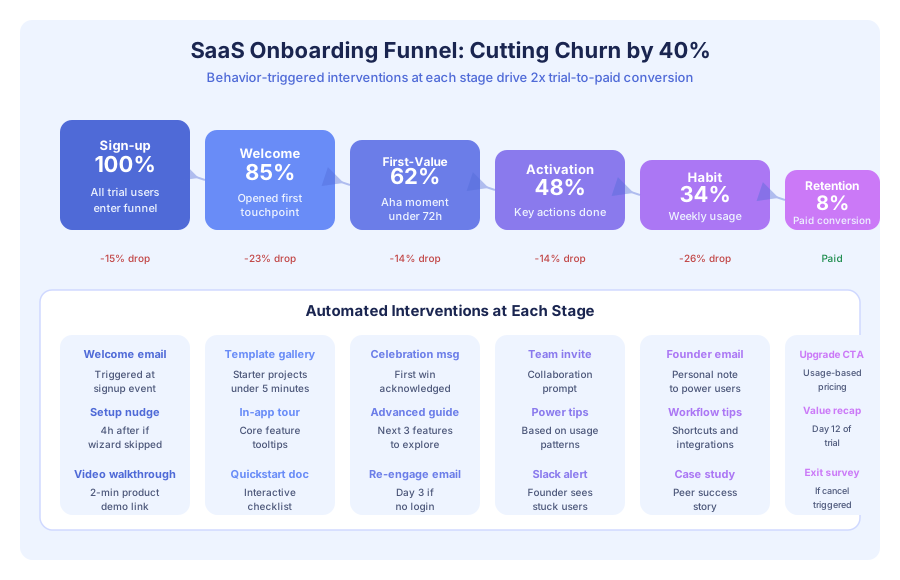
Why do time-based onboarding drips fail for SaaS products?
Time-based drips treat every user identically: Day 1 welcome, Day 3 feature highlight, Day 7 upgrade nudge. But users don’t progress on a schedule. Some activate in 20 minutes. Others ghost for three days. Drips can’t see who’s stuck, who’s thriving, or who already converted. They fire regardless.
Here’s the core issue. According to Amplitude’s 2024 Product Benchmarks Report, cutting time-to-value by 20% lifts annual recurring revenue by 18%. Time-based drips can’t touch time-to-value because they don’t know where any individual user is in their journey.
Behavior-based automation fixes this by tracking specific events. Did they finish the setup wizard? Create their first project? Invite a teammate? Connect Stripe? Each action (or inaction) triggers a different response. The system meets users where they are, not where the calendar thinks they should be.
A user who built three components on Day 1 shouldn’t get a “getting started” email on Day 3. A user who signed up and never returned shouldn’t get a power-user tips email on Day 7. Behavior triggers respect both realities.
What does behavior-triggered onboarding actually look like?
Behavior-triggered onboarding tracks activation events inside the product and fires targeted messages based on what each user has or hasn’t done. Skip setup for four hours, get a help video. Create your first project, get a congratulations plus advanced tips. Every message answers “what should this user do next?” based on actual in-product behavior.
Here’s KwikUI’s full flow:
| Trigger Event | Action | Timing |
|---|---|---|
| Signs up, skips wizard | 2-min video walkthrough email | 4 hours after signup |
| Completes wizard, no first component | Template gallery link | 24 hours after wizard |
| Creates first component | Celebration email + advanced guide | Immediate |
| No login for 3 days | Re-engagement email with customer story | Day 3 |
| Hits 5 components (power user) | Personal founder email + upgrade | Immediate |
| Trial day 12, no upgrade yet | Value recap + limited offer | Day 12 |
Every message changes based on user behavior. That’s the shift. Customer.io and Intercom both support event-triggered messaging natively. Mixpanel or Amplitude captures the events. Segment routes the data. Together they create a system that acts on user reality, not calendar assumptions.
What are the key activation metrics for SaaS onboarding?
Activation metrics are the one to three actions that predict conversion to paid. For KwikUI, it’s creating a first component within 72 hours. Slack’s is a team sending 2,000 messages. Dropbox’s is saving a file to the folder. Every SaaS has one or two actions that, when done, dramatically increase the odds a user stays and pays.
According to Mixpanel’s 2024 Product Benchmarks, companies that define and track activation metrics see 2-3x higher trial conversion than teams using generic engagement scores. The process:
- Pull paying customers from the last six months. Minimum 50 users for meaningful patterns.
- Find common early actions. What did 80%+ of converted users do in week one?
- Compare against churned users. What did paid users do that churners skipped?
- Pick one to three actions. These become your activation events.
For KwikUI the signal was crystal clear: users who created at least one component in the first 72 hours converted at 5x the rate of users who didn’t. That single metric became the North Star for every onboarding decision. If a tactic didn’t push users toward that first component, it got cut.
How do you automate support during the onboarding phase?
Automate repetitive support so founders focus on users with real complexity. KwikUI cut tickets 65% by building a chatbot for the top 20 onboarding questions, embedding contextual help inside the product, and auto-routing technical issues to a tagged Notion board. Robots handle tier-one support. Humans jump in for bugs, integrations, and enterprise conversations.
According to Zendesk’s 2025 Customer Experience Trends Report, companies that add proactive support during onboarding cut monthly churn from 15% to 11%. Proactive means the system reaches out before the user opens a ticket.
KwikUI’s support automation stack:
- In-app tooltips: Intercom product tours trigger when a user hovers over a complex feature for the first time.
- Chatbot for FAQs: Handles “how do I export?” or “where are my saved components?” questions that used to burn five minutes each.
- Error-triggered help: When the product throws a specific error code, the system fires an in-app message with the fix. No ticket needed.
- Escalation rules: If a user sends 3+ messages without resolution, a Slack alert goes to the founder with full context attached.
The 65% drop wasn’t just efficiency. It was speed. Users got answers in seconds, not hours. That speed kept them moving through onboarding instead of quitting out of frustration. Speed is the real churn killer.
How did KwikUI double their conversion with just two founders?
KwikUI went from 4% to 8% trial-to-paid conversion by replacing time-based drips with behavior-triggered onboarding. The system tracks six key product events, fires targeted messages based on user actions, and flags at-risk users for personal founder outreach. Support tickets dropped 65%. Churn fell 40%. Both founders got their weekends back.
Before automation, the founders’ day looked like this:
- Morning: check Slack, answer 15-20 support messages manually
- Midday: send check-in emails to trial users who looked stuck
- Afternoon: try to ship product features between interruptions
- Result: 4% conversion, growing support backlog, burnout
After automation:
- Morning: review dashboard of 5-10 flagged at-risk users, send personal outreach to top prospects
- Rest of day: product development, partnerships, strategic growth
- Result: 8% conversion, 65% fewer tickets, actual weekends
According to Stripe’s 2024 SaaS Benchmarks, median trial-to-paid conversion for self-serve SaaS sits at 3-5%. KwikUI’s 8% puts them in the top quartile with two people. The leverage came from letting automation handle the repetitive 80% so humans could focus on the high-value 20%.
What’s the right tech stack for SaaS onboarding automation?
The minimum viable stack is event tracking (Mixpanel or Amplitude), behavior-based messaging (Customer.io or Intercom), data routing (Segment), and payments (Stripe). Event tracking captures user actions. Messaging acts on that data. Segment connects everything. Stripe handles the conversion. Add n8n or Make for custom logic the messaging tool can’t natively handle.
Here’s the full stack comparison:
| Component | Budget Option | Growth Option | What It Does |
|---|---|---|---|
| Event tracking | Mixpanel (free tier) | Amplitude | Captures user actions in-product |
| Messaging | Customer.io | Intercom | Behavior-triggered emails and in-app |
| Data routing | Segment (free tier) | Segment (team plan) | Routes events between tools |
| Payments | Stripe | Stripe | Manages subscriptions and trials |
| Automation | n8n (self-hosted) | Make | Custom logic and integrations |
| Support | Notion + chatbot | Intercom (full suite) | Knowledge base and ticket routing |
KwikUI runs the budget column: Customer.io for messaging, Mixpanel for tracking, Segment for routing, Stripe for payments, and n8n for custom workflows like Slack escalation alerts. Total tool cost: under $300 per month. For 3,000 users and two founders, that’s roughly 10 cents per user per month to run the whole onboarding system.
How do you measure whether onboarding automation is cutting churn?
Track three cohort metrics weekly: activation rate (percentage of signups who hit key actions in week one), trial-to-paid conversion rate, and 30-day retention rate. Compare each monthly cohort against pre-automation baselines. KwikUI runs these in a Mixpanel dashboard that updates daily. Activation improvements show in two weeks; conversion data stabilizes after six.
The specific numbers KwikUI tracks:
| Metric | Before | After | Your Target |
|---|---|---|---|
| Activation rate (72 hrs) | 22% | 48% | 40%+ |
| Trial-to-paid conversion | 4% | 8% | 2x current |
| 30-day retention | 60% | 84% | 80%+ |
| Support tickets/week | 120 | 42 | 50% reduction |
| Time to first value | 4.2 days | 1.8 days | Under 2 days |
According to Amplitude’s 2024 Product Benchmarks, activation rate is the strongest leading indicator of conversion and retention. When activation improves, revenue follows. KwikUI’s activation jumped from 22% to 48% inside the first month. Conversion data lagged by about three weeks because trials need time to complete, but the trend was obvious early.
Don’t wait for conversion data to validate the approach. Watch activation and support ticket volume. Those move first and predict everything else.
What mistakes do SaaS teams make when automating onboarding?
The biggest mistake is automating without defining an activation metric first. You end up shipping more emails without knowing if they drive the right behavior. Second: pushing “buy now” on Day 2 to every user, which destroys trust. Third: ignoring the data after launch. Onboarding automation isn’t set-and-forget. Review weekly, A/B test, watch for broken segments.
Common pitfalls I see in early-stage SaaS:
- No activation metric defined. You’re flying blind. Fix this before automating anything.
- Too many emails. More than 6-8 touchpoints in a 14-day trial feels spammy. Quality over quantity.
- Generic upgrade CTAs. “Upgrade now!” tells users nothing. Show them what they’ll lose or unlock based on their actual usage.
- No human touchpoint. The best sequences include one personal founder email triggered by a behavior signal. Not automated-but-looks-personal. Actually personal.
- Ignoring churned user feedback. Set up an automated exit survey (Typeform or Intercom) for cancellations. That data tells you what to fix next.
According to Zendesk’s 2025 Customer Experience Trends Report, 72% of churned SaaS users say better onboarding support would have kept them. That’s not a product problem. It’s a communication problem. And communication problems are exactly what behavior-triggered automation solves.
The pattern’s clear. SaaS companies that automate onboarding on user behavior (not arbitrary timelines) convert more trials, retain more customers, and need fewer people to run it. KwikUI proved it with 3,000 users and two founders. The tools exist. The playbook’s here. The only question is whether you’ll build it before next month’s cohort signs up and churns.
Ready to build your onboarding automation? See how we work with SaaS companies, read how KwikUI doubled trial conversions, or view the full case study. For a step-by-step implementation guide, see how to automate customer onboarding. Want us to build it with you? Talk to us.