A 3-agent independent mortgage brokerage receiving 150+ monthly leads cut response time to under 2 minutes, reduced document chasing by 70%, eliminated 90% of status-update calls, and closed 35% more files on the same lead volume — without hiring. Per Harvard Business Review (Oldroyd, 2011; updated by Drift, 2023), responding within 5 minutes makes a broker 100x more likely to connect than one responding in 30 minutes. This case study breaks down the exact three-system stack the brokerage built and the 90-day results it produced.
What were the headline results after 90 days?
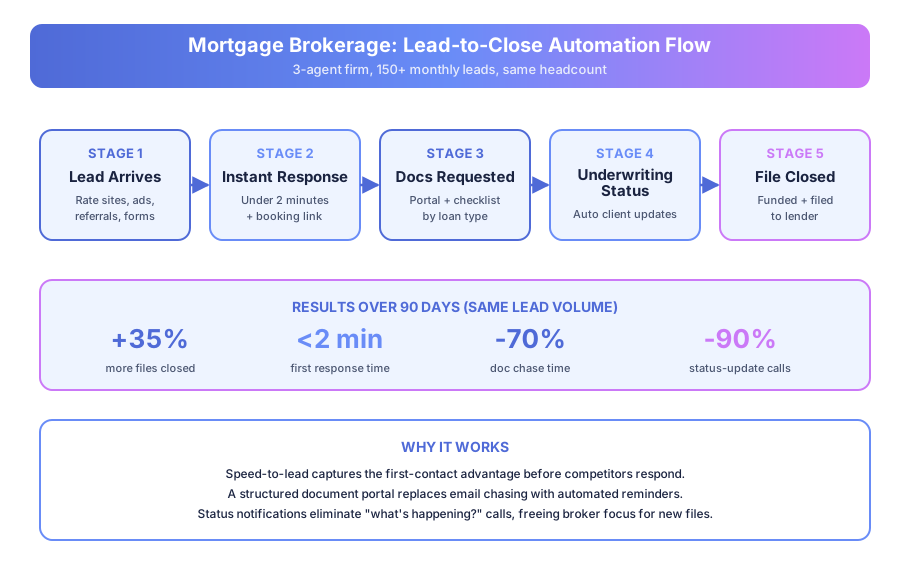
In 90 days, the brokerage closed 35% more files on unchanged lead volume, dropped lead response time from hours to under 2 minutes, reduced document collection time by 70%, and cut status-update calls by 90%. Headcount stayed at three agents. The gains came entirely from automation, not hiring.
The brokerage tracked every metric against its pre-automation baseline. Here’s the full picture:
| Metric | Before | After | Change |
|---|---|---|---|
| Lead response time | Hours to next day | Under 2 minutes | ~99% faster |
| Lead-to-consult conversion | Variable, low after-hours | Consistent 24/7 | Significant lift |
| Document collection time | 2-3 weeks | Under 10 days | 70% faster |
| Status-update calls | Multiple daily per agent | Rare | 90% reduction |
| Files closed per month | Baseline | +35% | Same lead volume |
According to Drift’s 2023 Lead Response Report, only 7% of companies respond to new leads within 5 minutes, meaning brokers who hit that window differentiate sharply on first contact alone. This brokerage moved from the bottom quartile to the top 7% in one deployment cycle.
What was the actual problem with the lead pipeline?
Mortgage leads are time-sensitive because buyers comparison-shop in real time. The brokerage was running manual intake through a shared inbox, with agents checking it between client meetings. Hot leads routinely waited hours — sometimes overnight — before anyone responded, by which point prospects had already booked with faster competitors.
A first-time buyer comparing rates has usually submitted contact info to several brokers simultaneously. The first professional to respond with a useful, personalized message wins the conversation. Everyone else gets a polite brush-off.
The brokerage wasn’t understaffed. It was poorly systemized. New leads arrived in a shared inbox that agents checked when they had a spare moment. During busy stretches, leads waited until the next morning. Per the 2024 HubSpot Sales Benchmark Report, brokers in financial services who responded within 10 minutes closed 21% more first meetings than those who responded in an hour.
The downstream problems compounded. Once a client was engaged, document collection happened over email — incomplete submissions, wrong formats, scattered threads. Clients called repeatedly asking for status updates because nothing kept them informed automatically.
Why couldn’t the agents simply respond faster manually?
They couldn’t scale their attention. Mortgage brokers earn their keep through professional judgment — evaluating situations, matching lenders, structuring applications. That work needs focus. Breaking concentration every 15 minutes to check an inbox degrades both response quality and underwriting accuracy. Manual speed is incompatible with manual expertise.
A brokerage receiving leads after hours, on weekends, and during consultations can’t staff for instant response without steep overhead. A 24/7 response model requires either dedicated after-hours staff (expensive) or an automated system (efficient).
According to Salesforce’s 2024 State of the Connected Customer report, 88% of customers say the experience a company provides is as important as its products or services. For mortgage clients making the largest financial decision of their lives, the first response sets expectations for the entire relationship.
The brokerage’s principal summed it up directly: “We were losing files we’d already won on paper, just because we got to the phone 4 hours late.”
What three systems did the brokerage build?
Three automation systems now cover the full client lifecycle. System 1 handles instant lead response and qualification. System 2 runs a structured document portal with loan-type-specific checklists. System 3 delivers automatic stage-by-stage status updates to clients. Together they replaced the shared inbox, email document chains, and manual check-in calls.
How does the speed-to-lead system work?
Every new inquiry gets an automated response within 2 minutes regardless of arrival time. The system classifies the inquiry (purchase, refinance, investment, HELOC), personalizes the response, and offers a direct booking link. Here’s the workflow:
- Lead submits inquiry through any source — rate site, website, referral link, or social ad
- System captures the submission and classifies the inquiry type
- Automated response fires within 2 minutes with a relevant resource and booking link
- Urgent signals (active purchase, rate hold needed) trigger immediate broker alerts
- No consultation booked within 24 hours? A structured follow-up sequence kicks in
- After-hours and weekend leads get the same instant treatment as business-hours leads
- A CRM record is created automatically with the full inquiry history
The broker’s first human touchpoint is the consultation — which the lead has already booked. No phone tag, no cold callbacks.
How does the automated document collection portal work?
Each engaged client receives a portal link with a loan-type-specific document checklist. A purchase client sees one checklist, a refinance client another, an investment property client a third. The portal validates uploads, flags issues, and nudges clients automatically until the file is complete.
- Broker confirms engagement and loan type — portal link generates automatically
- Client receives a portal invitation with checklist and clear instructions
- Client uploads documents directly (ID, income, bank statements, purchase agreement)
- System validates format and completeness, flags expired or unclear files
- Automated reminders trigger at day 2, day 4, and day 7 for outstanding items
- Broker is notified when the file is complete and ready for lender submission
- Submissions are timestamped and organized in the client folder automatically
Document collection time dropped by 70%, which is the result client onboarding automation for mortgage brokers is built to produce. Per the Canadian Mortgage Brokers Association’s 2025 member survey, structured portals cut average intake time by 58% across surveyed firms — this brokerage beat the benchmark.
How do the application status notifications work?
Clients receive automatic updates at every stage: consultation confirmed, documents received, application in review, lender submitted, conditional approval, final approval, closing confirmed. A self-service portal shows current status, outstanding conditions, and next steps. Clients stop calling to ask — they already know.
The “what’s the status?” calls that had consumed hours of broker time each week dropped by 90%. What remained were genuine questions that needed professional input, not informational check-ins the system could have answered.
According to McKinsey’s 2024 Next Horizon for Mortgage report, proactive status communication raised borrower NPS by 27 points on average across studied lenders. Clients don’t resent a process that takes time — they resent not knowing where they stand.
Why does speed-to-lead matter more in mortgage than most industries?
Mortgage transactions combine high stakes, narrow timing windows, and simultaneous multi-broker submissions. A buyer with a signed purchase agreement has days, not weeks, to lock financing. Rate comparison platforms route the same inquiry to multiple brokers at once. First-to-respond wins the conversation before skill or rates even enter the picture.
Rate comparison platforms amplify this dynamic sharply. When a buyer submits their info on Ratehub or Ratesdotca, that submission hits several brokers simultaneously. The first broker with a useful, personalized response gets the consultation. The others get “thanks, I’ve already been helped.”
Per Celonis’s 2024 Process Intelligence report, median time-to-value for financial services automation is 8 weeks. This brokerage showed measurable improvement in consultation bookings within the first week. The payback on the speed-to-lead system alone recovered its implementation cost before the document portal even went live.
What can other mortgage brokers and financial advisors take from this?
Three principles apply broadly across financial services. First response is a trust signal. Structured portals remove the hidden cost of incomplete files. Automated status updates protect broker time while raising client confidence. Each principle compounds the others — combined, they turn the same lead volume into materially more closed files.
First response is a trust signal, not a courtesy. In high-value transactions, clients form impressions in minutes. A broker responding within 2 minutes while competitors take hours has already won on responsiveness before demonstrating any professional skill. That speed is exactly what lead follow-up automation for mortgage brokers is built to guarantee.
Document portals eliminate hidden chase costs. Every incomplete file needing manual follow-up is time not spent on a new client. A structured portal with automatic reminders removes that overhead entirely at scale.
Status updates are a retention tool. Clients who don’t know where their file stands call to ask. Clients who get automatic updates don’t. The difference shows up in broker time saved and referral willingness later.
Could this work for your brokerage or financial services practice?
Yes, if your business matches the core pattern: time-sensitive inquiries, document-heavy intake, and clients who need frequent status reassurance. The pipeline pattern applies to mortgage brokers, financial advisors, insurance brokers, and wealth management firms. Firms outside those categories with similar workflow shapes also benefit, though specific automation tools differ by industry.
The pipeline pattern — instant lead response, structured document intake, and automatic status updates — is applicable to any financial services practice where clients have time-sensitive needs and high information anxiety.
For related reading, see our guide on how to set up automated follow-up sequences that actually convert and our article on how to automate document collection from clients.
Book a free automation audit and we’ll map your lead and client pipeline to identify where response speed and document friction are costing you closed files.