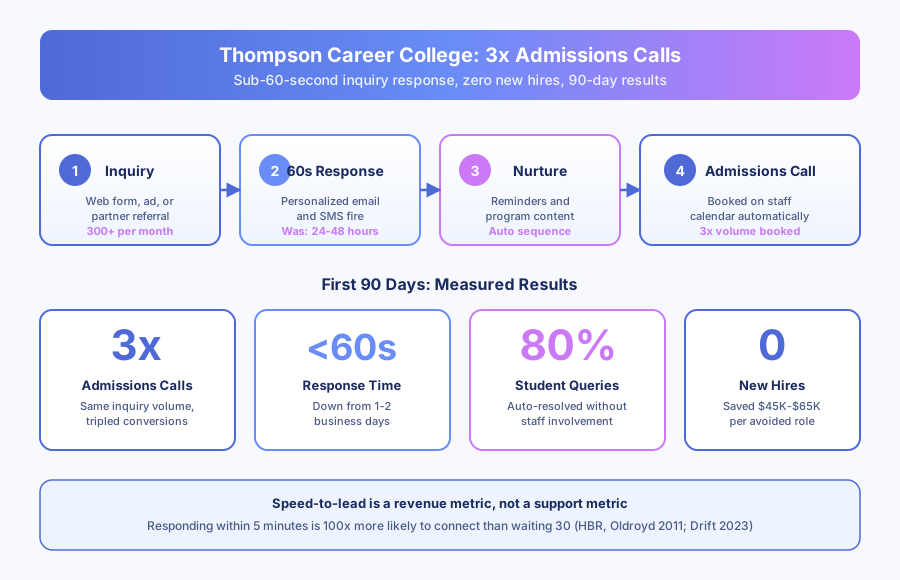
Thompson Career College in London, Ontario tripled admissions calls without hiring a single new staff member. The unlock was speed. Response time to prospective student inquiries dropped from 1-2 business days to under 60 seconds, and the same 300+ monthly inquiries started converting at three times the rate. Enrolled student queries were automated in parallel, with 80% resolved without staff involvement. All measured inside a 90-day window.
This is how a private career college out-paced larger, publicly funded competitors using automation instead of headcount, and what other education providers can copy.
What actually changed at Thompson Career College?
TCC kept the same admissions team, same programs, and same inquiry volume. What changed was the pipeline between a form submission and a booked call. The gap collapsed from days to seconds, and the conversion math flipped. Three times as many prospects reached the admissions call stage.
How bad was the old inquiry process?
Before automation, every inquiry ran through a fully manual pipeline. A staff member checked form submissions, looked up program details, drafted a personalized response, sent it, then manually booked a call or set a follow-up reminder. Average handling time: 10 to 15 minutes per inquiry. Average response time to the student: 1 to 2 business days.
TCC receives 300-plus monthly inquiries across career programs. That’s roughly 60 hours of manual inquiry work every month, or 1.5 full-time equivalents, before any other admissions duties. According to IDC’s 2023 Future of Work study, employees lose about 30% of their time to manual data entry and transfer work. For TCC’s admissions team, that number was higher because every inquiry touched at least three systems: the website form, the CRM, and email.
Why couldn’t the team just respond faster?
It was a math problem, not a motivation problem. The team also ran campus tours, processed enrollment paperwork, prepared orientations, and supported current students. Inquiries competed with everything else in the queue.
According to SHRM’s 2024 Human Capital Benchmarking report, average cost-per-hire in North America is $4,129, and that doesn’t include the $45,000-$65,000 annual salary for an admissions coordinator (per Statistics Canada’s 2024 SEPH data). Hiring a second or third coordinator would have spread the inefficiency across more people without fixing the underlying process.
Why does response speed decide career college enrollments?
Career college applicants typically submit inquiries to three or four schools at once, then enroll at whichever contacts them first. According to HBR research (Oldroyd, 2011; updated by Drift, 2023), responding within 5 minutes is 100x more likely to connect than waiting 30. TCC wasn’t waiting 30 minutes, it was waiting up to 48 hours.
What does the research actually say about speed to lead?
The original Harvard Business Review study tracked 1.25 million sales leads across 29 B2C and 42 B2B companies. Contacting a lead within an hour was seven times more likely to result in a meaningful conversation than waiting even 60 minutes more. Within 5 minutes, the conversion advantage is 100x.
Drift’s 2023 update looked at marketing-qualified leads across SaaS and services and confirmed the same pattern. Speed isn’t a nice-to-have metric, it’s a direct multiplier on the revenue you pull out of the same ad spend.
For TCC, the competitive context sharpens the math. The college competes against Fanshawe College, Western University’s continuing education programs, and other private career colleges in London, Ontario. Publicly funded schools carry much larger marketing budgets. Private colleges have to win on responsiveness, program fit, and personalized attention.
What did a 48-hour delay cost TCC in revenue?
Career programs run on fixed cohort dates. A student who misses an intake doesn’t just get pushed back, they typically enroll with a competitor whose next start date lines up sooner. Each lost enrollment is 6 months to 2 years of tuition revenue gone.
Running the numbers on the old workflow: 300 inquiries a month, industry-standard career college inquiry-to-enrollment rates of 8-12%, and a multi-thousand-dollar tuition gap per enrollment. Shaving response time from days to seconds moved the conversion needle enough to triple booked calls, and booked calls are the leading indicator for enrollment revenue.
How does the TCC automation actually work?
Two connected systems. One handles prospective students from inquiry to booked call. The other handles enrolled students so routine questions don’t clog the same queue.
What runs in the speed-to-lead pipeline?
The speed-to-lead system fires the moment a prospect hits submit. This is the same workflow pattern service firms and professional practices face with inbound leads, and it maps cleanly to a client intake automation approach.
Step-by-step:
- Student submits an inquiry form (website, landing page, or partner referral).
- The system captures the submission and identifies the relevant program in real time.
- An automated qualification check runs on program eligibility, intake date, and location.
- A personalized email and SMS fire within seconds, tailored to the exact program.
- The message contains a direct link to book an admissions call from the staff calendar.
- A CRM record is created with the full inquiry payload, no manual data entry.
- If no call is booked in 24 hours, a follow-up sequence kicks in with reminders and program content.
- Staff receive a summary notification only when human judgment is needed.
Total elapsed time from form submission to personalized, program-specific response: under 60 seconds.
What does the student support system cover?
The second system handles enrolled students. Current students regularly ask about class schedules, deadline dates, document requirements, and program-specific rules. Before automation, those questions landed in the same admissions inbox and competed with new prospect inquiries.
The student support system matches incoming questions against a structured knowledge base of program details, schedules, policies, and deadlines. It auto-resolves 80% of queries instantly. Only complex or sensitive cases, such as grade disputes, financial aid questions, or personal circumstances, are routed to staff.
According to McKinsey’s 2024 Global Survey on AI and Automation, 60% of occupations have at least 30% of tasks that could be automated. For repetitive student support queries, TCC’s automatable share was much higher because the patterns were so predictable.
What were the measurable 90-day results?
Here are the numbers, measured in the first 90 days after both systems went live.
| Metric | Before Automation | After Automation | Change |
|---|---|---|---|
| Response time to inquiries | 1-2 business days | Under 60 seconds | About 99% faster |
| Admissions calls booked | Baseline | 3x baseline | 200% increase |
| Enrolled student queries auto-resolved | 0% | 80% | Staff freed for enrollment |
| Staff handling time per inquiry | 10-15 minutes | 2-3 minutes (exceptions only) | About 80% reduction |
| Monthly inquiry volume handled | 300+ with delays | 300+ instantly | Same volume, zero wait |
| New hires required | Unknown (rising pressure) | 0 | Avoided $4,129 cost-per-hire plus salary |
The 3x increase in admissions calls came from conversion, not traffic. The same 300-plus monthly inquiries kept arriving. The difference was that students receiving a response in under 60 seconds were far more likely to book a call than students who waited a day or more.
According to Forrester’s 2024 Total Economic Impact studies, the average ROI on business process automation is 200% within the first year. TCC’s return ran substantially higher because the link between speed-to-lead and enrollment revenue made the financial impact immediate and measurable.
What can other education providers copy from this?
Three principles from the TCC implementation apply to most career colleges, vocational schools, training centers, and continuing education programs.
Treat speed to lead as a revenue metric
The Harvard Business Review data (Oldroyd, 2011) is 15 years old and has only gotten more true. Drift’s 2023 update confirmed the 100x advantage at 5 minutes. If your inquiry response time is measured in hours, you’re feeding enrollments to any competitor who responds in minutes. Treat speed to lead the way you treat cost-per-acquisition, because it directly determines how much revenue comes out of the same ad spend. That’s the whole point of lead follow-up automation for career colleges: the inquiry gets answered while the student is still deciding.
Separate prospect and enrolled student workflows
TCC’s bottleneck wasn’t just slow outreach, it was that new prospect responses competed with current student questions in one queue. Automating enrolled student support freed admissions capacity for enrollment-generating work. Two separate pipelines, each optimized for a different outcome.
Automate the volume, keep humans for the judgment
According to Deloitte’s 2023 Global Intelligent Automation Survey, 78% of organizations that implemented business process automation first reported faster time-to-value. TCC didn’t try to replace the admissions team. They removed the 80% of work that didn’t require human judgment so staff could focus on the 20% that did: complex situations, campus tours, and the actual enrollment conversations. This is the pattern we cover in the Education Enrollment Automation Playbook.
How long did the whole rollout take?
The speed-to-lead pipeline was live inside 4 weeks. The student support system followed shortly after. Both were measured in a 90-day window.
According to Celonis’s 2024 Process Intelligence report, the median time-to-value for business process automation is 6 weeks. TCC came in ahead of that benchmark because the inquiry workflow was well-understood and the team was ready to commit to a single clean pipeline rather than layering automation onto existing manual steps.
If your education institution faces the same pattern, high inquiry volume, manual response processes, and a competitive market where the first contact wins, the TCC playbook is directly portable. We’ve built similar systems for immigration firms, SaaS companies, and service businesses across multiple industries, and the underlying pattern is the same: automate the speed-critical pipeline first, then expand.
For the high-level engagement summary — headline metrics, client quote, and stats in case-study format — see the Thompson Career College case study overview.
Book a free automation audit and we’ll map your inquiry pipeline the same way we mapped TCC’s.