69% of tax firms say slow client document collection is their top operational bottleneck, according to CPA Practice Advisor’s 2025 Tax Season Technology Report. Not tax law. Not software. Just waiting for clients to send their paperwork. I’ve seen the same pattern in immigration consultancies, law firms, and marketing agencies: send email, wait, follow up, wait, call, receive half, chase the rest. Skylarks International cut collection time 70% after replacing that loop with a portal, and Taxvisory removed 80% of the chasing entirely while managing 300 clients solo.
This guide shows exactly how to build that system in about two weeks.
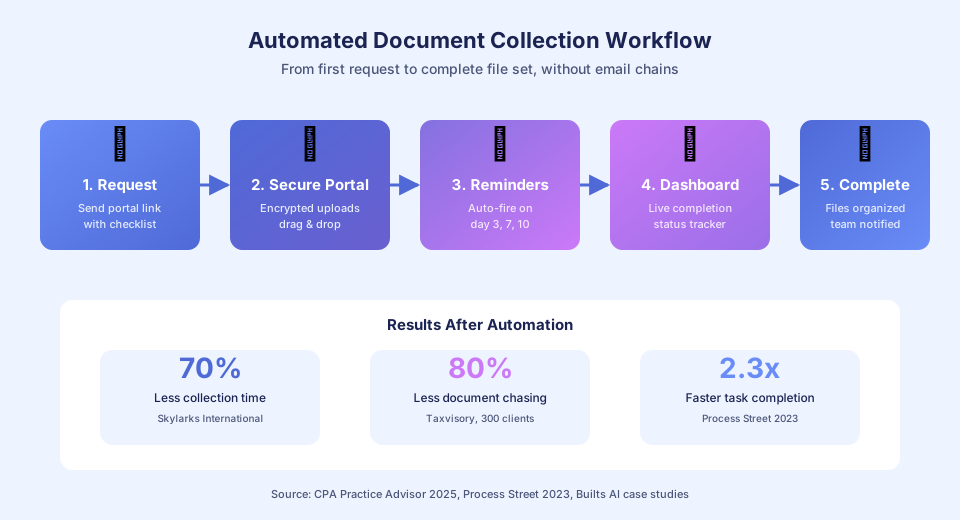
Why does email-based document collection fail?
Email was never built for structured file collection. Attachments get buried in threads, clients send wrong versions, files hit size limits, and nobody tracks what’s missing. The cost isn’t abstract, it’s hours your team loses every week to manual chasing instead of billable work.
Here’s what a 10-client email batch actually costs:
| Step | Time per client | Total (10 clients) |
|---|---|---|
| Send initial request email | 10 min | 1.5 hrs |
| Follow up (avg 3 times) | 5 min each | 2.5 hrs |
| Track what’s received | 15 min | 2.5 hrs |
| Chase missing items | 10 min | 1.5 hrs |
| Organize files into folders | 10 min | 1.5 hrs |
| Total | 9.5 hrs |
That’s nearly a full work day for 10 clients. Scale to 50 or 300 and the math breaks. Gartner’s 2023 Data Quality Market Survey pegs the average cost of poor data quality at $12.9 million annually per organization. For small firms, it shows up as missed deadlines, overtime, and client churn from people tired of being chased.
Taxvisory’s founder managed 300 tax clients solo. Before automation, chasing documents consumed her mornings. Today, 80% of that chasing is gone.
What does an automated document collection system look like?
An automated system replaces the entire email chain with a structured portal. The client gets one link, sees exactly what’s needed, uploads each file to the right slot, and the system tracks everything in real time. No guessing, no back-and-forth.
Four components do the work:
- Client-facing portal. A checklist of required documents with clear descriptions and drag-and-drop upload slots.
- Scheduled reminders. Emails or SMS that fire on a fixed cadence until every item is in.
- Live tracking dashboard. Green, yellow, and red status across every client at a glance.
- Auto-organization. Uploads route to the right folder, CRM record, or storage system.
Process Street’s 2023 Process Management Report found teams using structured checklists complete tasks 2.3x faster than those using unstructured communication. A document portal is a structured checklist with upload slots attached. The productivity gain shows up immediately.
Skylarks International, a 15-person immigration consultancy, cut their collection time 70% after deploying a client portal. Status calls dropped 80% because clients could see their submission progress live. Read the full breakdown in our Skylarks International case study on document collection automation.
What makes a portal different from a shared Dropbox folder?
A shared folder is just storage. A portal is a workflow engine. The difference is structure. A Dropbox link lets clients drop anything anywhere, with no checklist, no reminders, no validation, and no status view. A portal enforces which document goes in which slot, rejects wrong formats at upload time, and reports progress back to both sides in real time. McKinsey’s 2023 State of Automation report found workflow-based tools deliver 3x more time savings than simple file sharing for client-facing work.
Which document collection platform should you choose?
The answer depends on budget, volume, and how much customization you need. Purpose-built tools cost more but save setup time. DIY builds cost less but need more care upfront. For most firms, the right choice maps to client volume and compliance level.
| Platform | Price | Best For | Key Feature |
|---|---|---|---|
| Clustdoc | $100/month | Accounting, law, immigration | Compliance workflows, e-signatures |
| ContentSnare | $59/month | Agencies, bookkeepers | Client-friendly UI, approvals |
| Typeform + Google Drive | Free-$50/month | Simple collections | Easy setup, familiar tools |
| Google Forms + Drive + n8n | Free-$20/month | Custom workflows | Full control, unlimited automation |
| Airtable + Make | $20-$50/month | Visual tracking | Database views, automations |
| Custom portal (n8n + Dropbox) | $10-$30/month | High-volume, specific needs | Unlimited customization |
For compliance-heavy work like tax returns, immigration papers, and legal filings, Clustdoc or ContentSnare gives you audit trails and encryption out of the box. For simpler workflows, a Google Forms setup connected through n8n or Make costs almost nothing and runs forever.
IDC’s 2023 Automation Spending Forecast found businesses increased automation spending 30% year-over-year. Document portals sit in the highest-ROI bucket because they fix a daily pain point with simple technology.
How do you set up automated reminders that actually work?
Reminders are the backbone. Without them, you’ve replaced email chaos with portal chaos. A good sequence respects the client’s time while creating real urgency.
What cadence should reminders follow?
Use a four-touch sequence. Each message names exactly what’s missing, not a generic nudge. Specificity is what drives completion rates.
- Day 0 - Initial request. Personalized email with portal link, checklist, and deadline. “Hi Sarah, here’s your 2025 tax checklist. We need 8 items by March 15.”
- Day 3 - Gentle nudge. “We’ve received 3 of 8. Still missing: [specific list].”
- Day 7 - Deadline mention. “You’re 8 days from filing. 5 items outstanding.”
- Day 10 - Firm reminder. “Deadline in 5 days. Without these 3 documents, we may need to file an extension.”
All four can run automatically through Clustdoc, ContentSnare, or custom workflows in n8n and Make. Set once, fire for every client. Statistics Canada’s 2024 Survey of Employment, Payrolls and Hours puts the average professional services salary at $45,000 to $65,000 per year. Every hour your team spends on manual follow-ups is an hour lost to non-billable work.
Should reminders use email, SMS, or both?
Email works for most professional services. SMS lifts completion rates for time-sensitive work like tax deadlines or visa filings. Twilio’s 2024 State of Customer Engagement Report found SMS has a 98% open rate versus 20% for email. Use SMS sparingly for final reminders only, since daily text pings frustrate clients.
How do you track document completion across all clients?
Individual tracking is easy. The hard part is the bird’s-eye view across 50, 100, or 300 clients. You need to know who’s done, who’s missing one item, and who needs a phone call today.
Three approaches work well:
Built-in dashboards. Clustdoc and ContentSnare both provide client-level and document-level dashboards with green, yellow, and red status indicators. Good enough for most firms under 200 clients.
Airtable or Google Sheets tracker. Connect your portal to Airtable through Make or n8n. Every upload triggers a record update. Build views filtered by “Missing documents,” “Overdue 7+ days,” and “Ready for review.” More flexible than built-in dashboards.
CRM integration. If you already use HubSpot, Salesforce, Clio, or TaxDome, push completion data there. Your client record shows document status next to everything else.
Skylarks International built a tracker that eliminated 80% of status calls. When a client uploads, they get instant confirmation. When the team reviews, they see “Approved” or “Resubmission needed” with specific feedback. The portal answers “did you get my bank statement?” before the client thinks to ask.
How do you handle different file types and security requirements?
Not every document carries the same weight. A government ID scan has different security needs than a marketing brief. Your system needs to handle both without running two separate workflows.
What file types and sizes should you accept?
Set accepted formats per slot. Tax returns take PDF only. Receipt photos accept JPEG, PNG, and HEIC. Construction drawings need DWG or CAD. Clustdoc and ContentSnare let you specify formats per slot. Custom n8n workflows validate files and reject invalid uploads with an auto-notification.
For size limits, email caps at 25MB. Portal systems handle much larger files. Clustdoc allows 256MB per file. Google Drive accepts up to 5TB. Set sensible caps per document type and display them clearly in the upload UI.
How secure is a client portal compared to email?
Much safer. Verizon’s 2024 Data Breach Investigations Report found 68% of breaches involve a human element, with email as a top vector. People send sensitive files to the wrong address or forget to encrypt attachments. A portal uses fixed upload destinations, encrypted transfer, role-based access, and audit trails. For tax, legal, healthcare, and immigration, this isn’t optional.
Require SSL encryption (every platform above includes it). Enable two-factor authentication for team access. Set automatic file expiration for sensitive documents. Never use a shared inbox as your collection system.
What does the full setup process look like?
Here’s a 14-day timeline based on deployments across accounting, immigration, and professional services firms.
Days 1-2: Platform selection and setup. Pick from the comparison table above. Create your account, set up organization profile and branding.
Days 3-4: Build checklist templates. Create templates per service type. Tax firms might need personal returns, corporate returns, and HST filings. Immigration firms might need study permits, work permits, and PR applications. Use clear names: “T4 slip from your employer” beats “income statement.”
Days 5-7: Configure reminders. Set up the four-touch sequence above. Customize messaging for your voice. Test the full sequence with a team member playing client.
Days 8-10: Connect existing systems. Link to your CRM, practice management software, or Google Drive. Use n8n or Make for custom integrations. Set up the Airtable or dashboard view.
Days 11-14: Pilot with 10-15 clients. Start with your most responsive clients. Gather feedback. Adjust reminder timing, document descriptions, and interface based on real use before rolling out to everyone.
What are the most common setup mistakes?
Three traps show up in nearly every first deployment. First, overloading the checklist. If a client sees 20 required documents on day one, completion rates drop 40% versus a 6-8 item list, based on ContentSnare’s 2024 user benchmarks. Break big collections into phases. Second, generic reminder copy. “Please submit your documents” gets ignored. “3 items missing: T4, RRSP statement, donation receipts” gets action. Third, skipping the pilot. Rolling out to 200 clients on day one means catching portal bugs in front of paying customers. Start with 10, refine, then scale.
Forrester’s 2024 Total Economic Impact studies show business process automation averages 200% ROI within the first year. Document collection tends to hit payback faster because the time savings are immediate.
Taxvisory went from chasing documents all morning to managing 300 clients with 80% less follow-up. Skylarks International cut collection time 70% and freed their 15-person team from the status calls that ate their days. Neither firm added headcount.
Document collection is usually the first step in a broader onboarding workflow. If you’re also running intake forms and consultations manually, our guide on how to automate client intake covers the full pipeline from first contact to kickoff.
Ready to stop chasing documents?
The technology isn’t complicated. Clustdoc, ContentSnare, Google Drive, n8n, Make, Airtable, and Dropbox all work. The bottleneck is deciding to stop chasing documents through email. Two weeks of setup saves hundreds of hours every year. That’s the trade.
If you’d rather have someone build it for you, get in touch with Builts AI. We deploy document collection portals for professional services firms across North America, usually within 14 days.