Skylarks International, a 15-person immigration and education consultancy running offices in Canada and India, cut document collection time by 70%, removed 80% of status-update calls, and dropped first-response time on new leads to under 90 seconds. The firm did it without hiring. Consultation volume tripled within 90 days. Forrester’s 2024 Total Economic Impact research pegs average process automation ROI at 200% within year one, and Skylarks hit those numbers on the three workflows immigration firms spend the most time on.
Here’s how they did it, what the measured results looked like, and what other consultancies can copy.
What was slowing Skylarks down the most?
Three bottlenecks ran simultaneously: document chasing on 200+ active files, a flood of “where’s my file?” calls, and new inquiries waiting hours for a first response. None of them needed professional judgment. All of them consumed consultant time that should have gone to casework and advisory.
Skylarks ran study permits, bachelor’s and master’s placements, and PGWP applications across Canada and India. Document collection meant chasing missing pages, wrong formats, and expired documents across dozens of active files. Status-update volume was the biggest single category of inbound communication — clients calling and emailing just to ask where their application stood.
According to IDC’s 2023 Future of Work study, knowledge workers spend roughly 30% of their time on manual data entry and transfer tasks. For Skylarks consultants, the number ran higher. Each active file touched multiple systems, required ongoing client communication, and had its own checklist and deadline.
The cross-time-zone operation made it worse. New inquiries from India landed during Canadian off-hours and sat unanswered overnight. Applications in progress needed updates coordinated across two offices. And every consultant tracked documents slightly differently, so there was no standard process to improve.
Why couldn’t the team just work harder?
Skylarks didn’t have a capacity problem — it had a process problem. Fifteen staff were doing repetitive, pattern-matching work that shouldn’t have required a human. Hiring more consultants would have spread the same inefficiency across more people. The real fix was automating the predictable work so experts could focus on casework.
McKinsey’s 2024 Global Survey on AI and Automation found 60% of occupations have at least 30% of tasks that could be automated. Immigration consulting sits well above that baseline because so much of the client-facing work — document reminders, status notifications, FAQ responses — follows predictable patterns.
Adding another admin person might have absorbed volume temporarily. It wouldn’t have fixed the underlying issues: no structured document intake, no automatic client updates, no instant lead response, no single source of truth across two countries. Skylarks’ leadership wanted those gaps closed permanently, not patched with headcount.
What three systems did Skylarks build?
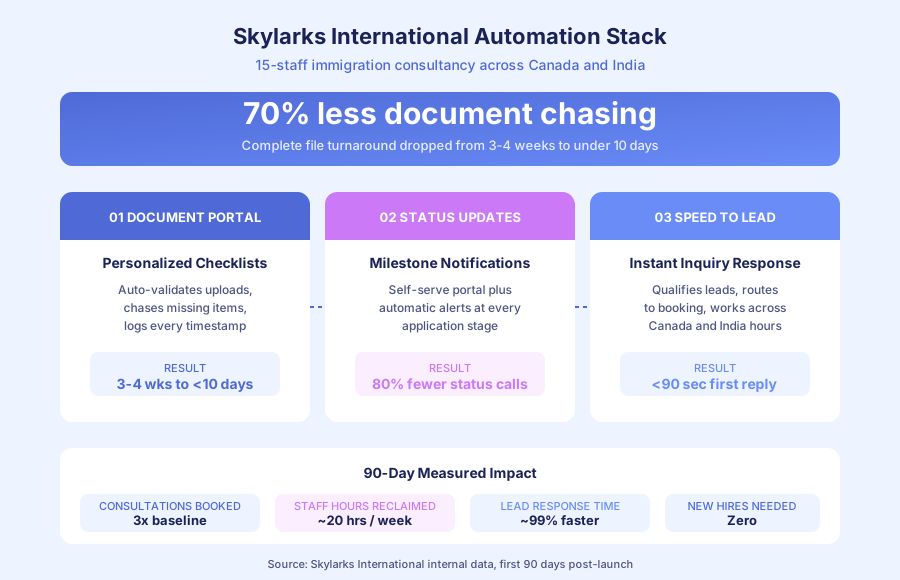
Skylarks built three connected automations covering the full client lifecycle: a document collection portal, a case status notification system with self-serve portal, and a speed-to-lead engine for new inquiries. Each one solved a specific bottleneck, and together they covered every touchpoint from first inquiry to submitted application.
System 1: automated document collection portal
Every client gets a portal with a personalized checklist based on their specific application type. Study permit applicants see one set of requirements. Master’s placement clients see another. PGWP applicants see a third. The workflow pattern follows a standard document collection automation design.
How it works:
- Client receives the portal link right after onboarding
- Checklist is pre-populated by application type and circumstances
- Client uploads documents directly through the portal
- System validates file formats, checks completeness, flags issues
- Automated reminders chase missing items on a schedule
- Consultant is notified only when a file is complete or hits an exception
- All uploads are timestamped for compliance
No email chains. No manual chasing. No consultants spending their afternoon following up on T4 slips.
System 2: case status notifications and self-serve portal
The system fires automatic notifications at every application milestone: documents received, application submitted, acknowledgment arrived, decision pending. The self-service portal lets clients check status anytime without calling in. It shows the current stage, next steps, and any outstanding items.
According to Salesforce’s 2024 State of the Connected Customer report, 80% of customers say the experience a company provides is as important as its products and services. Proactive updates and self-serve access aren’t just efficiency levers — they’re retention levers. Clients stop worrying about their files because they can see the status themselves.
System 3: speed-to-lead for new inquiries
Every new inquiry gets an automated response within 90 seconds. The system qualifies the lead by immigration goal, then routes accordingly. Clients holding offer letters get fast-tracked to a consultation booking. General inquiries receive an information package matched to their goal. If a consultation isn’t booked immediately, a follow-up sequence runs until they book or opt out.
After-hours inquiries from India now get the same instant response as business-hours leads in Canada. That single change unlocked the biggest downstream metric: a 3x increase in consultations booked.
What were the measurable results?
Here are the numbers from the first 90 days after all three systems went live. Skylarks tracked these against baseline communications and case-management data from the prior quarter. No new hires were added during the measurement window.
| Metric | Before | After | Change |
|---|---|---|---|
| Document collection time | 3-4 weeks | Under 10 days | 70% faster |
| Status update calls and emails | 70%+ of communications | 20% of communications | 80% reduction |
| Lead response time | Hours or days | Under 90 seconds | ~99% faster |
| Consultations booked from inquiries | Baseline | 3x baseline | 200% increase |
| Staff hours on status updates | Full days across team | ~20 hrs/week reclaimed | Redirected to casework |
The 3x jump in consultations didn’t come from more incoming leads. It came from the same 200+ monthly inquiries converting at a higher rate because instant response beat out competitors who took hours to reply. According to Harvard Business Review research (Oldroyd, 2011, updated by Drift in 2023), responding within 5 minutes makes contact 100x more likely.
Why does document collection speed matter this much?
Immigration deadlines don’t move. A study permit must land before the program start date. A PGWP has a strict filing window after program completion. A university intake won’t wait. When document collection takes 3-4 weeks because files are chased over email, clients can miss deadlines and defer entire semesters — with real financial consequences.
Deloitte’s 2023 Global Intelligent Automation Survey found 78% of organizations that implemented business process automation first reported faster time-to-value. For Skylarks, the time-to-value was immediate. Faster collection meant faster submissions, which meant less deadline pressure for both the firm and its clients.
The portal also produced an unexpected benefit: better compliance documentation. Every upload is timestamped, every reminder is logged, and every file carries a complete audit trail. For an industry where documentation integrity matters, that’s a meaningful operational win on top of the speed gains.
What did clients actually notice?
Clients noticed fast. Several mentioned in reviews that the onboarding experience felt more professional and organized than what they’d experienced at larger agencies. One family directly compared Skylarks’ process favorably to a 50-person firm they had worked with previously. Referrals ticked up as a result.
Immigration consulting runs on referrals. A client who had a smooth, well-organized experience is far more likely to recommend the firm than one who spent weeks chasing updates and resending documents. Bain & Company’s research on Net Promoter economics found that a 5-point increase in customer retention can raise profitability by 25-95%. For a referral-driven consultancy, client experience quality is a direct growth lever.
The self-serve portal changed the emotional tone of the relationship, too. Clients stopped feeling like they were pestering the firm for updates. The firm stopped feeling like it was drowning in inbound calls. Both sides won.
What can other consultancies copy from Skylarks?
Three principles transfer cleanly across immigration, education, and professional services firms: standardize before you automate, replace reactive calls with proactive updates, and use automation to cover time zones without hiring. Applied together, they produce the same operational lift Skylarks saw.
1. Standardize first. The document portal only works because Skylarks built consistent checklists for each application type. If every consultant runs a different process, automation amplifies inconsistency instead of removing it. That standardization step is where every client onboarding build for immigration consultants starts.
2. Proactive beats reactive. Every “where’s my file?” call is a failure of your update system, not just an operational inconvenience. Automatic milestone notifications should eliminate the need for those calls entirely.
3. Automate across time zones. A Canadian firm handling Indian inquiries can’t staff for 24-hour response without burning overhead. Speed-to-lead automation solves this instantly, regardless of what time it is in Vancouver or Delhi. For more on immigration consultancy automation patterns, the workflow holds across firm sizes.
Where can you read the full case study?
This article covers the operational highlights. For the complete breakdown — technical architecture, specific tools used, and the detailed ROI analysis — read the full Skylarks International case study.
If your consultancy faces the same bottlenecks — document chasing, status-update volume, slow lead response — we’ve built these systems for immigration firms, career colleges, tax practitioners, and professional services firms across Canada. The underlying workflow pattern is consistent. For more on how immigration firms specifically approach automation, see our Immigration Consultancy Automation Playbook and our guide on how to automate document collection from clients.
For the high-level engagement summary — headline metrics, client quote, and stats in case-study format — see the Skylarks International case study overview.
Book a free automation audit and we’ll map your document and lead pipeline the same way we mapped Skylarks’.