A freelance designer I worked with in 2025 spent every Sunday evening generating invoices in Google Docs. Twelve clients. Two hours minimum. Every single week. She hadn’t raised her rates in three years because she felt she couldn’t justify the time she was already losing. That’s not a design problem. That’s an invoicing problem — and it’s fully solvable for around $80 a month.
According to Atradius’ 2024 Payment Practices Barometer, 49% of B2B invoices in North America are paid late, and the average days-sales-outstanding (DSO) sits at 42 days. Teams running automated invoicing and reminder sequences cut that to 27 days — a 36% improvement in cash flow without raising prices or chasing a single client.
Here’s how to build the system, step by step, using tools you probably already have.
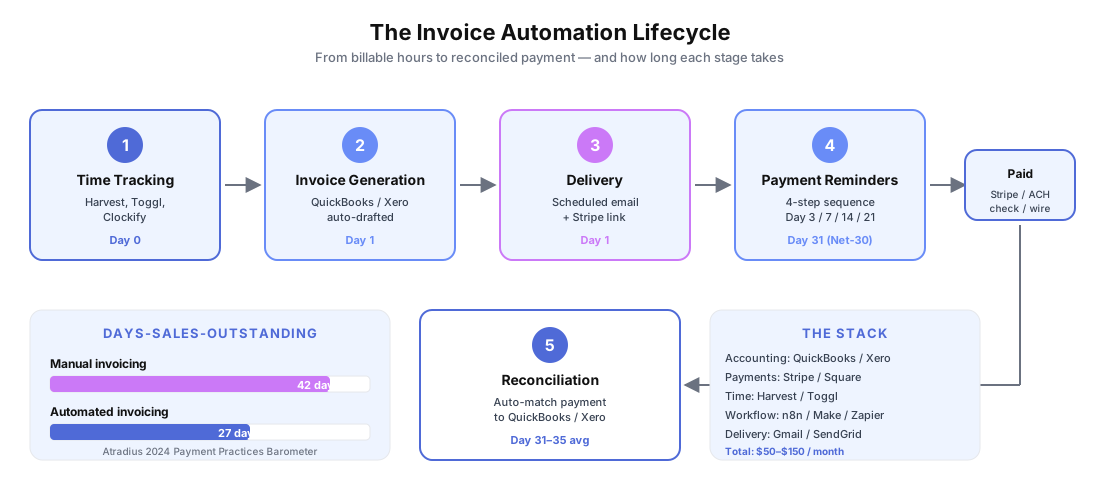
What Does a Fully Automated Invoicing System Actually Do?
An automated invoicing system pulls billable data from your time tracker or project tool, generates invoices in QuickBooks or Xero, delivers them on schedule, chases overdue payments through a reminder sequence, and reconciles paid invoices to your books. You only touch it when something breaks.
The five stages map to five triggers:
| Stage | Trigger | Tool | Average time |
|---|---|---|---|
| 1. Time tracking | Hours logged | Harvest, Toggl, Clockify | Day 0 |
| 2. Invoice generation | Billing period ends or milestone hit | QuickBooks, Xero, FreshBooks | Day 1 |
| 3. Delivery | Invoice created | Email + Stripe link | Day 1 |
| 4. Payment reminders | Overdue flag | n8n / Make / Zapier | Days 3, 7, 14, 21 |
| 5. Reconciliation | Payment received | Stripe + QuickBooks sync | Day 31–35 |
Each stage has a trusted tool and a clear handoff. When they’re wired together, you go from billable hours to reconciled payment without a human in the loop.
According to McKinsey’s 2024 Global Survey on AI and Automation, 60% of occupations have at least 30% of tasks that could be automated. For bookkeepers and billing coordinators, invoicing sits squarely in that 30%. It’s predictable, repetitive, and rule-based — exactly the work machines handle best.
How Do You Auto-Generate Invoices from Time Tracking or Milestones?
The first step is connecting your time tracker or project tool to your invoicing software. When billable hours hit a threshold or a milestone is marked complete, the system generates a draft invoice automatically. No copying, no pasting, no Sunday evenings lost to admin work.
Hourly billing: how does it work?
If you bill hourly, Harvest, Toggl Track, and Clockify all integrate natively with QuickBooks Online, Xero, and FreshBooks. The flow looks like this:
- Team logs time against client projects in Harvest
- At the end of each billing period (weekly, biweekly, monthly), n8n or Make pulls unbilled time entries
- The workflow calculates totals using your rate card
- A draft invoice is created in QuickBooks or Xero ready for review
Harvest’s direct QuickBooks integration handles steps 2–4 without a workflow engine for simple cases. For more complex billing (different rates per role, retainer top-ups, project-specific discounts), n8n gives you full control.
Milestone billing: what changes?
For milestone billing, the trigger changes. You mark a project phase complete in Asana, Monday.com, ClickUp, or Notion, and that status change triggers invoice generation. The line items pull from a pre-configured scope document or a pricing table in Google Sheets.
According to Gartner’s 2023 Data Quality Market Survey, poor data quality costs organizations an average of $12.9 million per year. For small businesses the absolute number is smaller, but the pattern is identical: manual data entry creates errors, errors delay payments, delayed payments hurt cash flow. Automated generation eliminates most of that entry error at the source.
Taxvisory, a solo CPA managing 300 clients, automated 80% of document chasing using the same pattern: define the trigger, define the template, let the system handle the repetitive cycle.
How Do You Schedule Invoice Delivery Automatically?
Once an invoice is generated, delivery should happen without you touching it. QuickBooks Online, Xero, and FreshBooks all have built-in scheduled sending. Create the invoice on Monday, schedule it to send Tuesday at 9 AM. Done. For teams that need conditional delivery rules, a workflow engine does the rest.
Here’s the delivery configuration most small businesses land on:
| Client type | Delivery method | Timing | Payment options |
|---|---|---|---|
| Retainer clients | Recurring auto-send in QuickBooks/Xero | 1st of each month, 9 AM | ACH, Stripe |
| Project clients | Triggered by milestone completion | Within 24 hours of milestone | Stripe link, bank transfer |
| Hourly clients | Triggered by billing period end | Friday 4 PM or Monday 9 AM | Stripe, Square, PayPal |
| Enterprise clients | PDF + CC to AP contact | Net-30 terms, on completion | Wire, ACH |
In n8n or Make, the delivery workflow looks like: invoice created in QuickBooks (trigger) → client preferences lookup in Google Sheets or CRM → email formatted with the right template → PDF attached or Stripe payment link inserted → sent via Gmail or SendGrid → send event logged back to your accounting software.
According to Forrester’s 2024 Total Economic Impact studies, the average ROI on business process automation is 200% within the first year. For invoicing the payback is faster than most categories because you’re cutting admin hours and shrinking DSO at the same time.
Pixorr, a 5-person SEO agency, reclaimed a full work week by automating their reporting. Their invoicing followed the same principle: remove every manual step between “work done” and “invoice sent.”
How Do You Build a Payment Reminder Sequence That Actually Works?
Late payments aren’t usually malicious. People forget. The invoice gets buried. The AP person is on vacation. A polite, consistent reminder sequence solves this without damaging relationships. The key word is consistent — manual follow-ups are sporadic and awkward, while automated ones are professional and reliable.
What does a 4-step reminder sequence look like?
Here’s the sequence that works for most small businesses:
| Step | Timing | Channel | Tone | Content |
|---|---|---|---|---|
| 1. Friendly nudge | 3 days overdue | Warm, helpful | ”Just a reminder that Invoice #1234 is past due. Here’s the payment link.” | |
| 2. Firm follow-up | 7 days overdue | Professional, direct | ”Invoice #1234 is now 7 days past due. Please process at your earliest convenience.” | |
| 3. Final notice | 14 days overdue | Email + SMS | Serious, clear | ”This is a final reminder for Invoice #1234. Payment is required within 7 days.” |
| 4. Personal outreach | 21 days overdue | Phone call or direct email | Human, problem-solving | Account lead reaches out to resolve |
Step 4 is where automation stops and a human takes over. The system flags the overdue account, notifies the account manager via Slack, and provides context: invoice amount, days overdue, previous reminder history, and any client responses.
Why does a sequence beat a single reminder?
According to Atradius’ 2024 Payment Practices Barometer, 49% of North American B2B invoices are paid late. A single reminder catches the “I forgot” segment. The sequence catches everyone else — the “I’ll get to it next week” client, the AP bottleneck, the returning-from-vacation signer. According to IDC’s 2023 Future of Work study, employees spend 30% of their time on manual data tasks, and payment chasing is one of the worst offenders because it’s draining on top of being time-consuming.
QuickBooks Online, Xero, and FreshBooks all have built-in reminder settings, but they’re limited to one or two reminders with basic templates. For a full escalation sequence with conditional logic (skip step 2 if the client responded to step 1), use n8n or Make connected to your accounting software and Stripe.
How Do You Reconcile Payments with QuickBooks or Xero?
Payment reconciliation is where most manual invoicing systems break down. The payment arrives in Stripe, Square, or your bank account, and someone has to match it to the open invoice, mark it paid, update the client record, and close out accounts receivable. For a business with 50+ monthly invoices, this takes hours every week.
Native integrations handle 80% automatically
Stripe, Square, and PayPal all have native integrations with QuickBooks Online and Xero. When a payment is processed, the invoice is automatically marked paid. The integration handles partial payments, refunds, and currency conversion. Stripe-QuickBooks sync handles Stripe fee tracking too, so your books reflect the net amount received rather than the gross.
What about wire transfers and checks?
For payments arriving outside card processors — wire transfers, checks, e-transfers — you need a matching workflow. In n8n this looks like: bank transaction feed via Plaid or your bank’s API triggers a lookup against open invoices in QuickBooks. If amount and client match within tolerance, the invoice is marked paid. If there’s ambiguity (partial payment, rounding difference, multi-invoice lump sum), it gets flagged for human review.
According to Statistics Canada’s 2024 Survey of Employment, Payrolls and Hours, the average Canadian salary runs $45,000–$65,000. An AR clerk spending 10 hours per week on reconciliation costs your business $12,000–$17,000 per year in that single task. Automation handles 80–90% of it, leaving humans for the exceptions that genuinely need judgment.
AcquireX Properties Capital, a 3-person real estate investment team, tripled their portfolio capacity by automating deal analysis and investor reporting. Their financial reconciliation followed the same pattern: connect the data sources, define the matching rules, let the system handle the volume.
What Tools Do You Actually Need for Invoice Automation?
You don’t need a custom-built ERP or a six-figure project. A small business can automate end-to-end invoicing with 3–4 tools. The exact stack depends on whether you’re already on an accounting platform and which payment processor you prefer.
| Tool category | Options | Monthly cost | Role in invoicing |
|---|---|---|---|
| Accounting | QuickBooks Online ($35+), Xero ($17+), FreshBooks ($19+) | $17–$60 | Invoice creation, AR tracking, reconciliation |
| Payments | Stripe (2.9% + 30¢), Square (2.6% + 10¢), PayPal | Transaction fees | Payment processing, auto-reconciliation |
| Time tracking | Harvest ($11/user), Toggl Track ($10/user), Clockify (free) | $0–$15/user | Billable hours source |
| Workflow engine | n8n (self-hosted, free), Make ($10+), Zapier ($20+) | $0–$50 | Logic, reminders, reconciliation |
| Email delivery | Gmail, SendGrid (free tier), Mailgun | $0–$20 | Branded delivery |
The architecture is straightforward. Your time tracker feeds the workflow engine. The workflow engine creates invoices in your accounting software. Your accounting software sends invoices and processes payments via your payment processor. The workflow engine monitors payment status and triggers reminders when they’re needed.
According to SHRM’s 2024 Human Capital Benchmarking Report, the average cost-per-hire is $4,129. That matters here because the alternative to automating invoicing is often hiring a part-time bookkeeper at $15,000–$25,000 per year. A well-built invoice automation runs $50–$150 per month in tool costs — roughly 5% of a bookkeeper’s annual salary.
What Mistakes Should You Avoid When Automating Invoices?
Three mistakes burn more projects than any others. Test your templates with real data before going live, space your reminders so they don’t feel aggressive, and build error handling into every step of the workflow so failures surface instead of staying silent. Skip any of these and automation creates new problems instead of solving old ones.
Mistake 1: Skipping real-data testing
An invoice that looks perfect in the template editor can break when a client name has special characters, a line item description wraps to three lines, or currency formatting is wrong for Canadian clients. Test with 10 real invoices before going live. Run them through the full workflow — generation, delivery, reminder scheduling — and check every output.
Mistake 2: Reminders too aggressive or too soft
A payment reminder 24 hours after the invoice was sent isn’t a reminder — it’s annoying. Wait until the payment is actually overdue (past the due date), then start the sequence. Net-15 means the clock starts at day 16. Net-30 means day 31. On the other end, don’t delay step 4 past day 21; every additional week cuts your recovery odds measurably.
Mistake 3: No exception handling
What happens when Stripe is down? When QuickBooks can’t create the invoice because a required field is missing? When the client’s email bounces? Your workflow needs error handling for each of these. In n8n, that means adding error branches that notify you via Slack when something fails. Without them, invoices disappear silently and you find out weeks later.
According to Process Street’s 2023 Onboarding Statistics Report, organizations with structured processes see 2.3x higher performance metrics. A structured, automated system with error handling outperforms a manual one every time — but only if the structure actually catches failures.
KwikUI, a SaaS platform with 3,000+ users, automated support tickets and saw trial-to-paid conversion double from 4% to 8%. Their lesson applies here too: when you remove friction from a money-related process, revenue improves on both ends of the pipeline.
How Do You Measure Whether Invoice Automation Is Working?
Track four numbers every month: hours saved on admin, days-sales-outstanding (DSO), invoice error rate, and percentage of invoices paid on time. Compare month over month for the first six months. If any of the four moves in the wrong direction, the workflow needs attention.
Here’s a simple scorecard most small businesses can implement in a spreadsheet:
| Metric | Before automation | After (month 3) | Target |
|---|---|---|---|
| Hours per week on invoicing | 6–12 | 1–2 | Under 2 |
| Days-sales-outstanding | 38–45 | 27–32 | Under 30 |
| Invoice error rate | 4–7% | Under 1% | Under 1% |
| Invoices paid on time | 51% | 72% | 70%+ |
The DSO number is the one that drives cash flow. According to Atradius’ 2024 Payment Practices Barometer, cutting DSO from 42 to 27 days on $500,000 in annual revenue frees roughly $21,000 in working capital. For a service business, that’s often the difference between taking on a new hire or not.
Start Automating Your Invoicing
You don’t need to rebuild your whole finance stack. Start with one stage — most teams get the biggest immediate win from automating reminders, since it takes 2–3 hours to configure and the cash flow impact shows up in the first month. Add time-tracking-to-invoice automation next, then reconciliation last.
For a broader look at how AI is transforming finance operations for small teams, read our guide on AI finance automation for small businesses. Learn more about finance and invoicing automation and invoice payment workflows.
Ready to map your own invoicing workflow? Book a free 30-minute audit and we’ll show you the exact stack, build plan, and payback period for your business — no sales pitch, just a plan you can act on.