AI voice agents are moving from enterprise pilots into small business operations faster than almost any other category of automation in 2026. VAPI is the infrastructure platform that quietly powers a large share of those deployments. At $0.05/minute for its platform layer plus pass-through provider costs, a well-tuned VAPI agent runs $0.068-$0.12 per minute all-in — materially cheaper than Bland AI ($0.09 flat) or Synthflow ($0.13-$0.20) at the same quality (pricing published on each vendor’s site, April 2026).
This review is for teams that have already decided they need AI voice capability and are evaluating whether VAPI is the right platform to build on — not the right product to buy.
What Is VAPI and What Does It Actually Build?
VAPI is plumbing, not a finished product. It supplies the infrastructure layer for AI voice agents — telephony, speech-to-text, LLM orchestration, and text-to-speech — and leaves the conversation logic to you. You get an API, a dashboard, and webhooks. You don’t get a ready-to-deploy phone agent.
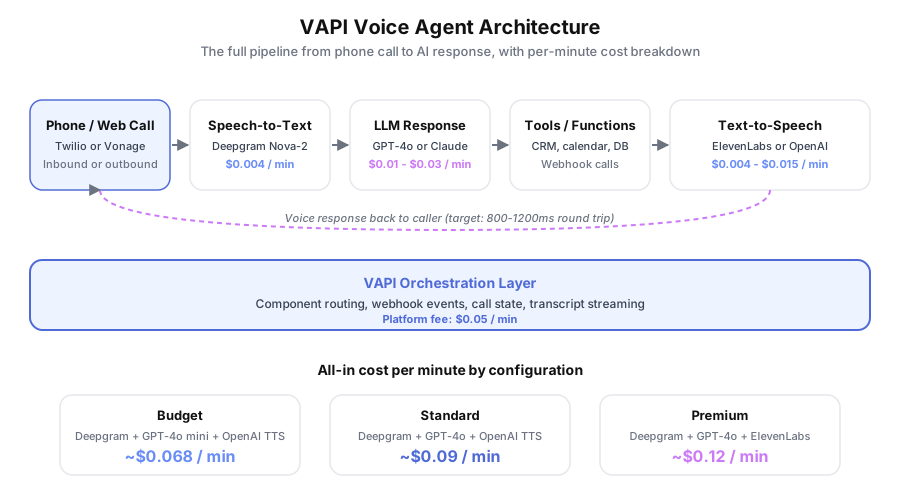
A voice call on VAPI moves through four components that have to fire in sequence, typically within 800-1200ms to feel natural on the phone:
- Telephony. A Twilio or Vonage number receives the call and hands it to VAPI.
- Speech-to-text (STT). Deepgram or Gladia transcribes the caller in real time.
- LLM processing. The transcript hits an OpenAI-compatible endpoint with your system prompt.
- Text-to-speech (TTS). ElevenLabs, OpenAI, Deepgram Aura, or PlayHT voices the response.
VAPI orchestrates all four and exposes the entire event stream to your backend. What you build on top — the system prompt, the escalation logic, the CRM writes — is the actual product.
Why Does VAPI’s Component Architecture Matter?
VAPI’s edge is that every component in the pipeline is swappable. You pick the STT, the LLM, and the TTS independently, and VAPI handles the orchestration. No other managed voice platform gives you this level of control in 2026, which is exactly why developer teams keep picking it over Bland AI or Retell.
Component choice matters because each one has different cost, latency, and quality characteristics, and the right mix depends on your use case. A budget-optimized high-volume stack can run at roughly half the cost of a premium configuration while handling the same call types.
Budget stack for simple high-volume calls:
- Deepgram Nova-2 STT: lowest latency, lowest cost
- GPT-4o mini: fast and cheap for Q&A
- OpenAI TTS: decent voice quality
- All-in: ~$0.068/minute
Premium stack for complex customer-facing calls:
- Deepgram Nova-2 STT: still the latency winner
- GPT-4o: better reasoning for messy conversations
- ElevenLabs: most natural voices available in production
- All-in: ~$0.12/minute
You can’t swap components this freely on Bland AI or Synthflow — both lock you to a fixed voice and model stack.
How Much Does VAPI Actually Cost in 2026?
VAPI charges a flat $0.05 per minute for its platform layer. Everything else — STT, LLM, TTS — is pass-through billed at provider rates (VAPI pricing page, accessed April 2026). That pricing model is the biggest single reason VAPI wins on unit economics at scale.
| Component | Provider | Cost per minute |
|---|---|---|
| VAPI platform | VAPI | $0.050 |
| Speech-to-text | Deepgram Nova-2 | ~$0.004 |
| LLM (standard) | GPT-4o mini | ~$0.010 |
| LLM (high quality) | GPT-4o | ~$0.030 |
| Text-to-speech (standard) | OpenAI TTS | ~$0.004 |
| Text-to-speech (premium) | ElevenLabs | ~$0.008-$0.015 |
All-in totals land at roughly $0.068/minute for a budget configuration, $0.09/minute for a standard GPT-4o build, and $0.12/minute for a premium ElevenLabs build.
Compare that to the managed alternatives: Bland AI is $0.09/minute flat, Synthflow starts at $0.13/minute, and Retell AI begins at $0.07/minute on its basic plan (vendor pricing pages, April 2026). At 10,000 minutes/month, a VAPI budget stack saves roughly $220/month against Bland AI and over $600/month against Synthflow.
What Can You Actually Build With VAPI?
Most production VAPI deployments fall into three buckets: inbound call handling, outbound campaigns, and transcript-driven analytics. Each one has a clean technical pattern, and each one replaces a human workflow that’s been expensive or inconsistent for decades.
Inbound Call Handling
Instead of “Press 1 for sales, press 2 for support,” a VAPI agent listens to what the caller actually wants and routes, answers, or escalates from there. The common deployments:
- Appointment booking. The agent hits a calendar API, confirms availability, and books the slot.
- FAQ answering. The agent pulls from a knowledge base or vector store to answer common questions.
- Lead qualification. The agent collects BANT-style data and schedules a human callback.
- After-hours coverage. The agent handles calls outside business hours and writes back to your CRM.
Outbound Call Campaigns
VAPI supports structured outbound calling — your agent dials a list and runs a scripted conversation. Use cases include appointment reminders 24 hours before a booking, lead follow-up within 60 seconds of a form submission, payment reminders, and survey collection. A typical outbound campaign runs at 3-5x the contact rate of manual dialing at a fraction of the cost (Builts AI client data, Q1 2026).
Transcript and Analytics Output
Every call produces a full transcript, structured metadata, and webhook events. That feed integrates cleanly with HubSpot, Salesforce, or a custom analytics stack, which makes VAPI a good fit for teams that want to mine conversation data — common questions, objection patterns, agent performance — rather than just automate answers.
What Are VAPI’s Real Limitations?
Every review of a developer-first platform has to answer the same question: where does the flexibility stop being worth the cost? With VAPI, there are four honest limitations small business buyers should know about before they commit.
1. The developer requirement isn’t negotiable. Building on VAPI means writing API calls, crafting system prompts that survive real callers, provisioning phone numbers through Twilio or Vonage, and testing against dozens of edge cases. This isn’t configuration — it’s software development, and it needs at least one engineer with conversational AI experience.
2. Conversation design is the hard part. The biggest failure mode in voice agent deployments isn’t the infrastructure — it’s the dialogue logic. Callers go off-script, ask unexpected questions, use slang, and have bad audio. VAPI gives you the tools; it doesn’t solve the prompt engineering problem for you. Expect 40-60% of build time on dialogue tuning.
3. There’s no built-in compliance tooling. Healthcare, finance, and insurance deployments need call recording consent, data retention rules, and HIPAA or PCI handling. VAPI ships none of that. You build it or you pick a managed platform that already handles it for your industry.
4. Latency is your responsibility. The 800-1200ms target breaks when LLM latency spikes, TTS lags, or STT misfires on poor audio. VAPI’s flexibility means you own the debugging when any component underperforms.
Who Should Actually Pick VAPI?
VAPI is the right foundation for a specific kind of team. Picking it without matching that profile is the fastest way to waste 4-6 weeks of engineering time on a product you could have bought off the shelf.
Strong fit:
- Developer teams or agencies building custom voice agents for clients
- Businesses with high call volume (1,000+ minutes/month) where unit cost matters
- Teams that need full control over the conversation stack and model choice
- Complex integration requirements against custom CRMs or proprietary scheduling
- Agencies running multiple voice deployments that benefit from a shared platform
Poor fit:
- Non-technical small business owners who want a voice agent deployed this week
- Simple inbound FAQ use cases where a managed tool ships faster
- Anyone who needs a production agent live in under two weeks without developer resources
How Does VAPI Compare to Bland AI, Retell, and Synthflow?
The four major voice agent platforms in 2026 each optimize for a different buyer. VAPI wins on flexibility and unit cost; the others win on deployment speed or specialized workflows. The table below lines up the tradeoffs by technical requirement, per-minute cost, and best use case.
| Platform | Technical requirement | Per-minute cost | Best for |
|---|---|---|---|
| VAPI | High (developer needed) | $0.068-$0.12 | Custom, complex, high-volume deployments |
| Bland AI | Medium | $0.09 flat | Managed outbound campaigns |
| Retell AI | Low to medium | $0.07+ | Calendar and booking integrations |
| Synthflow | Low (no-code) | $0.13-$0.20 | Non-technical teams |
| ElevenLabs Conversational AI | Medium | Variable | Voice-quality-first deployments |
For a deeper side-by-side, see our VAPI vs Bland AI vs Retell AI comparison.
The Honest Assessment: Is VAPI Worth It?
VAPI is genuinely the best infrastructure platform for teams that have the developer resources to build on it. The component-swappable architecture, the clean API, and the cost structure at scale are real advantages over managed alternatives, and the unit economics get better as call volume grows.
For small businesses evaluating voice AI for the first time, I’d start with a managed tool — Retell AI if you’re appointment-driven, Bland AI if you’re running outbound — learn what your actual requirements are, then move to VAPI if your use case outgrows what the managed platforms can handle.
For agencies building voice automation as a productized service, VAPI is the right foundation. The economics, the flexibility, and the API surface all point that direction.
Book a free automation audit and we’ll assess whether your call handling use case is a fit for VAPI, or whether a faster-to-deploy managed tool delivers the same outcome at a lower build cost.