
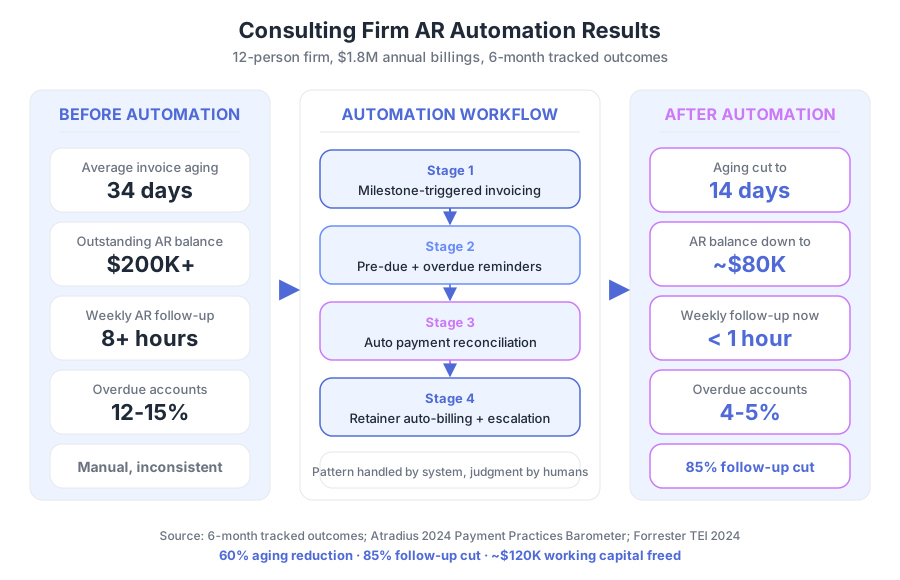
A 12-person consulting firm billing $1.8M a year carried more than $200K in outstanding receivables on any given day. Six months after switching to automated AR workflows, that balance was down to $80K. Average invoice aging dropped from 34 days to 14. Overdue accounts fell from 12-15% to 4-5%. Weekly AR follow-up work collapsed from 8+ hours to under an hour. That’s roughly $120K in working capital freed and the equivalent of a part-time admin hire recovered, without adding headcount or pressuring clients.
How Did the Firm Cut AR Follow-Up by 85%?
The firm automated three high-friction steps: invoice delivery, reminder sequencing, and payment reconciliation. Milestone-triggered invoicing eliminated delivery lag. A structured pre-due and overdue reminder flow replaced ad-hoc chasing. Payment matching happened automatically in the accounting system. Weekly AR work dropped from 8+ hours to under 1 hour.
The firm’s previous AR process had three clear failure points, and each one was costing cash and staff time.
Invoice delivery was manual. Invoices were generated in the accounting software and sent by email when the billing person got to them. Project-end invoices were delayed 3-5 days after project completion. Milestone invoices were sometimes missed when the billing schedule wasn’t flagged clearly.
Payment follow-up depended on human memory. No system tracked which invoices were overdue. The AR review happened when someone thought of it, which in a busy consulting practice was irregular at best.
Escalation was avoided. In professional services, every client has a personal dimension. Principals were reluctant to send formal notices to clients they’d worked with for years, so overdue invoices sat waiting for “the right moment” that never came.
What Did the 6-Month Results Look Like?
Six months of tracked outcomes showed material gains on every AR metric the firm measured. Aging, follow-up time, overdue percentage, and total outstanding balance all improved. The combined effect was roughly $120K in cash returned to the business and a finance function that ran itself.
| Metric | Before Automation | After Automation | Change |
|---|---|---|---|
| Average invoice aging | 34 days | 14 days | 59% reduction |
| Overdue accounts (>30 days) | 12-15% of volume | 4-5% of volume | 65% reduction |
| AR follow-up time | 8+ hours/week | Under 1 hour/week | 85% reduction |
| Invoice delivery lag | 3-5 days | Same day | Eliminated |
| Outstanding AR balance | $200K+ average | ~$80K average | 60% reduction |
According to Atradius’s 2024 Payment Practices Barometer, 48% of B2B invoices in North America are paid late, and poor follow-up processes are the primary reason cited by firms with high outstanding AR. The consulting firm wasn’t dealing with clients who refused to pay. It was dealing with a process that made it too easy for invoices to slip through.
Why Didn’t the Firm Just Hire a Dedicated AR Person?
A dedicated AR coordinator didn’t pencil out at $1.8M in annual billings. Statistics Canada 2024 data pegs AR coordinator salaries in Ontario at $45,000-$55,000, which would have consumed 2.5-3% of revenue for work that was mostly pattern-based. A system was cheaper, faster, and didn’t call in sick.
Most AR follow-up is pattern-based: send a reminder, wait, send a stronger reminder, wait, escalate. Only two steps require professional judgment — escalation decisions and relationship-sensitive situations involving long-standing clients. Everything else is repeatable and rule-driven.
Forrester’s 2024 Total Economic Impact studies on finance process automation report average ROI above 200% within year one for professional services firms. For this firm, the payback was immediate. The first month of automated reminders recovered more cash than the full year of software cost.
What Does the Automated AR Workflow Look Like?
The firm built a four-stage automated AR workflow covering invoice delivery, reminder sequencing, payment reconciliation, and retainer billing. Each stage handles a specific failure point from the old manual process, and the four stages hand off to each other with no human involvement required between them.
Stage 1: How Did Milestone-Triggered Invoicing Work?
Project scope and billing milestones get defined at contract signing. When a milestone is marked complete in the project management system, an invoice generates and delivers automatically within minutes. Each invoice includes the amount, line items, due date, and a direct payment link for credit card or e-transfer. Delivery confirmation is logged.
The biggest gain here was eliminating invoice delivery lag. Clients used to receive invoices 3-5 days after project completion, by which point the work was less fresh and the payment felt less urgent. Now invoices arrive within hours, while the work is top-of-mind and the client is most likely to act. Late delivery — the first cause of late payment — disappeared.
Stage 2: How Does the Reminder Sequence Actually Send?
Every unpaid invoice enters a reminder sequence calibrated to its payment terms. For net-30 invoices, the sequence runs like this:
- Day 0: Invoice delivered, confirmation logged
- Day 25 (5 days before due): Friendly pre-due reminder with payment link
- Day 32 (2 days overdue): First overdue reminder, professional tone
- Day 39 (9 days overdue): Firmer reminder requesting payment timeline
- Day 46 (16 days overdue): Formal notice requesting immediate payment
- Day 53 (23 days overdue): Escalation alert to the principal for human judgment
Each message references the specific invoice number, amount, and a one-click payment link. Clients who pay at any stage are removed from the sequence automatically and receive a payment confirmation. No one gets chased after they’ve already paid.
Stage 3: How Does Payment Reconciliation Stay Clean?
When a payment comes in, the system reconciles it in the accounting software automatically. The reminder sequence stops immediately, a receipt confirmation goes to the client, and payment data flows to monthly financial reporting. Nothing is manual and nothing goes out-of-sync.
Before automation, reconciliation was a separate manual task, and mismatches between payments received and invoices marked paid were the main reason clients would get accidental overdue notices after they’d already paid. That class of embarrassing error went to zero in the first month after the system went live.
Stage 4: How Does Retainer Billing Handle Itself?
For clients on monthly retainers, the system generates and delivers invoices automatically on the 1st of each month. No human involvement at all, including the reminder sequence if the invoice goes unpaid. Retainer billing is the highest-volume, lowest-judgment work in the firm, and it’s now completely hands-off. The only time a person touches a retainer invoice is when something breaks, which in six months has happened twice.
Why Do Professional Services Firms Underinvest in AR Automation?
Two reasons, both cultural. First, partners treat billing as a relationship matter and worry automation will feel impersonal. Second, AR problems stay invisible until cash gets tight. Both concerns evaporate once a firm sees how clients actually respond and how much cash sits trapped in unpaid invoices.
On the relationship concern, clients at professional services firms understand invoices need to be paid. A structured reminder is no more impersonal than the email they already receive from their own accounting software. The consulting firm in this case study logged zero complaints after six months of automated reminders. Clients actually thanked the firm for the pre-due nudges, which helped them schedule payments on their side.
On the invisibility problem, Celonis’s 2024 Process Intelligence report puts the median time-to-value for AR automation at 6 weeks. The payback is fast because every payment that arrives one week earlier is real working capital freed right now. Firms that wait until cash is tight lose 2-3 months of benefit they could have captured earlier.
What Can Other Professional Services Firms Take From This?
Three principles apply to any firm where billing and follow-up are partially or fully manual. They’re not specific to consulting — they work the same way for legal, accounting, design, marketing, and engineering services.
Invoice immediately, not when it’s convenient. Every day between project completion and invoice delivery adds a day to payment lag. Milestone-triggered delivery closes that gap at the source. Clients receive invoices when work is fresh, not when someone remembered to send them.
Pre-due reminders outperform overdue notices. A reminder 5 days before the due date gives clients time to process payment without urgency. An overdue notice requires them to explain or apologize, which creates friction. The pre-due reminder collects faster and generates no awkwardness.
Automate the pattern, keep humans for judgment. The decision to escalate a long-standing client to a formal collections conversation needs human judgment. The decision to send a second reminder to a net-30 invoice that’s 9 days overdue does not. Automation handles the pattern; humans handle the exceptions.
Could This Work for Your Firm?
Yes, if you bill clients on invoices and spend time chasing payment. The same invoice and payment automation pattern works for any professional services firm with recurring invoicing: consulting, legal, accounting, marketing, design, engineering, and technology services. The specific terms and escalation points differ, but the workflow structure is consistent across all of them.
A 12-person firm can usually reach full implementation in 4-6 weeks with a software budget under $400 per month. The harder part isn’t the tooling — it’s deciding that automated reminders are acceptable for your client base, and committing to the tone calibration that makes them work. Once those decisions are made, the build is straightforward.
For related reading, see our guide on How to Automate Invoice Generation and Payment Reminders and our piece on How to Automate Monthly Financial Reporting for Small Teams.
Book a free automation audit and we’ll analyze your current AR aging and identify the specific workflow changes that would reduce your outstanding balance fastest.