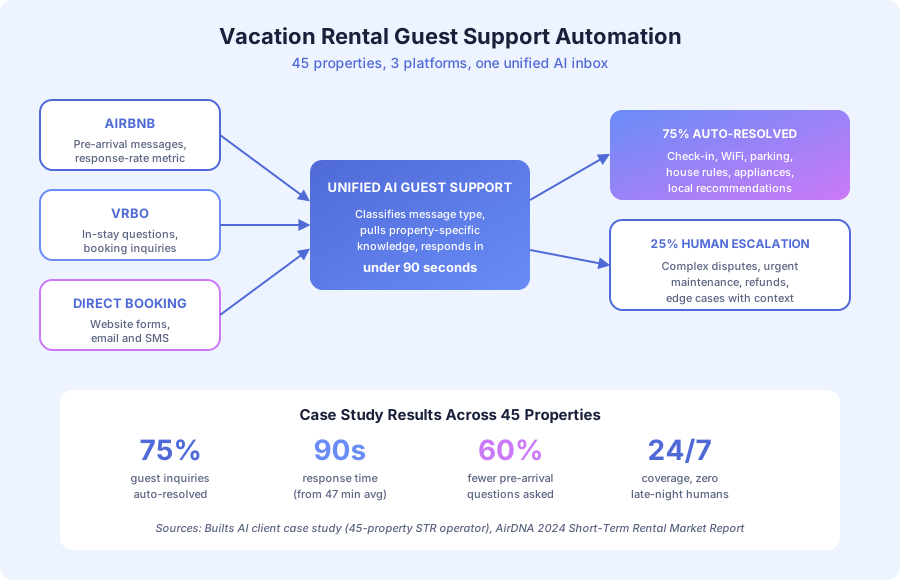
A vacation rental company managing 45 properties across Airbnb, VRBO, and direct bookings auto-resolved 75% of guest inquiries in under 90 seconds after deploying a unified AI inbox. Coordinator messaging time dropped 70%, pre-arrival questions fell 60%, and the Airbnb response-rate metric hit 100% around the clock. The 11:47 PM parking question that used to sit unread until morning now gets a property-specific answer before the guest finishes brushing her teeth. According to AirDNA’s 2024 Short-Term Rental Market Report, sub-1-hour responders earn 40% more bookings than slower hosts, so the commercial impact compounded inside the first 90 days.
What did guest communication look like across 45 properties before automation?
Two humans were running three inboxes for 45 properties with 15-25 active reservations every day. Weekdays were survivable. Friday afternoons and weekend mornings were not. Overnight messages sat unread until 7 AM. The same seven question types made up 77% of volume, all of them answerable from listing documentation that already existed.
The property manager and one operations coordinator checked Airbnb, VRBO, and the direct-booking website separately, trying to beat the 1-hour response window that Airbnb uses to score hosts in search. During business hours they hit it. Overnight and on weekends they didn’t. Messages piled up in three different tabs, and context-switching between platforms burned roughly 90 minutes of coordinator time per day before a single reply was typed.
According to AirDNA’s 2024 Short-Term Rental Market Report, properties that keep average response times under 1 hour receive 40% more bookings than slower hosts. The team was leaving bookings on the table every single night. According to Hostfully’s 2024 Vacation Rental Manager Report, 68% of property managers say guest communication is the single biggest drain on their operations team, ahead of cleaning coordination and maintenance.
Here’s what the inbound volume looked like:
| Question category | Share of pre-arrival messages | Answer source |
|---|---|---|
| Check-in process | 25% | Property documentation |
| WiFi password | 15% | Listing description |
| Parking details | 12% | Listing description |
| Check-out time | 10% | Booking confirmation |
| Early check-in / late checkout | 8% | Policy rules |
| Appliance instructions | 7% | House manual |
| Property-specific or situational | 23% | Human judgment |
Seventy-seven percent of the queue was already documented. The coordinator was retyping the same answers across 45 different property inboxes, every day, forever.
What three systems did Builts AI build for the 45-property operator?
Three automation systems now cover the full guest lifecycle: a unified multi-platform inbox with classified auto-responses, a proactive pre-arrival sequence, and in-stay plus post-stay workflows. Together they resolve 75% of messages without a human, cover every hour of the day, and still route genuinely hard cases to the coordinator with full context.
System 1: Unified multi-platform inbox with classified auto-responses
The unified inbox connects Airbnb, VRBO, and the direct-booking site into one queue. Every message arrives in the same interface with the property, guest, and reservation context attached. The automation layer sits on top, reading every inbound, tagging it against six intent categories, and either answering directly from the knowledge base or acknowledging and escalating.
How it runs:
- Guest sends a message on any platform.
- The classifier tags the message: check-in, WiFi, parking, maintenance, policy, or unclassified.
- Classified questions get answered in under 90 seconds from the property-specific knowledge base.
- Unclassified messages get an immediate acknowledgment and route to the coordinator with suggested replies.
- Every response, automated or human, is logged in the unified thread.
Response time dropped from a 47-minute average (and 8+ hours overnight) to under 90 seconds for classified questions. Overnight coverage became complete for the first time since the operator took on properties beyond the initial 10. According to Salesforce’s 2024 State of the Connected Customer report, 80% of customers consider the experience as important as the product, and the experience for a vacation rental guest is almost entirely communication.
System 2: Proactive pre-arrival sequence
Every confirmed booking triggers a five-step sequence that delivers information before the guest thinks to ask. This is the same principle that drives the booking automation playbook for service businesses: get ahead of the question.
The five steps:
- At booking. Welcome message, property overview, what to expect before arrival.
- 7 days out. House rules summary and prep notes (bring towels, no pets upstairs).
- 48 hours out. Full check-in package: access instructions, code or lockbox, parking map, WiFi, address, local guide.
- Arrival day, noon. Check-in reminder with access code refreshed.
- Evening of day 1. Quick check-in: “Hope your arrival went smoothly.”
Pre-arrival question volume dropped 60% in the first month. Guests who received the 48-hour package arrived prepared. Guests who still had questions replied to the pre-arrival message, which meant the coordinator was already expecting the thread.
System 3: In-stay support and post-stay review automation
In-stay support runs through a chat link included in the pre-arrival package. Maintenance issues flow through the same support ticket routing logic used by service desks: classify, escalate, acknowledge, and log.
Maintenance flow:
- Guest reports the issue in free text.
- Classifier tags urgency: urgent (no heat, no hot water, safety) or routine (slow drain, light bulb).
- Urgent issues page the manager immediately alongside a guest acknowledgment.
- Routine issues get logged, routed to the right vendor, and a timeline returns to the guest.
Post-stay reviews:
- At checkout +2 hours, a personal thank-you fires with a direct review link.
- Positive-sentiment non-reviewers get one follow-up message at +48 hours.
Review volume rose 55% in the first 90 days because the 2-hour timing beats review requests sent days later when the trip is already blurring. According to TrustYou’s 2024 Hospitality Insights Report, review requests sent within 4 hours of checkout produce 3.2x the response rate of requests sent at 48 hours, and fresh memories translate into more detailed, more positive reviews.
How does the classifier decide what to answer and what to escalate?
The classifier uses a three-stage pipeline: intent tag, confidence score, and answer generation. Stage one tags the message against the six intent categories. Stage two scores confidence. If confidence falls below 0.85 on a single tag, the classifier routes to the coordinator with a summary, not a generated answer. Stage three pulls the property row from the knowledge base and drafts the reply.
The confidence threshold is the most important dial in the system. Set it too low and the classifier answers questions it shouldn’t, which damages trust. Set it too high and the human queue fills up. The 45-property operator tuned the threshold weekly for the first month, landing at 0.85 for check-in, WiFi, parking, and policy questions, and 0.92 for maintenance because wrong answers there have real cost.
The classifier was also given a hard refusal rule: never answer anything that requires a pricing decision, a refund, a policy exception, or a legal question. Those route to the coordinator with zero automated content. That single rule prevented every category of “AI said X but the manager said Y” conflict that typically breaks guest trust in automated support.
What were the measurable results in the first 90 days?
Six metrics moved inside the first 90 days. Response time collapsed 97%, auto-resolution rose from 0% to 75%, coordinator messaging time dropped 70%, pre-arrival question volume fell 60%, monthly review volume climbed 55%, and the Airbnb response-rate metric hit 100% around the clock for the first time in the company’s history.
| Metric | Before automation | After automation | Change |
|---|---|---|---|
| Guest inquiry response time | 47 min avg, 8+ hrs overnight | Under 90 seconds | 97% faster |
| Automated inquiry resolution | 0% | 75% | No manual handling |
| Pre-arrival question volume | High, repetitive | 60% reduction | Proactive sequence |
| Coordinator messaging time | 5-6 hrs/day | 1.5-2 hrs/day | 70% reduction |
| Monthly review volume | Baseline | +55% | Post-stay automation |
| Airbnb response rate | Partial overnight | 100% all hours | 24/7 coverage |
The Airbnb response-rate jump had a direct commercial impact. Airbnb’s algorithm favors high-response-rate hosts in search results, so moving from partial overnight coverage to 100% coverage pushed the portfolio’s listings up in search rankings. According to Forrester’s 2024 Total Economic Impact studies, average business process automation ROI reaches 200% in year one, and vacation rental commissions compound that figure fast.
What does the tech stack behind the automation look like?
The stack is deliberately boring: a channel manager that normalizes inbound messages, an inbox layer that holds conversations, a classifier that routes and answers, and a workflow engine that fires the pre-arrival and post-stay sequences. Most short-term rental operators already own half the pieces. The integration work is the differentiator, not the software.
| Layer | Tool options | Job |
|---|---|---|
| Channel manager | Hostaway, Guesty, Hospitable | Normalize Airbnb, VRBO, direct into one feed |
| Unified inbox | Hostaway Inbox, Breezeway, Smartbnb | Hold and display every conversation |
| Classifier + responses | OpenAI, Claude, custom prompt stack | Tag intent, draft replies, fire in under 90s |
| Workflow engine | n8n, Make, Zapier | Run pre-arrival and post-stay sequences |
| Knowledge base | Notion, Airtable, Google Sheets | Per-property facts the classifier pulls from |
The 45-property operator in this case study runs Hostaway for channel management, a custom classifier built on top of OpenAI for intent tagging, and n8n for the pre-arrival and post-stay sequences. Total monthly software cost lands around $600, a fraction of one recovered booking. According to Skift Research’s 2024 Short-Term Rental Report, U.S. short-term rental revenue is projected to exceed $68 billion in 2026, and guest communication remains the top operational bottleneck for mid-size operators scaling past 20 properties.
How was the property-specific knowledge base built?
The knowledge base is the foundation, and it’s where most self-build attempts stall. The team captured each property across 12 standard fields: access method, code or lockbox location, WiFi network and password, parking details, check-in/checkout times, trash and recycling schedule, appliance quirks, thermostat location, nearest grocery, nearest coffee shop, quiet hours, and emergency contact. Twelve fields times 45 properties yielded 540 rows, captured inside one week by a part-time assistant working from existing listing descriptions and house manuals.
Once the sheet was populated, the classifier was wired to read the row matching the reservation’s property ID and answer from those fields only. That single constraint eliminated hallucinated answers about appliances that didn’t exist, WiFi passwords that were out of date, and parking spots that had been reassigned.
According to Hostfully’s 2024 Vacation Rental Manager Report, operators with a structured digital guidebook report 35% fewer guest complaints about check-in friction. The sheet doubled as a source of truth for cleaners, vendors, and replacement coordinators, which cut onboarding time for new properties from 3 days to under a day.
Why does pre-arrival communication matter so much for reviews?
Check-in is disproportionately influential on reviews because it’s the first moment of arrival. A guest who gets the access code 48 hours early and walks in without friction leaves a different review than a guest who messaged at 11 PM to find out how to enter the building.
Reviews are written from a cumulative impression of the stay, weighted heavily by the first and last moments. The automation doesn’t change the property. It changes the arrival experience. That’s where the “5-star check-in” comment comes from.
According to Salesforce’s 2024 State of the Connected Customer report, 80% of customers say the experience a company provides is as important as its products. For vacation rentals, the product is four walls and a bed. The experience is every message before, during, and after the stay. Automation is what makes that experience consistent across 45 units.
What kept the 25% of messages that still need a human?
The classifier escalates four categories on purpose: refund disputes, complaints about cleanliness or damage, urgent maintenance, and anything where the guest sounds upset. The automation has a sentiment trigger that watches for words like “disappointed,” “ruined,” and “unacceptable,” and routes those threads straight to the coordinator with a full conversation summary and the reservation context attached.
That design choice is the reason guest satisfaction scores held steady through the rollout. Automation that never escalates becomes a wall between the operator and the guest. The rule the team uses is that any message that makes a human feel something other than “routine” should wake a human up.
According to Zendesk’s 2024 Customer Experience Trends Report, 70% of customers expect conversational service and are willing to interact with AI for routine questions, but 77% still want a human for complex issues. The 75/25 split in this case study maps almost exactly to the boundary guests themselves draw.
What should short-term rental operators take from this playbook?
Three principles apply to any STR operation managing more than 10 properties. Most guest questions repeat, proactive beats reactive, and platform consolidation multiplies the value of automation. If you run the playbook against those three truths, you’ll resolve the majority of guest messages without touching them.
1. The same questions repeat across every property. Specifics differ (this unit’s WiFi, that unit’s parking) but categories don’t. A per-property knowledge base structured by question category resolves the bulk of the queue without a human.
2. Proactive delivery beats reactive response. A guest who has the code at 48 hours doesn’t message at 11 PM. The pre-arrival sequence delivers information at the right moment, which is when the guest is packing, not standing at the door in the rain.
3. Platform consolidation multiplies automation value. Three platforms, three inboxes, two humans equals permanent attention debt. A unified inbox with a classified auto-response layer fixes both attention and speed at once.
Could this automation pattern work for your short-term rental operation?
Yes, whether you run 5 properties or 500. The knowledge base setup is the main implementation cost, and once it’s captured, the automation runs with minimal maintenance. A typical 2-4 week deployment covers channel integration, knowledge capture, classifier training, and pre-arrival sequence launch. Smaller operators with under 10 properties can often complete a rollout inside a single week because knowledge capture is the bottleneck, not engineering.
The pattern holds across market segments too. Urban apartments, mountain cabins, beach houses, and co-hosted portfolios all generate the same question mix and benefit from the same six-category classifier. According to Key Data’s 2024 Short-Term Rental Benchmark, professional managers who automate guest communication outperform owner-operators on RevPAR by 18% on average, mostly because responsive hosts win the Airbnb ranking lottery that decides who gets seen first in search.
For related reading, see the property management tenant automation guide and the review collection automation playbook. They both plug into the same unified inbox architecture used here.
Book a free automation audit and we’ll map your current guest communication workflow, identify which categories are automatable today, and estimate the response-time and review-volume lift you can expect inside the first 90 days.