Four percent. That was KwikUI’s trial-to-paid conversion rate before automation, with two founders losing half their workday to repetitive support tickets. Ninety days later, conversion had doubled to 8%+, churn had dropped 40%, and 65% of support tickets never reached a human. No new hires. Three automations. One 2-person team. According to Forrester’s 2024 Total Economic Impact research, SaaS companies deploying behavioral automation achieve 200%+ ROI within 12 months — and KwikUI hit that threshold inside a single quarter.
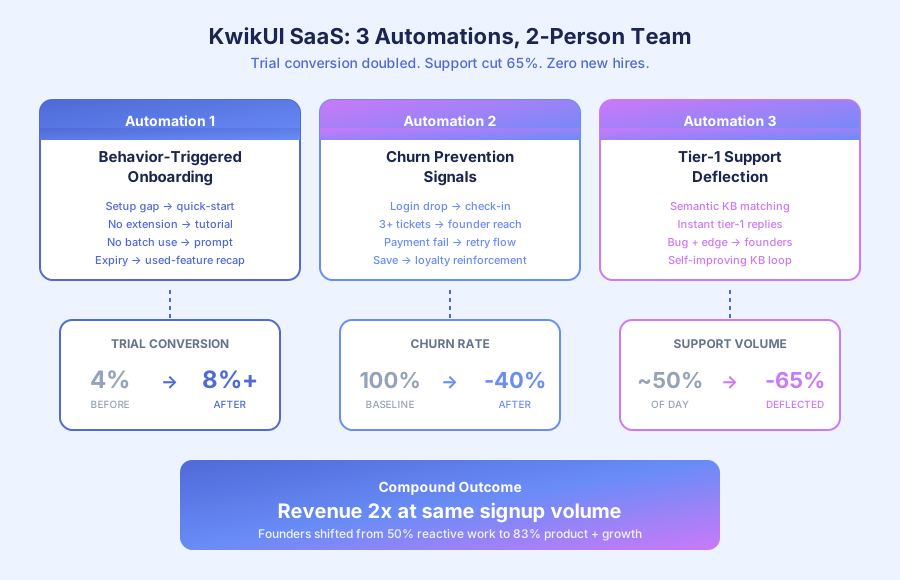
What measurable results did KwikUI achieve in 90 days?
KwikUI doubled trial-to-paid conversion from 4% to 8%+, cut churn by 40%, and deflected 65% of support tickets within 90 days of launching three automations. Founders reclaimed roughly 33% of their workday for product and growth work. No new hires were added during the transformation period.
The headline number is conversion doubling, but the compound effect tells the real story. Here’s what shifted in the first quarter after the automations went live:
| Metric | Before Automation | After Automation | Change |
|---|---|---|---|
| Trial-to-paid conversion | 4% | 8%+ | 2x |
| Churn rate | Baseline | 40% lower | Major MRR retention |
| Support tickets to founders | ~50% of workday | ~17% of workday | 65% reduction |
| Founder time on product/growth | ~50% of day | ~83% of day | +33 points |
| User base served | 3,000+ | 3,000+ | Same team |
According to Gartner’s 2024 Digital Workplace Insights, SaaS companies that implement behavior-triggered onboarding see 30-50% improvement in trial conversion within 90 days. KwikUI’s gain of 100% sits well above that benchmark, driven by how specifically the sequences responded to individual user behavior rather than a generic drip.
Why was KwikUI stuck at 4% conversion before automation?
KwikUI had product-market fit but weak activation. New users got one generic welcome email and were left to find the Chrome extension and batch processing alone. Most hit a setup wall, got no help, and quietly churned before ever reaching the aha moment that made the product worth paying for.
Three problems compounded at once. Trial conversion sat at 4% because new users weren’t being guided to the product’s highest-value features. Churn was invisible because at-risk paying customers weren’t flagged until after they cancelled. And support tickets piled up because the same questions arrived dozens of times a week, each one consuming 10-15 minutes of founder time across 3,000+ users.
According to a 2024 OpenView Partners SaaS benchmark report, median freemium-to-paid conversion sits at 4-5% for early-stage SaaS — exactly where KwikUI was. The teams breaking past that ceiling share one trait: they stop treating every trial user the same way and start responding to actual behavior.
Why didn’t they just hire a support person?
The math didn’t work yet. A dedicated support hire costs $40,000-$55,000 annually in Canada per Statistics Canada 2024 wage data. At 4% trial conversion, KwikUI’s revenue base couldn’t absorb that cost structurally. Hiring also wouldn’t fix conversion or churn — it would just accelerate ticket replies.
The real leverage sat upstream. Doubling trial conversion meant doubling revenue at the same signup volume. Cutting churn 40% compounded MRR growth for years. These were the metrics that would make the support hire feasible later — and automation was the path to get there first, cheaper, and without losing the founder hours that should go to product.
According to Forrester’s 2024 Total Economic Impact research, SaaS companies that implement behavioral automation for trial conversion and churn prevention see average ROI of 200%+ within 12 months. The unit economics of automation beat headcount at this stage, especially for teams under 5 people where every hour of founder attention has outsized strategic value.
What three automations did KwikUI actually build?
KwikUI built three systems spanning the full user lifecycle: behavior-triggered trial onboarding, churn signal monitoring, and tier-1 support deflection. Each system handled one compounding problem, and each shipped in two-week increments over six weeks. The founders designed the logic; their existing tools ran the execution.
Automation 1: How does behavior-triggered onboarding convert more trials?
The conversion system replaced one generic welcome email with dynamic sequences that respond to what each user has actually done inside KwikUI. Every message is conditional. Users who hit the aha moment early skip irrelevant steps. Users who stall get help exactly when they stall.
The behavior-triggered flow works like this:
- User signs up — the old generic welcome is retired
- Day 1: If setup is incomplete, a quick-start guide fires
- Day 2: If the Chrome extension isn’t installed, a 90-second walkthrough sends
- Day 4: If batch processing hasn’t been tried, a targeted prompt activates
- Day 6: Inactive users get re-engagement referencing what they did use
- Day 8: Trial-expiry message references specific features the user actually tested
According to McKinsey’s 2024 State of Personalization report, personalized communications drive 10-15% higher conversion rates than generic alternatives. KwikUI’s gain was larger because the sequence eliminated the specific gap between signup and batch processing — the single highest-converting feature path in the product.
Automation 2: How does churn signal monitoring prevent cancellations?
The churn system watches three plain signals across the paying customer base in near real time: login frequency, support ticket volume, and billing status. When any signal crosses a threshold, a specific intervention fires before the customer decides to leave. Recovery is dramatically easier at the point of disengagement than at the point of cancellation.
The signal-to-action mapping:
- Login frequency drops below a personal baseline for two weeks → automated check-in email
- Customer files 3+ tickets in 7 days → founder outreach with frustration context
- Payment fails on first attempt → retry flow + friendly billing nudge, escalates after 48 hours
- Customer saves after a close call → loyalty reinforcement sequence triggers
According to Bain & Company research, acquiring a new customer costs 5-7x more than retaining an existing one. KwikUI’s churn system captured the small percentage of accounts drifting toward cancellation each month — and even a modest recovery rate produced the 40% overall churn improvement.
Automation 3: How does tier-1 support deflection free founder hours?
The support automation handles tier-1 questions from a structured knowledge base. Chrome extension installs, plan changes, batch processing, exports, and account settings get instant automated answers. Anything the system can’t confidently match routes to founders with a suggested response already drafted, and every resolution feeds back into the knowledge base.
The workflow:
- Ticket submitted through the support channel
- System matches against knowledge base using semantic search
- Confident match → instant tier-1 reply with answer and help link
- No match → routed to founders with pre-populated suggested response (the same support ticket routing pattern works at any SaaS scale)
- Founder resolution → added to knowledge base, improving future deflection
- Bugs, feature requests, edge cases → always route straight to founders
Tier-1 deflection reached 65% in 90 days. According to Gartner’s 2024 Customer Service Insights, teams deploying knowledge-base-driven automation hit 50-70% deflection within the same window — KwikUI landed in the upper half of that range.
Why does behavior-triggered onboarding beat generic drip sequences?
Behavior-triggered sequences respond to what users actually did. Generic drip sends the same messages regardless of user state — treating someone who’s already installed the extension identically to someone who’s stuck on signup. That mismatch wastes attention and kills conversion at exactly the moments where personalization matters most.
Some users install the Chrome extension on day one but never touch the prompt generator. Others do the opposite. A generic welcome sequence sends both users the same messages at the same times. The result is irrelevance — messages that don’t address where the user is in their journey.
Behavior-triggered sequences fill gaps and amplify strengths. A user using the prompt generator but missing batch processing gets a message unlocking exactly that next value step, not a generic feature-tour blast. According to McKinsey’s 2024 State of Personalization report, this approach drives 10-15% higher conversion on average — and much higher when the product has a clear aha feature, as KwikUI does.
What did the founders notice beyond the metrics?
Amar, KwikUI’s co-founder, mentioned the energy shift before mentioning conversion numbers when describing the impact. Reactive work — triaging tickets, chasing failed payments, checking on quiet customers — had dropped from half the day to under 20%. The remaining hours went to product strategy, growth experiments, and real customer conversations again.
That reactive work had a specific psychological cost beyond the time itself. Constant context switching fragments attention and crowds out the deep work that moves SaaS products forward. Every support ticket interrupt cost a founder more than just 10 minutes; it cost the next hour of focus too.
After automation, the tickets that reached the founders were the interesting ones: real bugs, feature requests revealing user needs, genuine edge cases worth thinking about. The customer touches that required founder involvement became strategic, not reactive. Product discussions returned. Growth experiments restarted. That energy shift, while hard to put in a spreadsheet, is the upstream cause of most of the metric gains KwikUI measured downstream.
What three principles should other lean SaaS teams take from this?
Three principles apply to any early-stage SaaS team managing acquisition, conversion, and retention at once without a big team. KwikUI’s results aren’t a one-off — they’re what happens when lean teams move the right levers in the right order using the tools they already have.
1. Conversion happens at the aha moment, not at signup. If your customer onboarding doesn’t reliably guide users to the feature that makes your product worth paying for, you’re relying on users to find it themselves — and most won’t. Map the aha moment first, then build sequences that take every trial user there.
2. Churn is preventable when you catch it early. The signals of at-risk customers — declining logins, support frustration, billing issues — appear before cancellation. Systems that watch for those signals and respond automatically catch customers who’d otherwise disappear silently. Three signals are usually enough. You don’t need machine learning.
3. Support deflection compounds over time. Every ticket answered from the knowledge base is one that never interrupts a founder. Every resolution creates a knowledge base improvement that deflects future tickets. The system gets better every week without additional work — and the hours it frees go straight into product and growth.
Where can you read the full case study?
For the complete breakdown including behavioral trigger architecture, specific tools used, and detailed conversion analysis, read the full KwikUI case study. For related reading, see our SaaS Customer Onboarding and Churn Prevention Playbook and our guide on How to Set Up Automated Follow-Up Sequences That Actually Convert.
Ready to map your own trial conversion and retention pipeline the same way? Book a free automation audit and we’ll walk through the three-system approach KwikUI used — tailored to your stack, your users, and your stage.